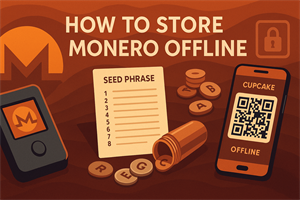
To store Monero offline, create the wallet on a device that never touches the internet, or on a hardware wallet, and keep the seed phrase on paper or metal in a safe place. You can still receive XMR at any time, because only your address is needed for that, and you bring the keys out only to sign a spend.
This guide covers five ways to do it: hardware wallets, an air-gapped computer with the official wallet, air-gapped phone signing with Cupcake, a paper seed, and a Monero Seed Phrase Capsule, where the seed is hammered into metal washers for a backup that survives fire and water.
What "Offline" Really Means
Your Monero is never inside a device. The coins are entries on the blockchain, and what you hold is the private spend key that can move them. Every Monero wallet can turn that key into a seed phrase: 25 words in the official wallet, or 16 words (Polyseed) in wallets such as Feather and Cake Wallet. Offline storage, also called cold storage, means the spend key and seed only ever exist on something with no network connection: a hardware wallet, an air-gapped computer or phone, paper, or steel.
Why Offline (Cold) Storage Matters
- Security: keys that are never on an internet-connected device cannot be taken by remote attackers.
- Protection against malware: keyloggers, clipboard hijackers and fake wallet updates on your everyday computer cannot reach a key that is not there. It also removes exchange risk, since the coins are not held by a third party.
- Durability: a seed backup that is stored well can outlive the device it was created on.
- Privacy: Monero's privacy features only help if nobody else gets your keys.
Offline Storage Methods Compared
| Method | Cost | Difficulty | Spending from it | Best for |
|---|---|---|---|---|
| Hardware wallet | Price of the device | Low | Plug in, confirm on the device | Most people |
| Air-gapped computer (official CLI) | A spare computer | High | Move files by USB stick, sign offline | Technical users, large holdings |
| Cupcake on a spare phone | A spare phone | Medium | Scan QR codes between two phones | Phone-first users |
| Paper seed only | Almost nothing | Low | Restore the seed into a wallet first | Savings you rarely touch |
| Metal seed backup | Washers and punches, or a capsule kit | Medium (hand work) | Restore the seed into a wallet first | A backup for any method above |
5 Ways to Store Monero Offline
1. Hardware Wallets
- Options: Ledger Nano S/X and Trezor Model T are the classic choices. The official Monero downloads page lists the Ledger Nano S, Nano S Plus and Nano X and the Trezor Model T, Safe 3 and Safe 5 as supported. For a fully air-gapped, QR-based device there is XMR Street's cold storage signer. Our Monero hardware wallet comparison goes through each model.
- How it works: the spend key stays on the device. You manage the wallet in a Monero app on your computer, such as the official Monero GUI or Feather, and approve each transaction on the device's own screen. The manufacturer's own app does not manage XMR.
- Setup: set a strong PIN and update the firmware. On a Ledger, install the Monero app on the device. In the Monero GUI or Feather, choose to create a new wallet from a hardware device.
- Seed backup: write the device's recovery phrase on the included sheet. Note that this is the device's own phrase (12 to 24 words, depending on the model), not a 25-word Monero seed, so recovery means restoring onto a compatible hardware wallet.
- Pros: easy to use, PIN protection, keys never leave the device.
- Cons: device cost, and supply-chain risk if you buy from an unofficial seller. Buy direct from the maker.
2. Air-Gapped Computer With the Official Wallet
The official Monero documentation describes offline transaction signing with two wallets: a full wallet on a computer that is never online, and a view-only wallet on your normal computer. The view-only wallet can watch incoming funds and prepare transactions but cannot sign them. The same documentation notes this is not necessarily the recommended setup and suggests a hardware wallet for most people, so treat it as the advanced route.
- Download the CLI from the official Monero downloads page, verify it, and copy it to the offline computer on a USB stick.
- On the offline computer, create the wallet, then run
seedand write the words on paper:monero-wallet-cli --generate-new-wallet /path/to/wallet-file
- Still offline, run
addressandviewkeyand carry both values to the online computer. - On the online computer, create the view-only wallet:
monero-wallet-cli --generate-from-view-key /path/to/wallet-file --daemon-address node-address:port
- To spend, run
transfer ADDRESS AMOUNTin the view-only wallet. It writes a file calledunsigned_monero_tx. - Move that file to the offline computer and run
sign_transfer. It writessigned_monero_tx. - Move the signed file back and run
submit_transferin the view-only wallet to broadcast it.
So that the view-only wallet shows the right balance after you spend, sync the two wallets now and then: run export_outputs on the view-only wallet, import_outputs and export_key_images on the offline wallet, then import_key_images on the view-only wallet.
3. Cupcake: Air-Gapped Mobile Signing
Cupcake is an air-gapped wallet app from the Cake Wallet team that uses QR codes. It works like a hardware wallet: a spare phone holds the private keys and signs, and your everyday phone never has them.
- What is Cupcake?
- A separate app for iOS and Android that turns an old phone into an offline signer. It supports Monero, Bitcoin and Litecoin.
- Cake Wallet on your online phone keeps only the view keys. Cupcake holds the private keys.
- Transactions are built in Cake Wallet, shown as a QR code, scanned and signed in Cupcake, then scanned back and broadcast.
- Setup:
- Install Cupcake from the App Store, Google Play or the project's GitHub releases, then take the phone offline (airplane mode, Wi-Fi and Bluetooth off).
- Create the wallet in Cupcake and write down its seed.
- Pair it with Cake Wallet on your online phone by scanning the QR code Cupcake shows.
- Pros: phone-friendly, no extra hardware to buy if you have an old phone.
- Cons: you need to be comfortable with an air-gapped routine and fixing problems yourself. A phone is not a purpose-built security device.
4. Paper Seed (Paper Wallet)
- Generate offline: use the official Monero GUI or CLI on a computer that is disconnected from the internet. A new wallet can be created without a network connection.
- Write it down: copy the seed words, the wallet's primary address and the creation date or restore height onto good paper. Then delete the wallet files, or keep that computer offline for good.
- Pros: very low cost, nothing electronic to fail.
- Cons: paper is vulnerable to water, fire and fading, and anyone who reads it owns the coins.
Writing the seed by hand with a pen is safer than printing it. Printers and the computers that drive them can keep a copy of what they print.
5. Monero Seed Phrase Capsule (Metal Washer Method)
Reviewed option: a DIY approach where each seed word is hammered, letter by letter, into metal washers, which are then sealed in a stainless-steel capsule. Our hands-on write-up is in the XMR Street 316L Seed Capsule review.
See video: Protecting My Monero Seed Forever – Steel Backup with XMRStreet (also on Monerica Video)
- How it works:
- Gather supplies: stainless-steel washers and an alphanumeric punch set.
- Stamping: hammer each character of your seed phrase into the washers.
- Organization: thread the washers onto a ring or seal them inside a stainless-steel capsule.
- Storage: keep it in a fireproof safe or a deposit box.
- Pros: resists fire, water and corrosion far better than paper.
- Cons: slow hand work that needs tools and some patience.
Step-by-Step: Creating Your Metal Washer Seed Capsule
- Prepare your workspace: clean and well lit, with protective eyewear, somewhere you can be loud.
- Have your seed ready: generate it on an air-gapped computer or hardware wallet and work from a handwritten copy.
- Select washers: large enough for clear stamping.
- Stamp: the word's number in the sequence, then the full word.
- Dry run: assemble on a temporary ring and read the whole seed back against your copy.
- Finalize: seal the washers in a tamper-evident capsule.
- Store securely: keep backups in more than one secure location.
What to Write Down
- The seed words, in order. This alone restores the wallet.
- The creation date or restore height. It tells a wallet where to start scanning, which turns a restore that could take many hours into a short one.
- Which wallet created it and the seed type (25-word, 16-word Polyseed, or a hardware wallet phrase), so whoever restores it knows what to use.
- Any passphrase (seed offset) you added. Store it separately from the seed. Without it the seed opens a different, empty wallet.
- Your primary address, kept somewhere handy. It is safe to share and lets you deposit without touching the backup.
How to Receive and Check Your Balance While Offline
You do not need the cold wallet to receive. Send XMR to its address and the funds are there when you next open it. To watch the balance without exposing the spend key, create a view-only wallet on your everyday computer (in the Monero GUI: Settings → Wallet → Create a view-only wallet). It shows incoming transactions only. Once you have spent from the cold wallet, the view-only balance will be wrong until you import key images, as described in method 2.
Test Your Backup Before You Trust It
- Send a small amount to the new cold wallet.
- Wipe the wallet, or use a second offline device, and restore from your written seed only.
- Check that the address matches and the small amount shows up.
- Only then move the rest. If you are buying first, how to buy Monero covers the options, and you can withdraw straight to the cold wallet's address.
Best Practices for Offline Monero Storage
- Redundancy: keep at least two backups in separate places.
- No digital copies: never photograph the seed, type it into a notes app or store it in cloud storage. If you must keep an encrypted file, use a strong passphrase and an offline drive.
- Periodic checks: inspect your backups every 6 to 12 months.
- Secure handling: only reveal your seed during recovery. Nobody from a wallet, exchange or support team needs it (see how to spot a Monero scam).
- Plan for others: if family should be able to recover the funds, leave instructions. Our Monero estate planning guide covers this.
- Keep spending money separate: hold a small amount in a normal wallet for daily use (see the best Monero wallets) and keep savings cold.
Frequently Asked Questions
What is the safest way to store Monero offline? For most people, a hardware wallet plus a metal backup of its recovery phrase in a second location. It keeps the key off your computer while still being simple enough to use correctly.
Can I store Monero on a USB stick? You can copy wallet files to a USB stick, but that is a weak form of cold storage. The files were created on some computer, flash memory fails, and the stick is only as safe as the password on the file. A written seed is the real backup.
Can I receive Monero while my wallet is offline? Yes. The sender only needs your address. The funds appear when the wallet next syncs, or right away in a view-only wallet.
Is a paper wallet still safe? It is safe from online attacks if it was created offline. Its weak points are physical: fire, water, fading and anyone who finds it. A metal backup fixes the first three.
Does Ledger or Trezor support Monero? Yes, through a Monero wallet app rather than the maker's own software. The official downloads page lists the Ledger Nano S, Nano S Plus and Nano X and the Trezor Model T, Safe 3 and Safe 5.
What happens if my hardware wallet breaks? Nothing is lost as long as you have the recovery phrase. Restore it onto a replacement device and open the wallet again.
How do I move Monero out of cold storage? With a hardware wallet, connect it and confirm the send. With an air-gapped setup, sign offline and broadcast from the online device. With a paper or metal seed, restore it into a wallet first, and treat that seed as hot from then on.
Conclusion
Storing Monero offline comes down to two things: keep the spend key off the internet, and keep a seed backup that will survive an accident. A hardware wallet, an air-gapped computer, Cupcake or a paper seed handles the first, and a Monero Seed Phrase Capsule or other metal backup handles the second. Using two methods together gives you redundancy.
Related Articles
- How To Buy Monero
- How To Mine Monero
- How To Accept Monero Payments
- Best Monero (XMR) Wallet For Desktop & Mobile
- How to Buy Gift Cards With Monero