Holding Monero means you are your own bank — nobody can freeze your funds, and nobody can hand them back if something goes wrong. That independence is the whole point, but it puts two long-term problems squarely on you: making sure your XMR survives you holding it for decades, and making sure it reaches the people you choose after you're gone. This guide covers both, and the different ways you can custody the funds along the way.
The one rule that changes everything
With a bank, someone can recover your account for your heirs after a death, or reset access if you lose your credentials. With Monero there is no recovery. If the keys are lost, or if you die and no one can find or use them, the coins are gone permanently — no support line, no court order, nothing. Every decision below flows from that single fact: your plan has to keep the keys safe from loss while also keeping them reachable by the right people at the right time.
Planning for the long haul (retirement)
If you're holding XMR for years or decades, the goals are durability and a small attack surface:
- Cold storage. Keep the bulk of your holdings in a wallet whose keys never touch an internet-connected device — a hardware wallet or an offline (air-gapped) setup — and keep only spending money in a hot wallet.
- Durable seed backups. Your 25-word Monero seed is the master key. Paper degrades and burns; stamping or engraving it onto metal survives fire and flood. Store copies in more than one location.
- Minimize who and what can reach it. Fewer devices, fewer copies floating around, no seed in a photo, email, cloud drive, or password manager you don't fully control.
- Review periodically. Check that your backups are still readable and your plan still reflects who you'd want to inherit, roughly once a year.
Planning for after you're gone (inheritance)
Inheritance is the hard part, because it pulls in two directions. Your heirs need to be able to access the seed — but if you simply hand it to them now, you've given away your coins while you're still alive, and added a theft risk. A good plan lets someone reach the keys only when they should, without exposing them today. The custody choice you make is what makes that possible.
Ways to custody the funds
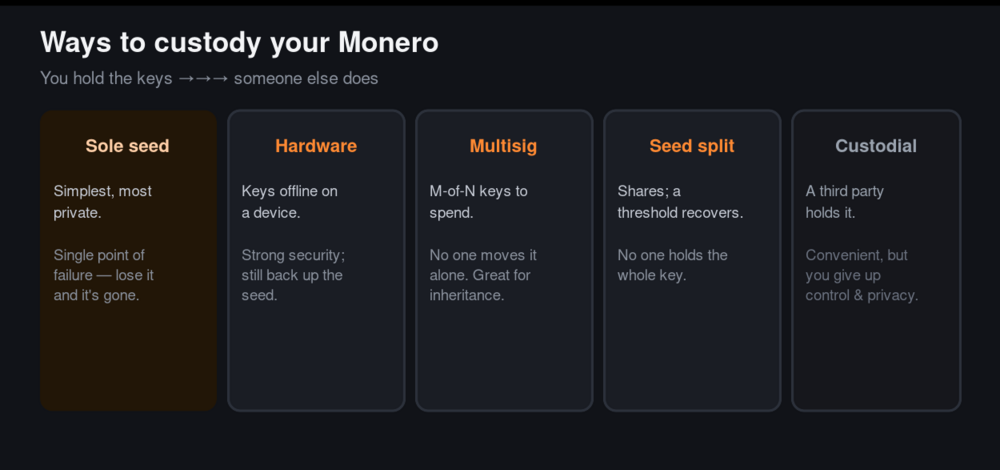
- Sole self-custody (a single seed). One 25-word seed controls everything. Simplest and most private, but it's a single point of failure: lose it and it's gone; if only you know it, your heirs get nothing.
- Hardware wallet. The keys live on a dedicated offline device (e.g. Ledger or Trezor models that support Monero). Great protection against malware; you still must back up and pass on the recovery seed, so it's a security layer, not an inheritance plan by itself.
- Multisig (M‑of‑N). Monero supports multisignature wallets where, say, 2 of 3 keys are required to spend. You might hold two keys and give one to an heir or lawyer — no single person can move the funds alone, and your heirs can combine their share with a backup after you're gone. Powerful for inheritance, but more complex to set up and use.
- Seed splitting (Shamir‑style). Split the seed into several shares where a threshold (e.g. any 3 of 5) reconstructs it. Give shares to different trusted people or locations so no one holds the whole key, yet the right group can recover it.
- Custodial (a third party holds it). An exchange or custodian keeps the keys for you, with account recovery and, sometimes, beneficiary features. Convenient and familiar to heirs — but you give up self-custody and privacy, and you take on counterparty risk (the custodian can freeze, fail, or be hacked). Generally the least aligned with why people hold Monero, but an option for a portion of funds.
Building the inheritance plan
Whichever custody model you choose, the mechanics matter:
- Write a letter of instruction. Plain-language directions your heirs can follow: what exists, what software to use, and how to access it — without putting the actual seed in the document.
- Never put the seed in your will. Wills often become public record in probate. Reference where the keys or shares are, not the keys themselves.
- Store the secret safely and redundantly. Metal backups in a home safe and a bank safe-deposit box; multisig or split shares held by different trusted parties; sealed instructions with an attorney or executor.
- Consider a time-delay or "dead man's switch" that releases access or instructions only after a period of inactivity — so nothing is exposed while you're active.
- Share the view key (optional). Monero's view key lets someone see incoming funds and the balance without being able to spend them. Giving an executor or heir the view key — kept separate from the spend seed — lets them confirm the estate's XMR exists and track incoming transactions for accounting or reassurance, with no power to move the coins early.
- Test it. A plan no one can actually execute is no plan. Walk a trusted person through a dry run (without revealing live secrets) so you know it works.
Common mistakes to avoid
- Keeping the only copy of the seed in one place (or only in your head).
- Telling no one that the Monero even exists — heirs can't claim what they don't know about.
- Handing an heir full access years early with no safeguards.
- Trusting a screenshot, cloud note, or email as a "backup."
Learn more
- Moneropedia: Mnemonic Seed — the 25 words that are your master key.
- Monero multisig guide — setting up M‑of‑N multisignature wallets.
- Moneropedia: Air-gap — keeping keys fully offline for cold storage.
- Monero user guides — wallet, restore, and cold-storage walkthroughs.
- New to living on Monero? Start with the Monerica directory.
None of this is legal advice — for a sizable estate, talk to an attorney who understands digital assets. But the core idea is simple: decide how the funds are custodied, back the keys up so they can't be lost, and make sure exactly the right people can reach them at exactly the right time.