Monero's privacy is a feature for you — and, unfortunately, a lure for scammers. Because a Monero payment is irreversible and cannot be charged back, a bad actor who gets your XMR is gone for good. The good news: nearly every Monero scam gives itself away with the same handful of red flags. This guide shows you exactly what to look for before you send a single coin.
The Biggest Red Flag: A Static Payment Address at Checkout
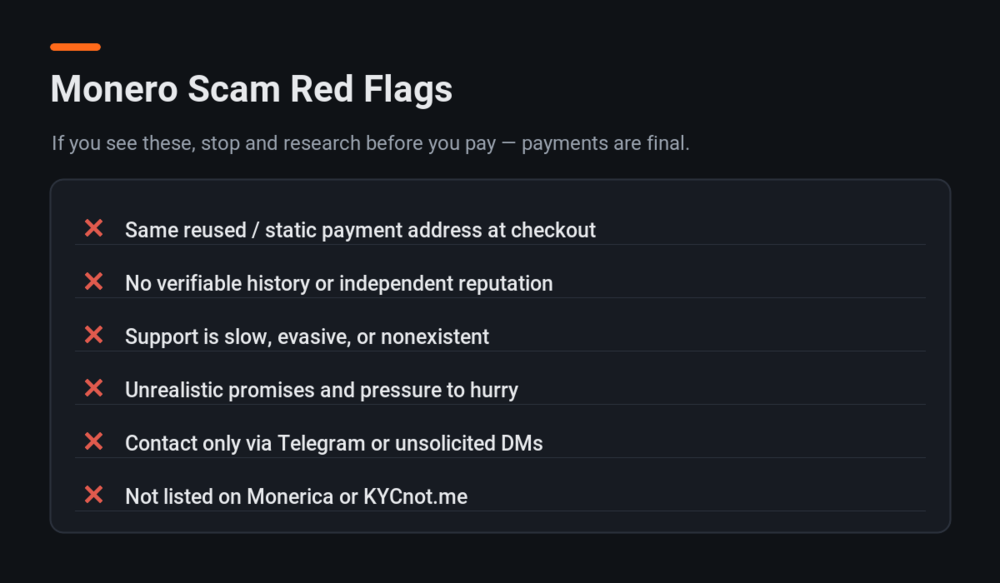
A legitimate Monero merchant or processor generates a fresh subaddress for every order. If a checkout shows the same reused address to everyone — or a copy-paste address in a chat or a comment — treat it as a scam until proven otherwise. Reused addresses mean the "store" cannot reliably tell which payment is yours, which is exactly how fake shops operate.
Real integrations use tools like an automated payment processor that issues a unique address and confirms your specific payment.
No Reputation, No History
Scam sites are disposable. Look for a real track record: age of the domain, mentions on established communities like the r/Monero subreddit, and a presence in curated directories rather than a site that appeared last week. You can check when a domain was registered with a free WHOIS lookup — a brand-new domain claiming years of business is a lie.
- New and unknown with big promises (unrealistic discounts, guaranteed returns) is the classic setup.
- Thin or copied content, stock photos, and no verifiable owner.
- No independent reviews anywhere off their own site.
Test Support Before You Trust
Always message support before you buy, especially if you have any doubt. Ask a specific question and see if a real human answers in reasonable time. Scammers often have no support at all — or they answer only until they have your money, then go silent, and sometimes the whole site simply disappears.
Poor, slow, or evasive support is a strong signal to walk away. Good merchants want the sale and will help you.
Be Extra Careful With Certain Sources
Some regions and channels carry a much higher scam rate. A large share of low-quality "no-KYC" shop clones and fake exchangers are Russian-language operations that spin up, scam, and vanish. This is not about any one country's people — it is a practical warning that these networks are prolific, so apply extra scrutiny to sites with no reputation, machine-translated copy, and Telegram-only contact.
The same caution applies to unsolicited DMs, "giveaways", and anyone who contacts you first with a deal.
Do Your Research First
Before paying anyone, cross-check them. Two habits catch the vast majority of scams:
- Look them up on Monerica — a curated directory of vetted, community-known merchants and services. If a service claims to be reputable but appears nowhere, ask why.
- Check KYCnot.me — an independent, community-run list that grades exchanges and services on privacy and trustworthiness.
It also helps to know the tactics in general; our Monero myths piece clears up confusion that scammers exploit, and the community-maintained shame list tracks bad actors.
A Quick Pre-Send Checklist
- Unique payment address at checkout? (Reused = run.)
- Verifiable history and independent reputation?
- Did support answer a real question before you paid?
- Listed or discussed in Monerica / KYCnot.me / r/Monero?
- Are the promises realistic?
If any answer is "no", slow down. With Monero there are no refunds — a few minutes of research is the only insurance you get.