Holding stablecoins like USDT or USDC is convenient, but they are the opposite of private: most run on transparent chains, many can be frozen by the issuer, and every transfer is permanently public. Swapping them into Monero converts that visible balance into private, self-custodied money. This guide covers the main stablecoins and chains, how to swap them into XMR without an account, and where to find trustworthy services.
Know Your Stablecoin (and Its Chain)
A stablecoin is a token pegged to a currency, usually the US dollar. The big three you will meet are:
- USDT (Tether) — the most widely supported, issued on many chains.
- USDC (Circle) — popular and heavily regulated; freezable by the issuer.
- DAI — a more decentralized, crypto-collateralized option on Ethereum.
The same USDT exists on different chains — and the chain matters for fees and compatibility:
- Tron (TRC-20) — very low fees, extremely common for USDT.
- Ethereum (ERC-20) — universal support, higher gas fees.
- Solana, BNB Chain, Polygon — fast and cheap, widely accepted by swap services.
Before you swap, always confirm the service supports the exact token and network you hold — sending TRC-20 USDT to an ERC-20 address loses the funds.
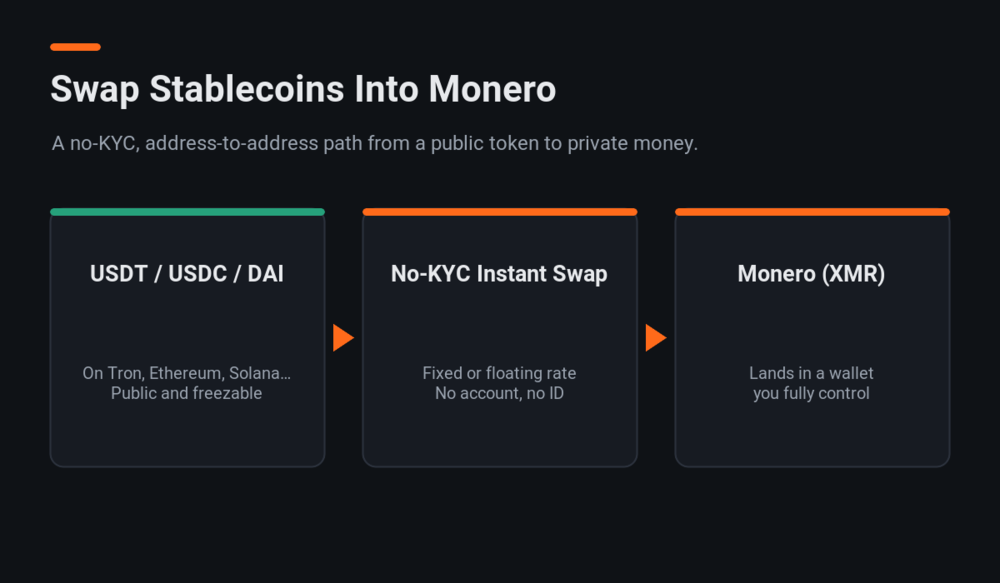
How to Swap Stablecoins Into Monero, Step by Step
- Get a Monero wallet you control — see our best Monero wallet picks — and copy your receiving address.
- Pick a no-KYC swap service that supports your stablecoin and network on the "from" side and XMR on the "to" side.
- Choose a rate type. A fixed rate locks your XMR amount up front; a floating rate can be slightly better but moves while your deposit confirms. Our instant swap guide explains the difference.
- Send your stablecoin to the deposit address on the correct network, paste your XMR address as the payout, and add a refund address.
- Wait for confirmations. The service converts and sends XMR to your wallet — address-to-address, no sign-up.
Why Swapping Into Monero Beats Holding Stablecoins
- Privacy. Stablecoin transfers are public forever; Monero amounts, senders, and receivers are hidden by default.
- No freeze risk. Centralized issuers can and do blacklist USDT/USDC addresses. Nobody can freeze XMR in your own wallet.
- Self-custody. Once it is in your Monero wallet, it is yours — no platform stands between you and your money.
The trade-off is that Monero's price moves, whereas a stablecoin holds a dollar peg. Many people keep only what they want private in XMR and swap the rest as needed.
Where to Find Instant Swaps
Browse Monerica's curated list of no-KYC instant swap exchanges, or use an exchange aggregator to compare rates across many of them at once. Independent grades on KYCnot.me are a useful second opinion before you commit. Going the other way? See how to exchange XMR to USDT.
Frequently Asked Questions
Which stablecoin and chain should I use? USDT on Tron (TRC-20) is cheap and widely supported; USDC and DAI work too. Always confirm the swap service supports your exact token and network before sending.
Why move from a stablecoin to Monero? Stablecoin transfers are public and freezable by the issuer. Monero is private by default and can't be frozen in your own wallet.
Do I lose the dollar peg? Yes — XMR's price moves, so keep in Monero only what you want private and swap the rest as needed.
Is it no-KYC? Reputable instant swaps are address-to-address with no account for standard amounts; verify the provider before you send.