No-KYC means "no Know Your Customer": a product or service you can use without proving your identity. There is no ID upload, no selfie, no proof of address, and often no account at all. For Monero users it is the default way to buy, swap, and spend, because handing over identity documents defeats the whole point of using private money. This guide explains what KYC is, why no-KYC exists, whether it is legal, how to buy Monero with no verification, and where else it matters.
What KYC Actually Is
Know Your Customer is a set of rules that require regulated businesses, mostly banks and licensed exchanges, to collect and verify who you are before serving you. It grew out of anti-money-laundering (AML) law and is meant to deter fraud and illicit finance.
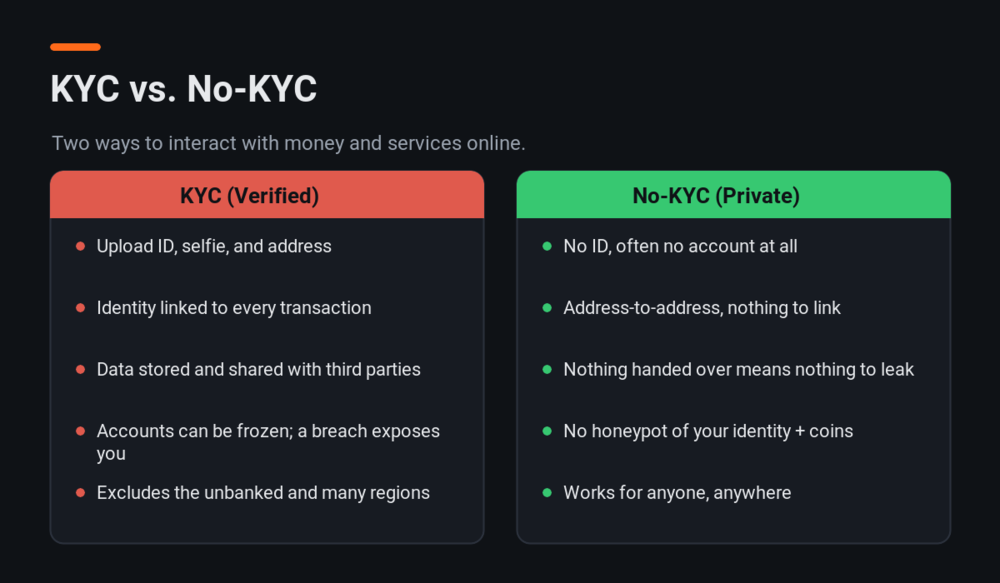
In practice it means an exchange asks for your legal name, date of birth, a government ID, sometimes a selfie, and a home address. That data is stored, shared with third parties, and linked to every transaction you make on the platform.
KYC is one part of AML. AML is the wider set of duties: identifying customers, keeping records, monitoring transactions and reporting to the authorities. In the United States, for example, the Bank Secrecy Act requires financial institutions to keep records and to file reports on cash transactions above $10,000 and on suspicious activity. Most countries base their own rules on the recommendations of the Financial Action Task Force (FATF), which is why the process looks similar almost everywhere.
The levels of verification
"Verification" is not one thing. Services ask for different amounts of it, and the word no-KYC is used loosely for anything at the top of this table.
| Level | What you hand over | What it links to you |
|---|---|---|
| No account | Nothing. You give a payout address and send the deposit. | Only what your connection and the coins themselves reveal |
| Account, no verification | A username or email and a password | That email, if it is tied to you |
| Phone or SMS verification | A mobile number that receives a code | Your SIM, which in many countries is registered to your ID |
| Basic KYC | Legal name, date of birth, government ID | Your legal identity |
| Full KYC | ID plus selfie or video, proof of address, sometimes source of funds | Identity, face, home address and finances |
What No-KYC Means
A no-KYC service simply does not ask for any of that. You interact address-to-address or with a throwaway login, and the service never learns your legal identity. An instant swap exchange, for example, takes your deposit and sends the output to a wallet you control. No sign-up is required.
No-KYC is not the same as illegal, and it is not the same as perfectly anonymous. It means one thing: you were not forced to identify yourself to use the service.
No-KYC vs no verification vs anonymous
These terms get used as if they were the same. They are not.
- No KYC (also written non-KYC or "without KYC"): no identity documents are required.
- No verification: usually the same claim, but check whether it still means an email or phone check.
- No account: no registration at all. Every order stands alone.
- Anonymous: nobody can work out who you are. That depends on you as much as on the service: your IP address, your email, the coin you pay with and any delivery address can all identify you even when no ID was requested.
Why People Choose No-KYC
- Privacy by default. What you buy and hold is nobody else's business. KYC links your identity to your entire financial history.
- Security. Data you never hand over cannot leak. Identity databases are breached constantly. See the running tally at Have I Been Pwned.
- Access. Millions of people are unbanked or shut out of KYC platforms for where they live. No-KYC tools work regardless of paperwork.
- No honeypot. A verified exchange account ties your ID to coins that can be frozen. A no-KYC swap does not.
| KYC service | No-KYC service | |
|---|---|---|
| To start | Account, ID upload, often a waiting period for approval | Usually nothing, or an email |
| Data held about you | Identity documents plus full transaction history | Order details, and whatever logs the service keeps |
| Paying with a bank or card | Widely supported | Rare. Most are crypto-to-crypto or cash. |
| Custody | Often holds your balance for you | Usually sends straight to your own wallet |
| If something goes wrong | Support desk, a known legal entity, sometimes a regulator | Depends entirely on the operator's reputation |
The Risks and Limits of No-KYC
No-KYC removes one risk, the identity database, and leaves others in place. Know them before you send money.
- "No KYC" can be conditional. Many services that advertise no verification keep a clause in their terms that lets them hold a transaction and ask for ID or proof of funds if their screening flags it. Read the terms, and check the KYC policy shown on the service's Monerica profile before a large swap.
- Scams use the label too. A site that asks for nothing from you also promises nothing to you. Stick to services with a track record and public reviews, and learn the red flags of a Monero scam.
- There are no chargebacks. Crypto payments are final. Test a new service with a small amount first. Some exchanges post a bond to cover user losses: see what a deposit guarantee is.
- No ID does not hide your connection. The site still sees your IP address unless you use Tor or a VPN.
- The coin matters. Swapping Bitcoin with no KYC still leaves a public trail on the Bitcoin blockchain. Monero hides sender, receiver and amount by default, which is why no-KYC and XMR are usually mentioned together.
Is No-KYC Legal?
In most countries, buying, holding, and spending cryptocurrency for yourself is perfectly legal, with or without KYC. The KYC obligation falls on regulated businesses, not on you as an individual. Monero itself is legal in the large majority of jurisdictions. For the details see our country-by-country breakdown. As always, you are responsible for your own tax reporting where it applies.
The rules for businesses are tightening. The EU's anti-money-laundering regulation, Regulation (EU) 2024/1624, applies from 10 July 2027. Its Article 79 bars banks, financial institutions and crypto-asset service providers from keeping anonymous accounts, and names anonymity-enhancing coins in that ban. It is written as a duty on providers. It does not address individuals who hold coins in their own wallets. This is general information, not legal advice.
How to Buy Monero With No KYC
The most common no-KYC route into Monero is a crypto-to-crypto swap that needs no account:
- Install a Monero wallet you control and copy a receive address.
- Pick a swap service. Monerica's main sponsors are CCE Cash, SageSwap and GhostSwap. Each profile shows that exchange's KYC policy, liquidity and deposit guarantee, so check there instead of relying on a slogan.
- Choose the pair (for example BTC to XMR or USDT to XMR), enter the amount and paste your Monero address.
- Send the deposit to the address the service shows, from your own wallet.
- Wait for the XMR to arrive. It becomes spendable after 10 confirmations, about 20 minutes.
Guides for specific pairs: BTC to XMR with no KYC and swapping USDT and other stablecoins for Monero. Going the other way, xmr2cex is a sell-only service for turning XMR into other assets, with its details on its Monerica profile.
Other routes that involve no verification: buying with cash in a peer-to-peer trade, atomic swaps directly with another person, being paid in XMR for goods or services, and mining with a CPU.
Can you buy Monero with a debit or credit card and no ID?
Rarely, and not reliably. Card payments run through banks and payment processors that are themselves regulated, so a service that takes your card almost always has to identify you, and your bank sees the purchase either way. The realistic choices are to accept verification for the card step, or to use a route that does not involve a card at all. Both are laid out in buy Monero with a debit card.
Where No-KYC Matters Most
No-KYC is a whole ecosystem, not just exchanges. The privacy-minded tend to reach for it across the board:
- Buying and swapping crypto: buy Monero without KYC or use no-KYC instant swaps.
- VPNs: no-log VPNs you can pay for with Monero.
- Email: anonymous email providers.
- Phone numbers and SIMs for SMS verification. A rented number receives the one-time code so your own SIM is never tied to the account. See no-KYC SMS verification.
- eSIMs: mobile data without registering a SIM in your name. See the best Monero eSIMs.
- Hosting: no-KYC VPS and offshore hosting.
- Prepaid cards: for paying merchants that only take cards. Read no-KYC prepaid card types first, because the limits and fees vary a lot.
What to look for in a no-KYC VPS
A VPS with no identity verification should need nothing more than an email address, and ideally not even that. Before you pay, check four things: what the signup form asks for, whether Monero is accepted directly and not through a processor that wants an account, which country the company and the servers are in, and what the acceptable use policy allows. A host that takes XMR but demands a phone number or a billing address is not no-KYC in any useful sense. The VPS hosting category on Monerica lists hosts that accept Monero, with user reviews.
How to Check a No-KYC Service Before You Use It
- Read the terms for the words "verification", "AML" and "source of funds". That is where the conditions are.
- Look it up on Monerica. Listings carry a status, user reviews and, for exchanges, the stated KYC policy. Avoid anything marked Scam or Questionable.
- Start small. Send a test amount and confirm delivery before a larger order.
- Keep the order ID and transaction ID until the order is complete. Support will ask for them.
How to Get Started Without KYC
The simplest first step is to get some Monero without an account, then hold it in a wallet only you control. Our guide on how to buy Monero no-KYC walks through the private options, and the whole point of Monerica is to catalogue vetted no-KYC merchants and services so you are not clicking random links.
No-KYC FAQ
What does no KYC mean?
It means the service does not require you to prove your identity. You are not asked for a government ID, a selfie or proof of address. Some no-KYC services still ask for an email, and some need no account at all.
Is no-KYC the same as anonymous?
No. No-KYC only describes what the service asks for. Your IP address, email, payment trail and delivery details can still identify you. Using Monero, Tor or a VPN and a separate email closes most of those gaps.
Is it legal to use a no-KYC exchange?
In most countries the legal duty to run KYC sits with the business, not the customer, and using crypto for yourself is legal. Laws differ by country and change over time, so check your own. Start with is Monero legal.
Can a no-KYC exchange still ask for my ID?
Yes, some can. Many swap services reserve the right to pause a flagged transaction and request verification before releasing or refunding it. Check the terms and the KYC policy on the exchange's Monerica profile, and test with a small amount.
Is SMS verification a form of KYC?
Not formally, since no identity document is checked. In practice a phone number often points to you, because many countries require ID to register a SIM. If a service wants a code sent to a phone, a separate number from a no-KYC SMS provider keeps your own SIM out of it.
What is the difference between KYC and AML?
AML (anti-money-laundering) is the whole body of rules a regulated business must follow. KYC is the part of it that deals with identifying the customer. Transaction monitoring, record keeping and reporting are the other parts.