Short answer: you can check Monero’s supply yourself. Miner rewards are public, so your own node can add up every coin ever created with one command: print_coinbase_tx_sum. Every other transaction hides its amounts, but it must prove that what goes in equals what comes out plus the fee, and that no amount is negative. Your own node checks that proof for every transaction when it syncs with full verification. Together, those two checks are the audit.
This guide explains how both checks work in plain language, then walks you through running the audit on your own computer. It ends with what the audit assumes, where it has failed before, and how it compares to Bitcoin.
In this guide: why people ask · how the supply stays honest · run the audit yourself · compare to the emission curve · what it assumes · past bugs · vs Bitcoin · FAQ
Why People Ask
On Bitcoin, every amount is public. Anyone can add up all unspent coins and see the total. Monero hides amounts with RingCT, which became mandatory for all transactions in 2017. You cannot look at a Monero transaction and see how much moved.
That raises a fair question: if nobody can see the amounts, how does anyone know a bug or a cheater has not created coins out of nothing? “Trust us” is not a good answer for money. The good news is that you do not have to trust anyone. You can check it.
How Monero Keeps the Supply Honest
Check 1: new coins are public
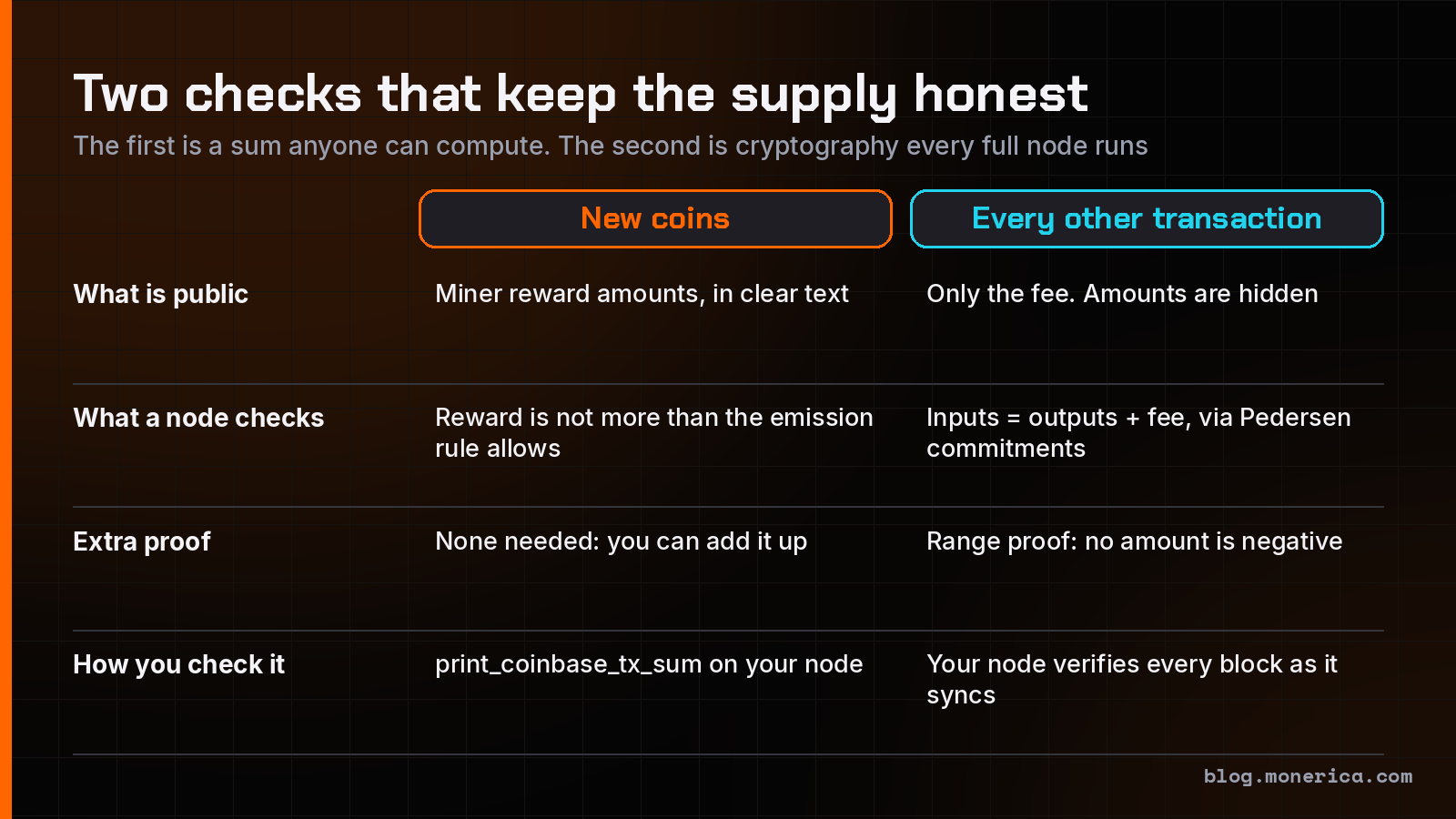
New XMR only enters the world through the miner reward in each block, called the coinbase transaction. Its amounts are written in clear text. The technical book Zero to Monero (section 7.3.1) puts it simply: nodes that receive a block must verify the block reward is correct, and can calculate the current money supply by summing all past block rewards.
Your node refuses any block whose miner pays itself more than the emission rule allows plus the fees in that block. You can see the check in Monero’s blockchain.cpp (the “coinbase transaction spend too much money” error) and the reward rule in get_block_reward.
Check 2: every other transaction must balance
Ordinary transactions hide their amounts inside Pedersen commitments. A commitment is like a sealed envelope with a number inside. Nobody can see the number, but the envelopes can be added together. That lets a node check that the inputs add up to the outputs plus the fee, which is the only amount left public, without opening anything.
The balance check is in Monero’s rctSigs.cpp: the node adds up the input commitments, adds up the output commitments plus the fee, and rejects the transaction if the two sums differ (“Sum check failed”).
Check 3: no negative amounts
Balancing alone is not enough. Someone could try to send 1,000 XMR and −999 XMR to themselves, which still balances on paper. In the math, a negative amount wraps around to a huge number, so it would quietly create coins. To stop that, every output carries a range proof showing its hidden amount is a normal, non-negative value. Monero uses Bulletproofs for this, upgraded to Bulletproofs+ in the August 2022 network upgrade.
Every full node runs all three checks on every new block and transaction, and a block that fails any of them is rejected, no matter who mined it. With full verification turned on (step 2 below), your node runs them on the entire history too.
One more detail: before RingCT was activated in January 2017, Monero amounts were public, so early transactions can be checked the same way you would check Bitcoin.
How to Audit the Monero Supply Yourself
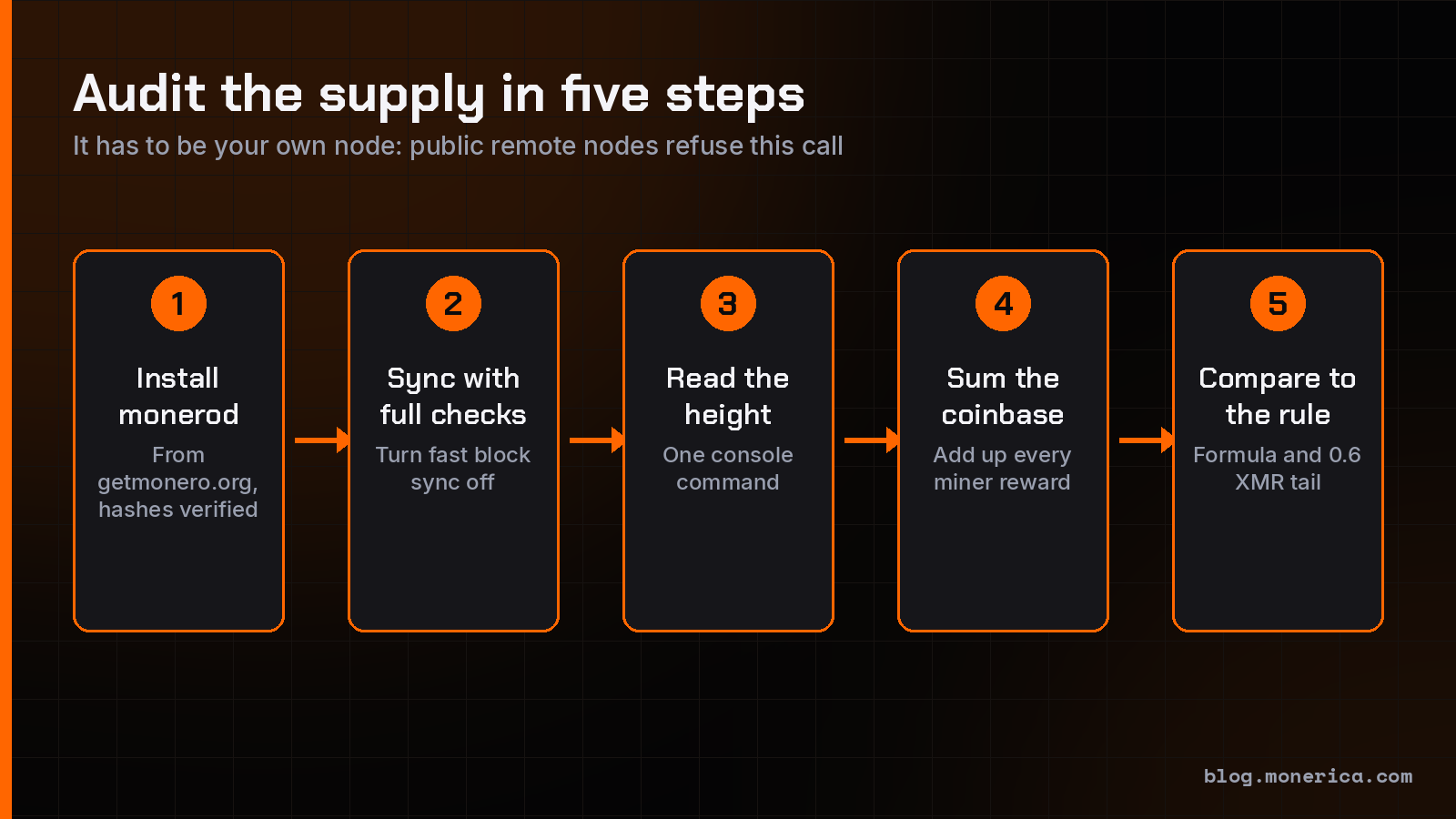
You need your own full node. A public remote node will not work for this, and the reason matters: the supply sum is only meaningful if your own computer verified the chain. Asking someone else’s node for a number is just trusting them again. Public nodes also run in restricted mode, and Monero’s RPC server turns get_coinbase_tx_sum off in restricted mode.
Step 1: install monerod and verify it
Download the Monero CLI from getmonero.org/downloads and check the download against the signed hashes, following the official verification guide. You are about to trust this program to check every block, so make sure it is the real one. Hardware and disk needs are in our Monero node requirements guide, and setup is covered in How to Run a Monero Node.
Step 2: sync with full verification
By default, monerod syncs faster by skipping some work on older blocks. The monerod reference describes --fast-block-sync as a way to trust the monerod binary about old blocks, using block hashes built into the program. In the source, blocks covered by those hashes skip the proof-of-work check and the transaction input checks. For a real audit, turn it off:
./monerod --fast-block-sync=0This sync is much slower, because your node checks every signature, commitment and range proof from 2014 to today. You can add --prune-blockchain to save disk space. A pruned node still checks everything as it syncs. If your node already synced with the default setting, you would need a fresh sync to get the full check on old blocks.
Step 3: read the current height
Once the node is synced, type commands into the monerod window, or send them from a second terminal by putting the command after ./monerod:
./monerod print_heightThe result is the number of blocks in your chain. Use it in the next step.
Step 4: add up every coinbase
The command is documented in the monerod reference as print_coinbase_tx_sum <start_height> [<block_count>]. Start at block 0 and count every block:
./monerod print_coinbase_tx_sum 0 <height>Replace <height> with the number from step 3. Two tips from the source code: always give the block count, because a count of 0 sums nothing, and do not use a number larger than your height, because the node rejects any range past the tip (“requested range exceeds blockchain height”). The node reads every block to do this, so give it some time.
The answer comes back in this format (this is the format string from rpc_command_executor.cpp, not a real result):
Sum of coinbase transactions between block heights [0, <height>) is <total>
consisting of <emission> in emissions, and <fees> in fees
The emission number is the one you want. It is the total XMR ever created. Fees are not new money: they are existing XMR moved from senders to miners, so they do not count toward the supply.
The same thing over RPC
If you prefer scripts, the daemon RPC offers get_coinbase_tx_sum with height (start block) and count (number of blocks). On your own node the RPC listens on 127.0.0.1 port 18081 by default:
curl -s http://127.0.0.1:18081/get_height

curl -s http://127.0.0.1:18081/json_rpc -H 'Content-Type: application/json' -d '{
  "jsonrpc": "2.0", "id": "0",
  "method": "get_coinbase_tx_sum",
  "params": { "height": 0, "count": HEIGHT }
}'
Replace HEIGHT with the height from the first call. Amounts come back in atomic units (1 XMR = 1,000,000,000,000 piconero). The full total is in wide_emission_amount, a hex string, because the sum is stored as a 128-bit number. The Monero docs show this example for two blocks starting at block 1,563,078:
"emission_amount" : 9471836197320,
"fee_amount" : 0,
"wide_emission_amount" : "0x89d556e91c8",
"wide_fee_amount" : "0x0"
That is 9.47183619732 XMR over two blocks in 2018. To turn your own wide_emission_amount into XMR, divide it by 1012, for example python3 -c "print(int('0x89d556e91c8', 16) / 1e12)".
Compare Your Total to the Emission Curve
A sum on its own means little. You want to know if it matches the rules. There are two easy checks.
The tail emission check
Since block 2,641,623 in June 2022 (report at the time), Monero has been in tail emission: each block creates 0.6 XMR, or slightly less if the block took a size penalty. That rule is FINAL_SUBSIDY_PER_MINUTE (0.3 XMR) times two minutes in cryptonote_config.h. So any stretch of recent blocks should show at most 0.6 XMR per block. For example, 1,000 blocks after the tail started should show at most 600 XMR in emissions:
./monerod print_coinbase_tx_sum 3000000 1000The formula check
The block reward is computed from the coins already created: (M − A) >> 19, never less than 0.6 XMR, where M is 264−1 atomic units and A is the coins already created. Before the 2016 network upgrade at block 1,009,827, blocks came every minute and the shift was 20, with a floor of 0.3 XMR. This short script runs the rule from the first block, as if no block ever paid less than the full reward:
M = 2**64 - 1                    # MONEY_SUPPLY in atomic units

def formula_total(height):
    """Coins the emission rule allows for blocks 0 .. height-1, in XMR."""
    a = 0
    for h in range(height):
        if h < 1009827:              # 1-minute blocks before the 2016 upgrade
            shift, floor = 20, 300000000000
        else:                        # 2-minute blocks
            shift, floor = 19, 600000000000
        a += max((M - a) >> shift, floor)
    return a / 1e12

print(formula_total(3800000))        # put your own height here
Your node’s emission total should come out a little below the script’s number, never above it. Some real blocks paid less than the full reward, mostly because of the block-size penalty, and between 2016 and 2020 miners were allowed to claim less than the full amount. Coins that were never claimed were never created. A total above the formula would mean something is wrong.
For a recent published figure to compare against, see How Many Monero Exist?, which explains the numbers and why sources differ by small amounts.
What the Audit Proves, and What It Assumes
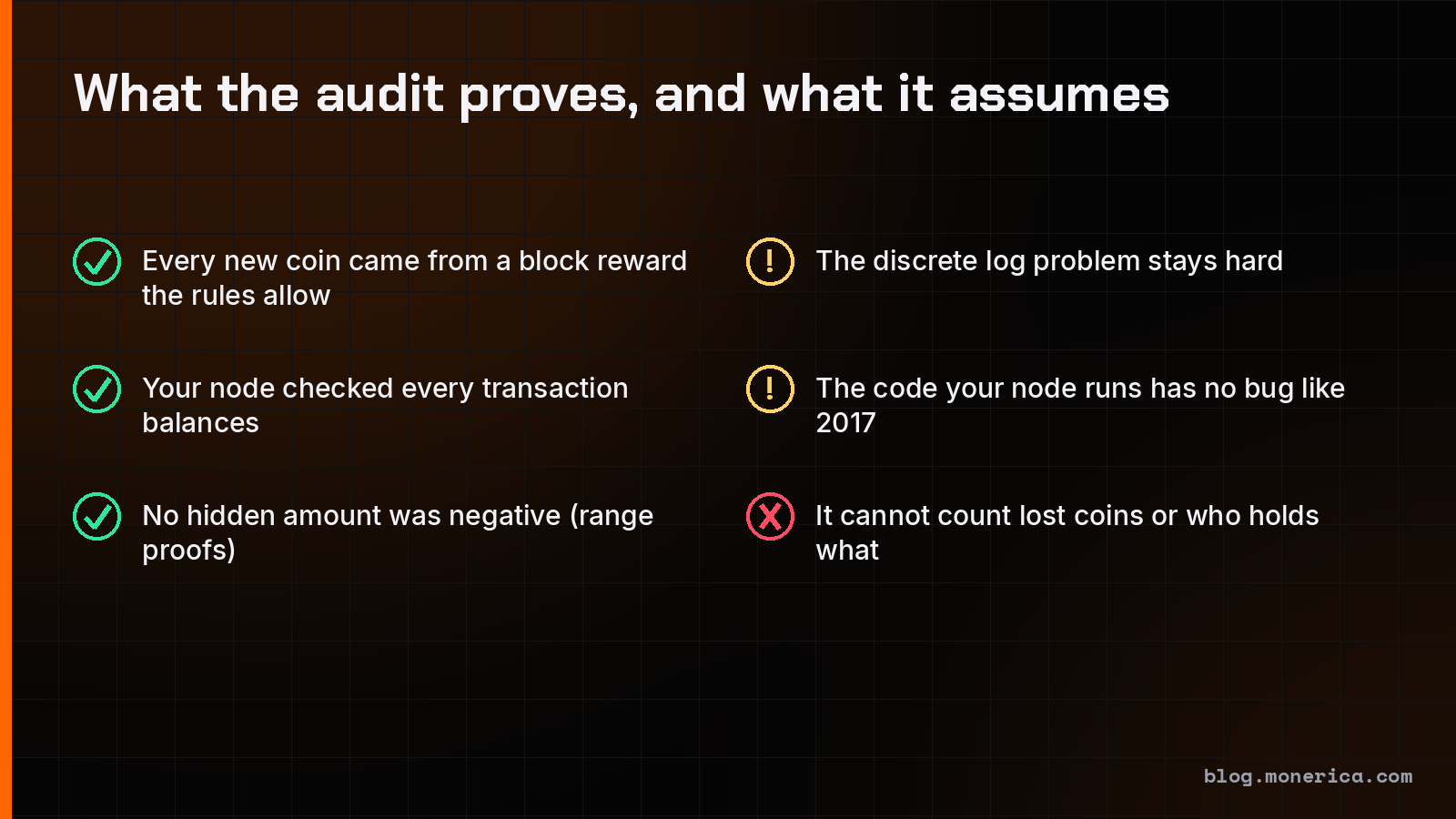
It is worth being precise here, because this is where the honest answer is a little more complicated than “it is all proven.”
The coinbase sum only counts coins created the normal way. If an attacker found a flaw that let them create coins inside a hidden transaction, those coins would not show up in print_coinbase_tx_sum. The sum would look perfect while the real supply was larger. Preventing that is the job of the commitments and range proofs, so the audit also depends on them.
Commitments rest on a math assumption. A Pedersen commitment can only be “opened” to one amount as long as nobody can solve the discrete logarithm problem for the curve Monero uses. Zero to Monero (section 5.2) calls this property computational binding: even the person who made the commitment cannot find another amount that fits it without solving that problem. No one is known to be able to do this today. A large enough quantum computer running Shor’s algorithm could, in theory, which is one reason quantum resistance is a research topic for Monero and for most other cryptocurrencies.
The code has to be right. Correct math does not help if the program that checks it has a bug. Monero has had such bugs, which is why the next section matters.
What it cannot tell you: how many coins are lost, who holds what, or how many coins are in circulation versus sitting in forgotten wallets. Nobody can see that on Monero, and that is the point of a private coin.
Past Bugs and Audits
2017: the CryptoNote key image bug
In February 2017 a member of the Monero Research Lab found a flaw that affected every CryptoNote-based coin. By changing a transaction’s key image in a special way, someone could spend the same coins more than once and create coins that, in the words of the Monero team’s disclosure, were “undetectable to an observer unless they know about the fatal flaw and can search for it.”
According to that post, the team scanned the Monero blockchain the next day and found it had never been exploited, quietly patched it, and waited until a hard fork in April 2017 made sure the whole network ran the fix. Other CryptoNote coins were warned, and the bug was disclosed publicly on May 17, 2017. The fix is a check every node still runs: each key image is multiplied by the curve order and must give the identity point, or the transaction is rejected. You can find it as check_tx_inputs_keyimages_domain in cryptonote_core.cpp.
This is the clearest example of why the second half of the audit matters: a bug like this does not show up in the coinbase sum.
2018: the Bulletproofs audits
Before Bulletproofs went live, the community paid for outside audits. The Moneropedia names Quarkslab and Kudelski Security as the auditors. Quarkslab’s report found four major vulnerabilities in the proof verification code, plus medium issues in data parsing. It said none of them led to a working exploit during the audit, but it did not rule one out. Publication was held until the October 2018 release that patched the last issue, and OSTIF reported that the October 2018 network upgrade enabled Bulletproofs and corrected all outstanding issues raised by both audits.
2021: the Bulletproofs+ audits
The newer Bulletproofs+ code got two audits funded through Monero’s community crowdfunding system: one by a ZenGo X research team and a second by JP Aumasson, finished in March 2021. Bulletproofs+ went live in the August 2022 network upgrade.
None of this proves the code is perfect today. It shows a pattern: new cryptography gets outside review before it reaches the main network, and bugs that were found were fixed and disclosed.
How This Compares to Bitcoin
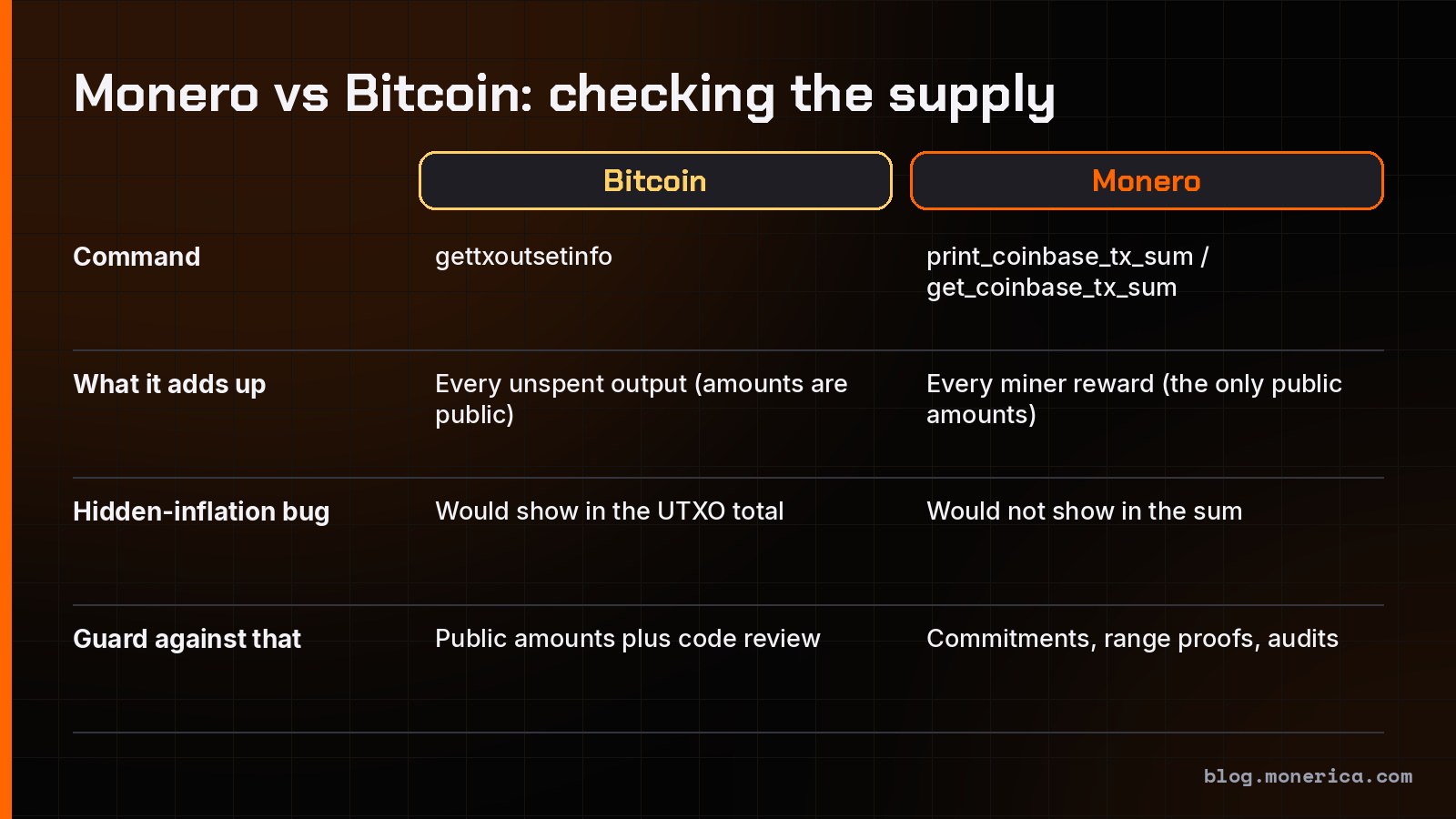
Bitcoin Core has a command, gettxoutsetinfo, that returns statistics about the unspent output set, including the total amount. Because Bitcoin amounts are public, that total is a direct count of every coin that exists right now. If a bug ever created extra coins, a node that adds up the unspent outputs would see them.
Monero cannot do that, because both amounts and which outputs are spent are hidden. It counts what came in through the coinbase instead, and relies on cryptography to guarantee nothing came in any other way.
Fair to both sides: transparency does not make a coin bug-free. In 2018 Bitcoin Core fixed CVE-2018-17144, which included a critical inflation bug; the developers said they were unaware of any attempt to exploit it. The difference is in how a bug would be noticed. On Bitcoin, inflation would show up in public numbers. On Monero, it would have to be found in the code or the math. Monero trades a little of that visibility for privacy, and makes up for it with open code, published proofs and paid audits.
Use Your Own Node
Everything in this guide comes back to one idea: do not trust, verify, and verify on your own machine. If you do not run a node yet, start with Should You Run Your Own Monero Node? and What Is a Monero Node?
Monerica runs a public remote node at node.monerica.com that your wallet can connect to when you are away from your own node. It is handy for sending and receiving, but it cannot do this audit for you: it runs in restricted mode, and a supply number from someone else’s node would only be as good as your trust in them. Node software, hardware and other public nodes are listed in the Monerica nodes directory.
And once you are sure the coins are sound, use them. Monerica.com is a directory of thousands of places that accept Monero, from hosting and VPNs to phone plans, gift cards and travel, each with reader reviews.
Find places to use Monero on Monerica →
FAQ
Can you verify the Monero supply if amounts are hidden?
Yes. Miner rewards are public, so your node can add up every coin ever created. Every other transaction must prove it balances and has no negative amounts, and your node checks those proofs as it syncs.
What command shows the total Monero supply?
In monerod, print_coinbase_tx_sum 0 <height>, where the height comes from print_height. Over RPC it is get_coinbase_tx_sum with height 0 and count set to the chain height. Read the emission part of the answer, not the fees.
Can I run the audit on a remote node?
No. Public remote nodes use restricted RPC, which turns off get_coinbase_tx_sum. And a number from someone else’s node is only as good as your trust in them. Use your own node.
Do I need a full node, or is a pruned node enough?
A pruned node is fine. It verifies everything as it syncs and then drops data it no longer needs. What matters more is syncing with --fast-block-sync=0, so old blocks are fully checked too.
Could someone secretly inflate Monero?
Only by breaking the math (the discrete log problem) or finding a bug in the code. That is exactly what the 2017 key image bug was, and it was found, patched and confirmed unexploited before disclosure. It is a real risk, which is why the cryptography gets outside audits.
Has Monero ever been inflated by a bug?
Not according to the Monero team’s own review. When the 2017 bug was found, they scanned the blockchain and reported it had never been exploited.
Is Monero’s supply capped?
No. Since June 2022 every block adds 0.6 XMR forever. See How Many Monero Exist? for the numbers.
How is this different from Bitcoin’s gettxoutsetinfo?
Bitcoin adds up every unspent coin directly because amounts are public. Monero adds up what was created through mining and relies on cryptography to prove nothing was created any other way.
Sources
- Zero to Monero 2.0, sections 5.2 (Pedersen commitments) and 7.3.1 (block reward and money supply)
- Monero docs: monerod reference (print_coinbase_tx_sum, print_height, --fast-block-sync)
- Monero docs: daemon RPC (get_coinbase_tx_sum, get_height)
- Monero source code on GitHub (blockchain.cpp, rctSigs.cpp, cryptonote_core.cpp, core_rpc_server.h, rpc_command_executor.cpp, cryptonote_config.h, hardforks.cpp)
- getmonero.org: Disclosure of a Major Bug in CryptoNote Based Currencies (May 17, 2017)
- Quarkslab: Security audit of Monero Bulletproofs (October 2018)
- OSTIF: Bulletproofs is complete, critical bug patched
- Moneropedia: Bulletproofs, Pedersen Commitment, Ring CT, Tail Emission
- CCS: Bulletproofs+ audit (ZenGo X) and CCS: Bulletproofs+ audit 2 (JP Aumasson)
- getmonero.org: network upgrade on August 13, 2022
- Bitcoin developer reference: gettxoutsetinfo and Bitcoin Core: CVE-2018-17144 disclosure
This article was written on November 27, 2026, against the current Monero source code. Command names and outputs can change between releases; check help in your own monerod if something does not match.