▶ Watch the full video on YouTube · or on Monerica Video
Bitcoin and Monero are both digital cash. Both are peer to peer, run by nobody, and mined by anyone with hardware and electricity. But they took opposite directions at the very beginning, and everything else follows from that choice: Bitcoin made every transaction public forever. Monero made every transaction private forever.
This article compares the two on history, technology, mining, real-world privacy, market cap and price history, and the question most people actually care about: which one is better for paying for things. That means looking at the Lightning Network and whether you can really be private on it. If you only know Bitcoin, you'll get the full picture. If you've been in crypto for years, there are a few things here you probably haven't heard.
Disclosure: the video this article is based on is sponsored by Kotova, a swap comparison site. The sponsor section is clearly marked below. Nothing here is financial advice.
The history of Bitcoin
In October 2008, someone calling themselves Satoshi Nakamoto posted a nine-page paper to a cryptography mailing list. The network went live on January 3rd, 2009, and its first block has a newspaper headline about bank bailouts embedded in it, so you know exactly what it was reacting to.
For its first year Bitcoin had no price at all. The first real purchase came in May 2010: ten thousand bitcoin for two pizzas. Satoshi vanished in late 2010 and has never been heard from since, which turned out to be the best thing that ever happened to Bitcoin. There's no founder to pressure, arrest or buy out.
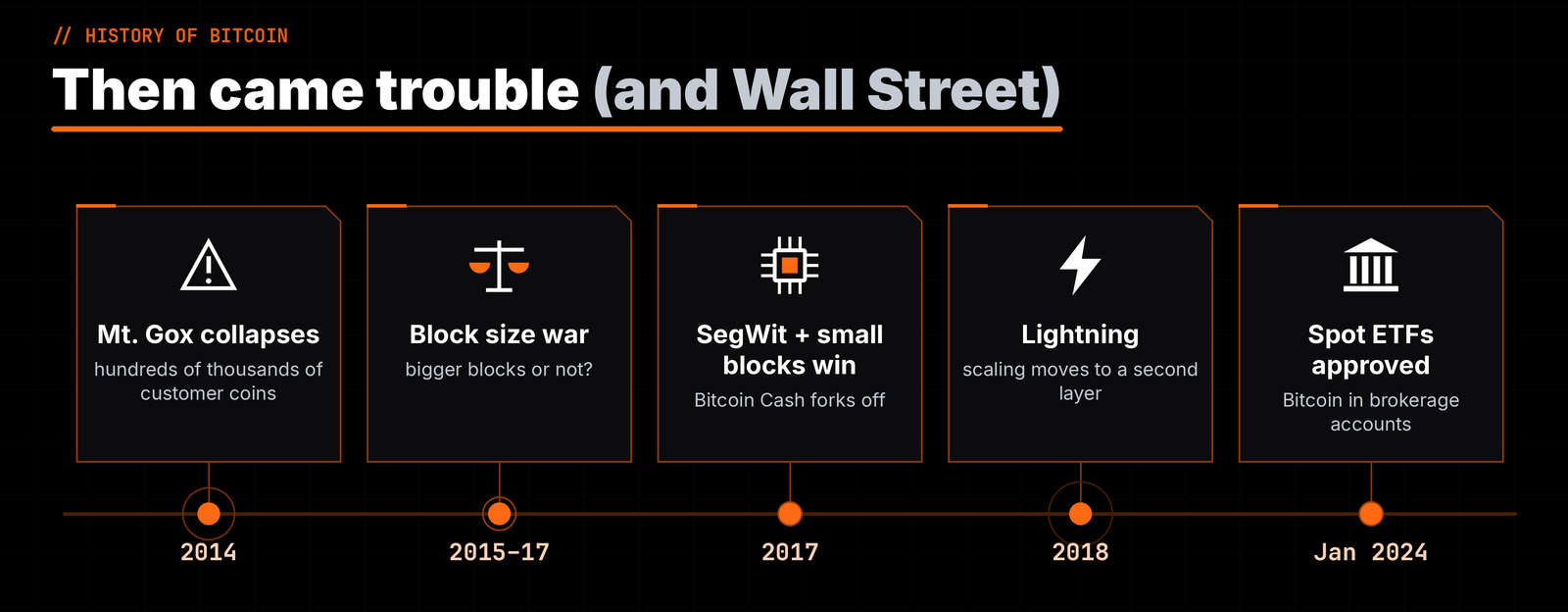
Then came trouble. Mt. Gox collapsed in 2014 with hundreds of thousands of customer coins. From 2015 to 2017 the community fought the “block size war” over whether to make blocks bigger. The small-block side won, SegWit activated in 2017, Bitcoin Cash forked off, and scaling was pushed to a second layer called Lightning. Spot ETFs were approved in January 2024, and Bitcoin became something Wall Street holds in a brokerage account.
The history of Monero
Monero's story is messier. In 2013 an anonymous author published the CryptoNote paper, a privacy design that had nothing to do with Bitcoin's code. The first coin built on it was Bytecoin, and Bytecoin turned out to have a massive secret premine. So in April 2014 the community forked it onto a clean chain, and after a fight with the original launcher the project became Monero (first called “BitMonero”). Monero means “coin” in Esperanto. No company is behind it, and no foundation owns it or takes a cut.
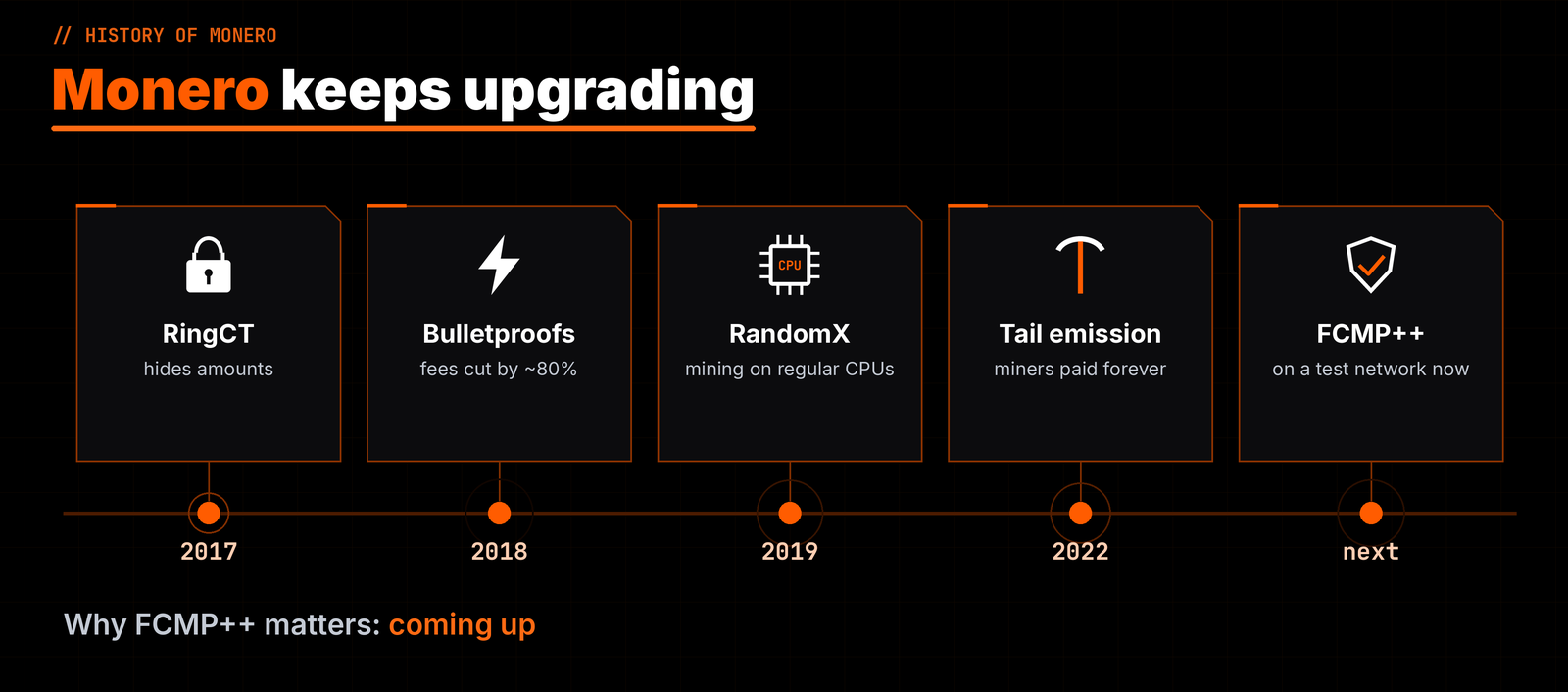
Unlike Bitcoin, Monero changes constantly. RingCT in 2017 hid transaction amounts. Bulletproofs in 2018 cut fees by about 80%. RandomX in 2019 made mining work well on ordinary CPUs. Tail emission started in 2022. And the next upgrade, full chain membership proofs (FCMP++), is running on a test network right now — more on why that matters below.
How Bitcoin works
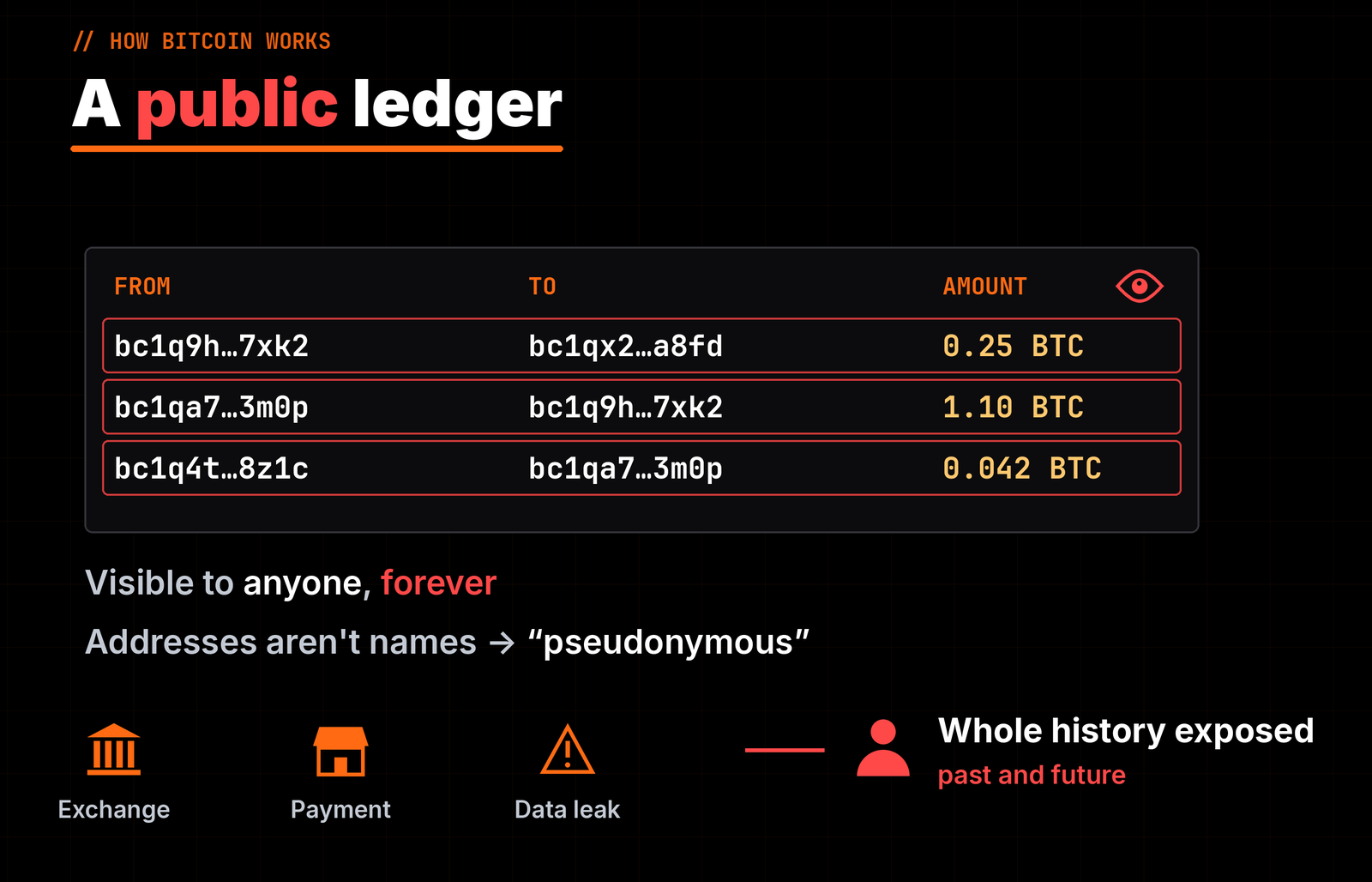
Bitcoin is a public ledger. Every transaction ever made shows the sending address, the receiving address and the exact amount, forever, to anyone who looks. Addresses aren't names, so people call it “pseudonymous.” But the moment one address is tied to you — through an exchange, a payment or a data leak — your entire history is exposed, and so is everything you do from then on.
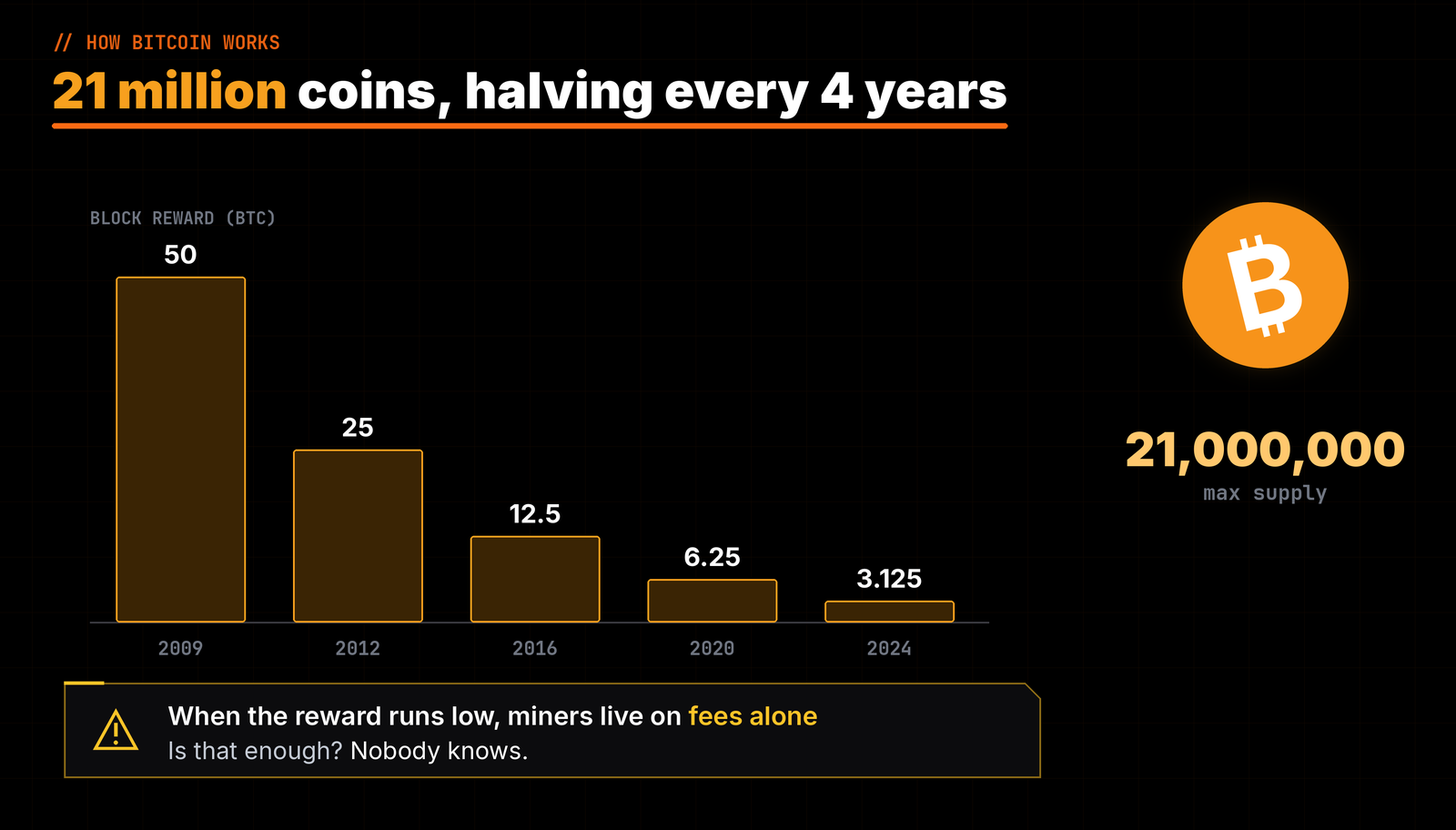
There will only ever be 21 million bitcoin, and the mining reward halves every four years. That sounds great, but it has a problem Bitcoiners don't like discussing: when the reward runs low, miners have to live on fees alone, and nobody knows if that will be enough. Blocks come every ten minutes and are capped in size, so when demand spikes, fees spike. People paid around $50 a transaction in 2021 and over $100 during the Ordinals craze in 2024.
How Monero works
Monero hides three things on every transaction, and there's no way to turn it off:
- Ring signatures hide the sender by mixing your real input with fifteen decoys.
- Stealth addresses hide the receiver. Every payment lands on a fresh one-time address, so your public address never appears on the chain.
- RingCT hides the amount.
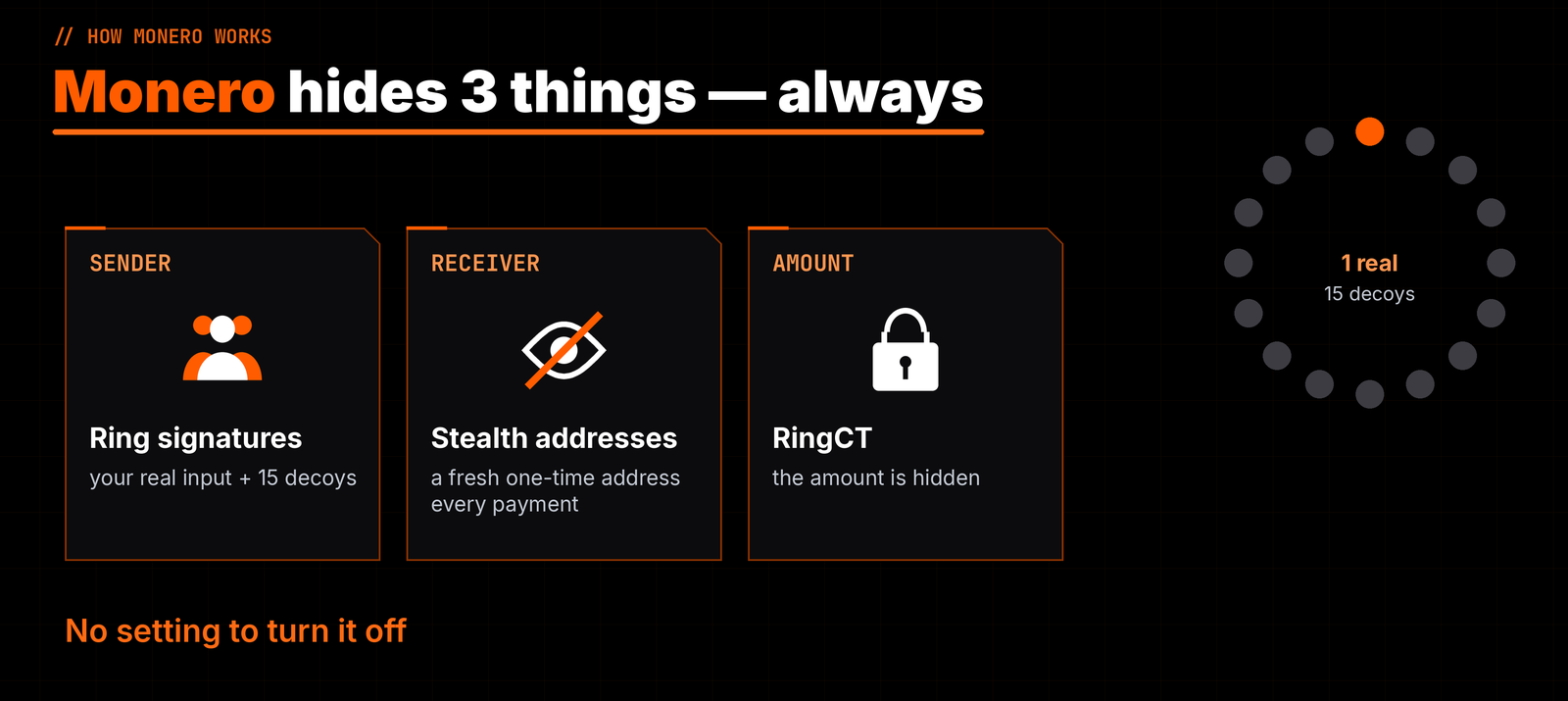
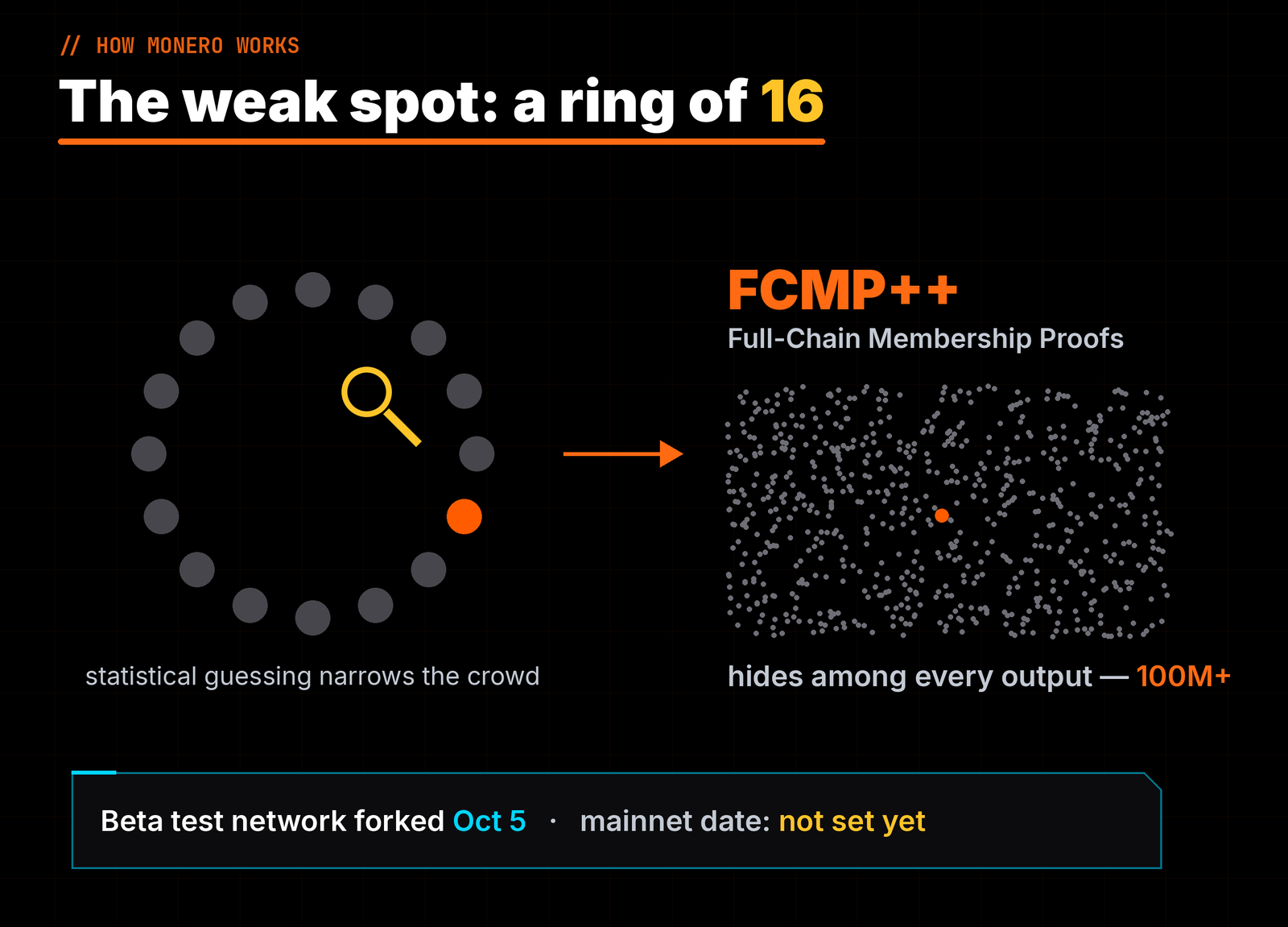
The ring of sixteen is the real weak spot. It's a crowd of sixteen, and researchers can do statistical guessing within it. That's exactly what full chain membership proofs fix: instead of fifteen decoys, every transaction hides among every output on the entire chain — over a hundred million. The FCMP++ beta test network forked on October 5th, and there's no mainnet date yet.
Blocks come every two minutes, the block size grows with demand, and fees are a few cents. The supply is about 18.4 million XMR plus a tail emission of 0.6 XMR per block, forever. That's under 1% inflation and shrinking every year, and it means miners always get paid. Bitcoin left that question for the future; Monero has already answered it.
Self-custody: the part everyone skips
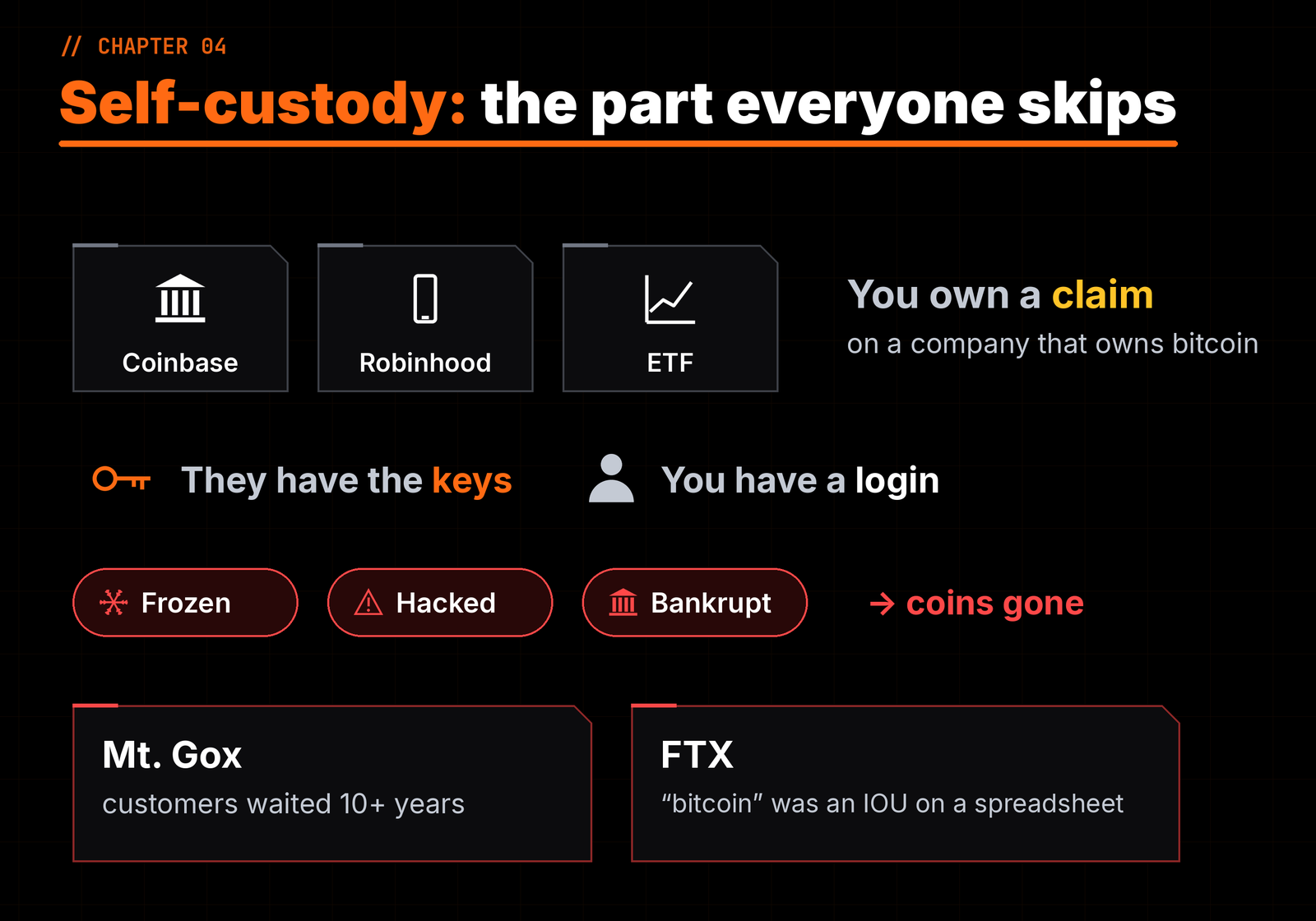
A lot of people own bitcoin without ever actually holding it. If it's in a Coinbase account, a Robinhood account or an ETF, you don't own bitcoin — you own a claim on a company that owns bitcoin. They have the keys; you have a login. If they freeze your account, get hacked or go bankrupt, your coins are gone. Mt. Gox customers waited over a decade. FTX customers found out their bitcoin was an IOU on a spreadsheet.
The whole reason Satoshi created Bitcoin was so you could hold money nobody can take, freeze or inflate. That only works if you hold the private keys yourself. That's self-custody: a wallet where only you have the secret, usually 12 or 25 words written down. No account, no company, nobody to lock you out.
Everything in this article about privacy assumes self-custody. Monero sitting on an exchange is just a number on their server with your name next to it. Buy it wherever you have to, then move it to a wallet you control.
Tainted coins and risk scores
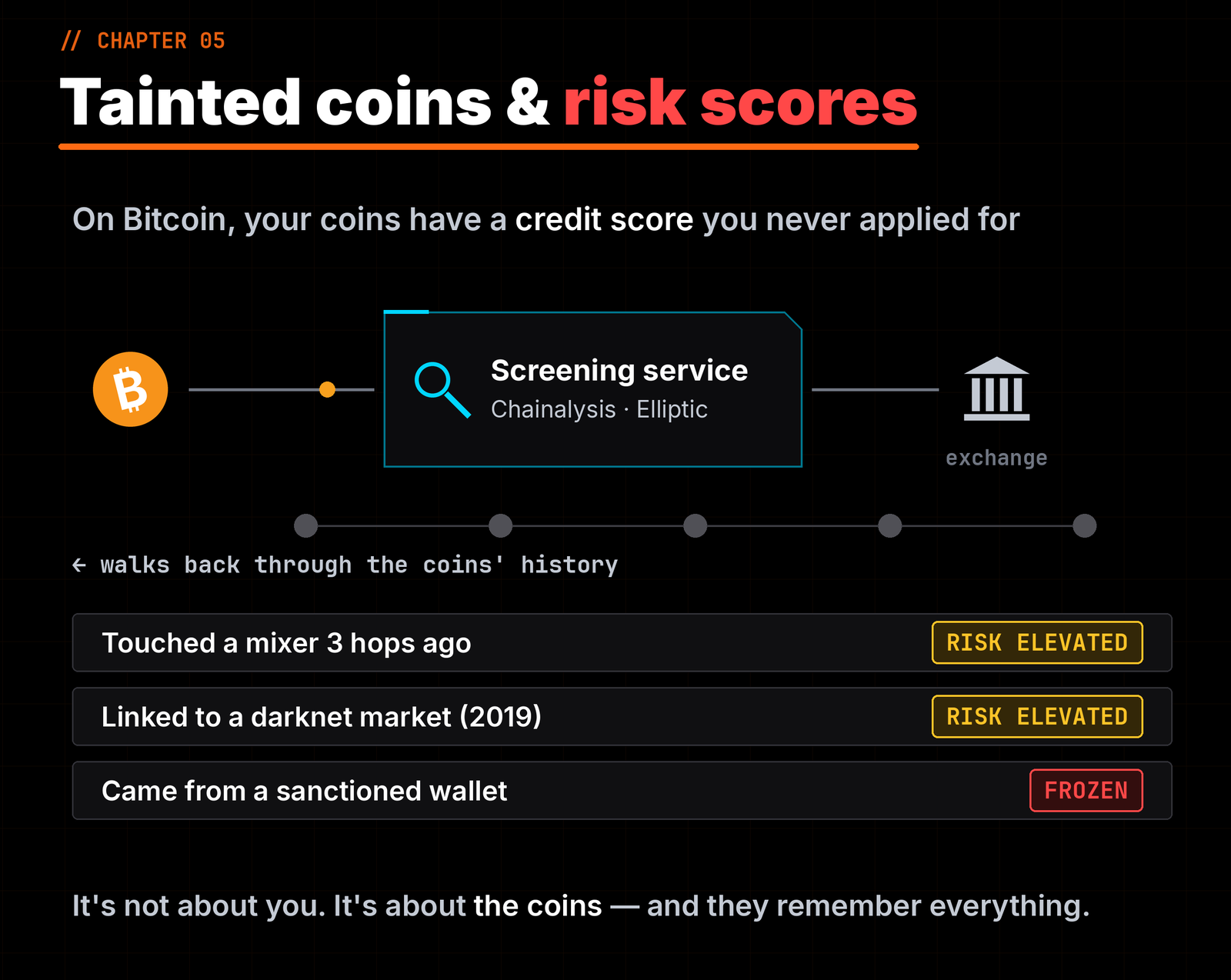
Here's something most people learn the hard way: on Bitcoin, your coins have a credit score, and you never applied for it.
Every major exchange runs incoming deposits through a screening service like Chainalysis or Elliptic, which walks backward through the history of the coins you just sent and scores them. Touched a mixer three hops ago? Risk elevated. Passed through an address linked to a darknet market in 2019? Risk elevated. Came from a sanctioned wallet? Frozen. The score isn't about you. It's about the coins, and the coins remember everything.
You can get caught without doing anything wrong. A customer pays you, their coins came from a swap service, that swap service's wallet once touched a hack, and now your deposit is flagged and you're the one answering questions. Freshly mined bitcoin with no history can even sell at a premium — unless it's known to have been mined in a sanctioned country. The market already knows not all bitcoin is equal. That's what people mean when they say Bitcoin isn't fungible.
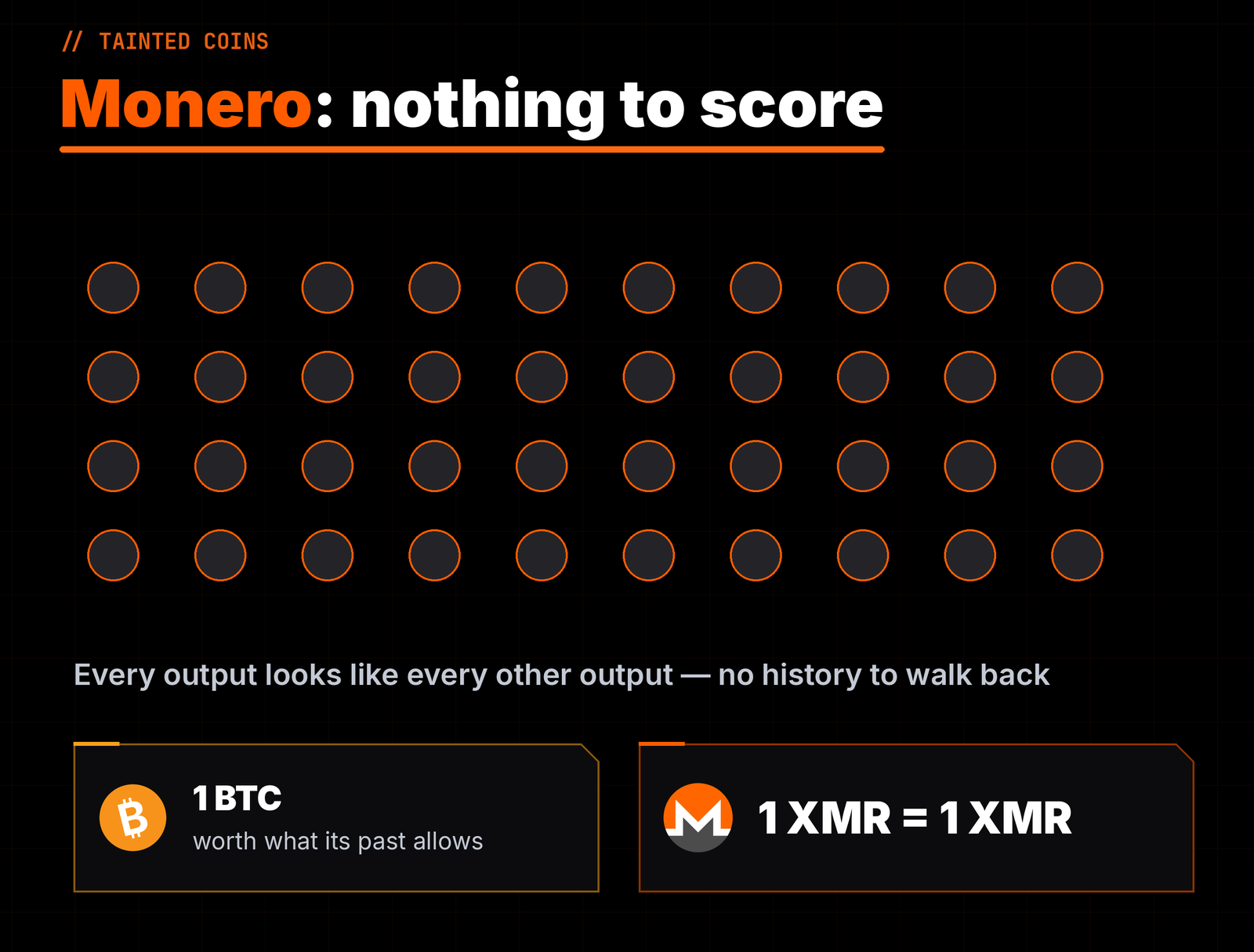
Monero has nothing to risk-score. Every output looks like every other output, and there's no history to walk back through. A bitcoin is worth what its past allows; 1 XMR is always worth 1 XMR.
Mining and security
Bitcoin is mined on ASICs — machines that do exactly one thing, made by a handful of companies. The upside is more hashrate than most countries could organize an attack against. The downside is that a few pools and a few chip makers sit at the top. It's secure like a fortress, not like a crowd.
Monero's RandomX algorithm runs best on normal CPUs, so anyone can mine on a laptop and there's no pool operator in charge. The downside is far less total hashrate, which makes it cheaper to attack. In 2025 a project called Qubic pointed its computing power at Monero and, for a time, reorganized blocks. A reorg can't steal coins or break privacy, but it can double-spend recent transactions, which is why exchanges raised their confirmation counts. It happened; the practical cost was waiting longer for funds to settle on exchanges.
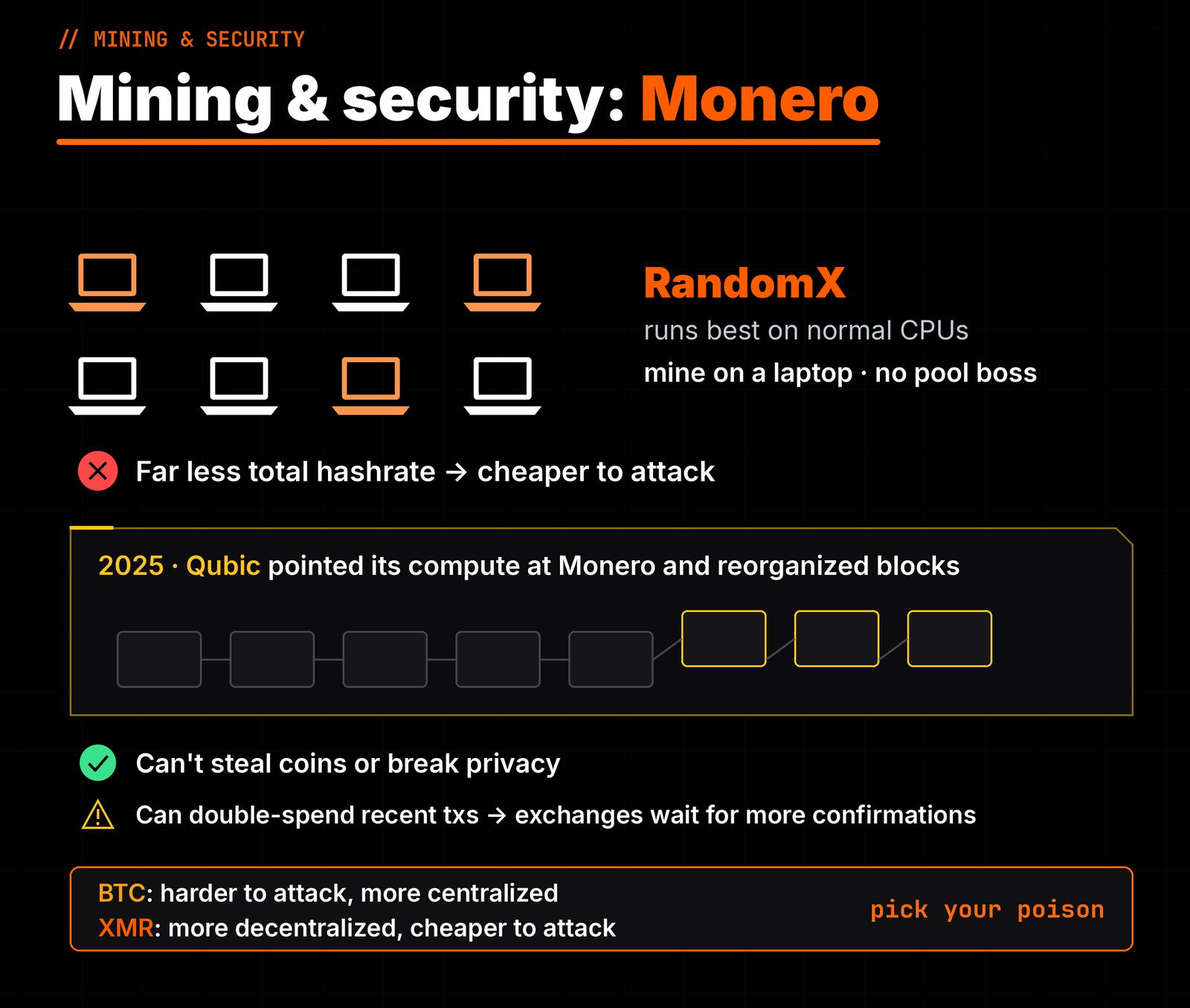
Bitcoin is harder to attack and more centralized. Monero is more decentralized and cheaper to attack. Pick your poison.
Market cap and price history
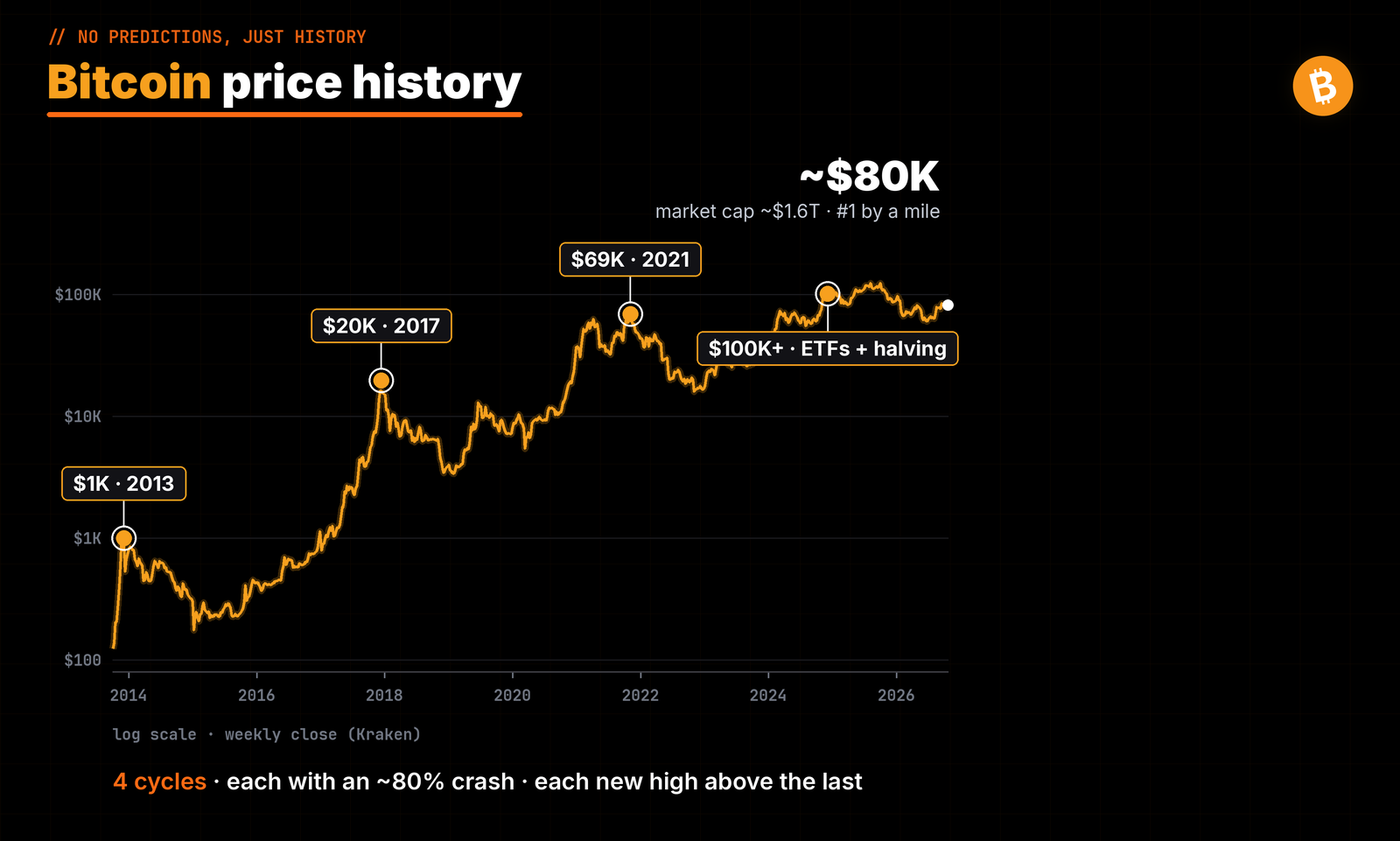
No predictions here — just history, at the time of writing (October 2026).
Bitcoin is the number one crypto asset by a mile: around $80,000, with a market cap near $1.6 trillion. It hit $1,000 in 2013, $20,000 in 2017 and $69,000 in 2021, and crossed $100,000 after the ETFs and the 2024 halving. Four cycles, each with an ~80% crash, and each new high above the last.
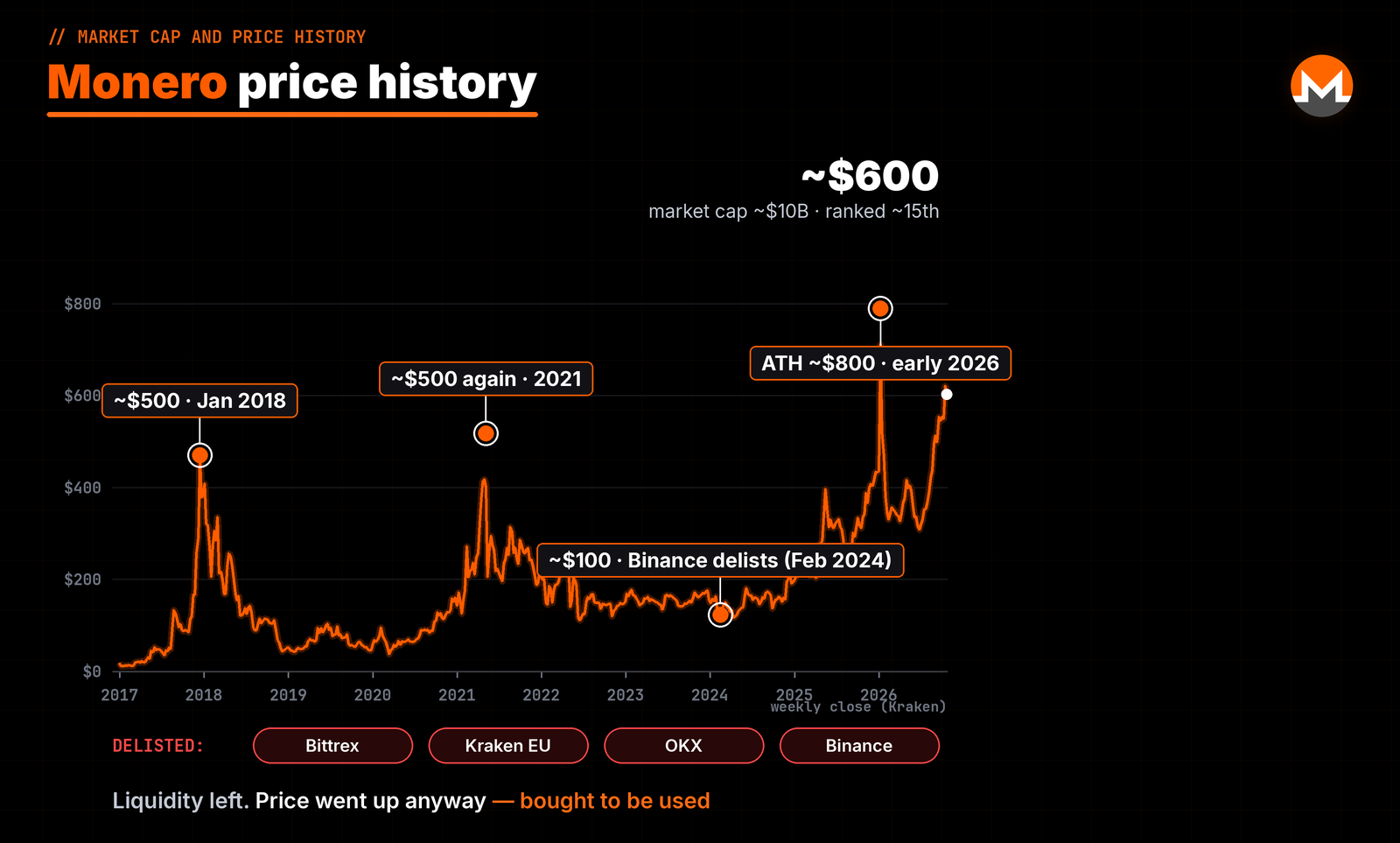
Monero sits around $600 with a market cap near $10 billion, ranked about 15th. It peaked near $500 in January 2018 and again in 2021, then got hit by something no other major coin has faced: delistings. Bittrex, Kraken in Europe, OKX, and then Binance in February 2024, which dropped it to around $100. Then it came back and set a new all-time high in early 2026 near $800 — with less exchange access than ever. The liquidity left and the price went up anyway, most likely because the people buying Monero are buying it to use it.
To be fair, Bitcoin is a few hundred times bigger, with institutions, ETFs and liquidity that Monero doesn't have. If you're holding for ten years, that matters.
Sponsor: Kotova
Speaking of how to get Monero, the video is sponsored by Kotova. Since many readers are coming from Bitcoin, here's the background.
If you've only bought crypto through something like Coinbase, you've only used a custodial exchange: you make an account, upload your ID, and they hold the coins. That works for Bitcoin. It mostly doesn't work for Monero, because most centralized exchanges have dropped it.
So how do people get Monero? Usually through an instant exchange. No account, no ID. You tell the site “I have bitcoin, I want Monero,” it gives you an address, you send bitcoin from your own wallet, and minutes later Monero shows up in your Monero wallet. It's like a currency booth at the airport, except you never show a passport.
The problem is that there are dozens of these services, and it's hard to find the best price. Kotova solves that. It isn't an exchange — it's a comparison site. Pick your pair, it asks several services at once, shows every quote side by side, and you send straight to the best one. Kotova never touches your coins, and there's no account and no email.
It also has a feature called Freeze Protection. Turn it on and every service capable of holding your deposit is removed from the list, so your swap only goes through an automated protocol with no desk that could freeze anything.
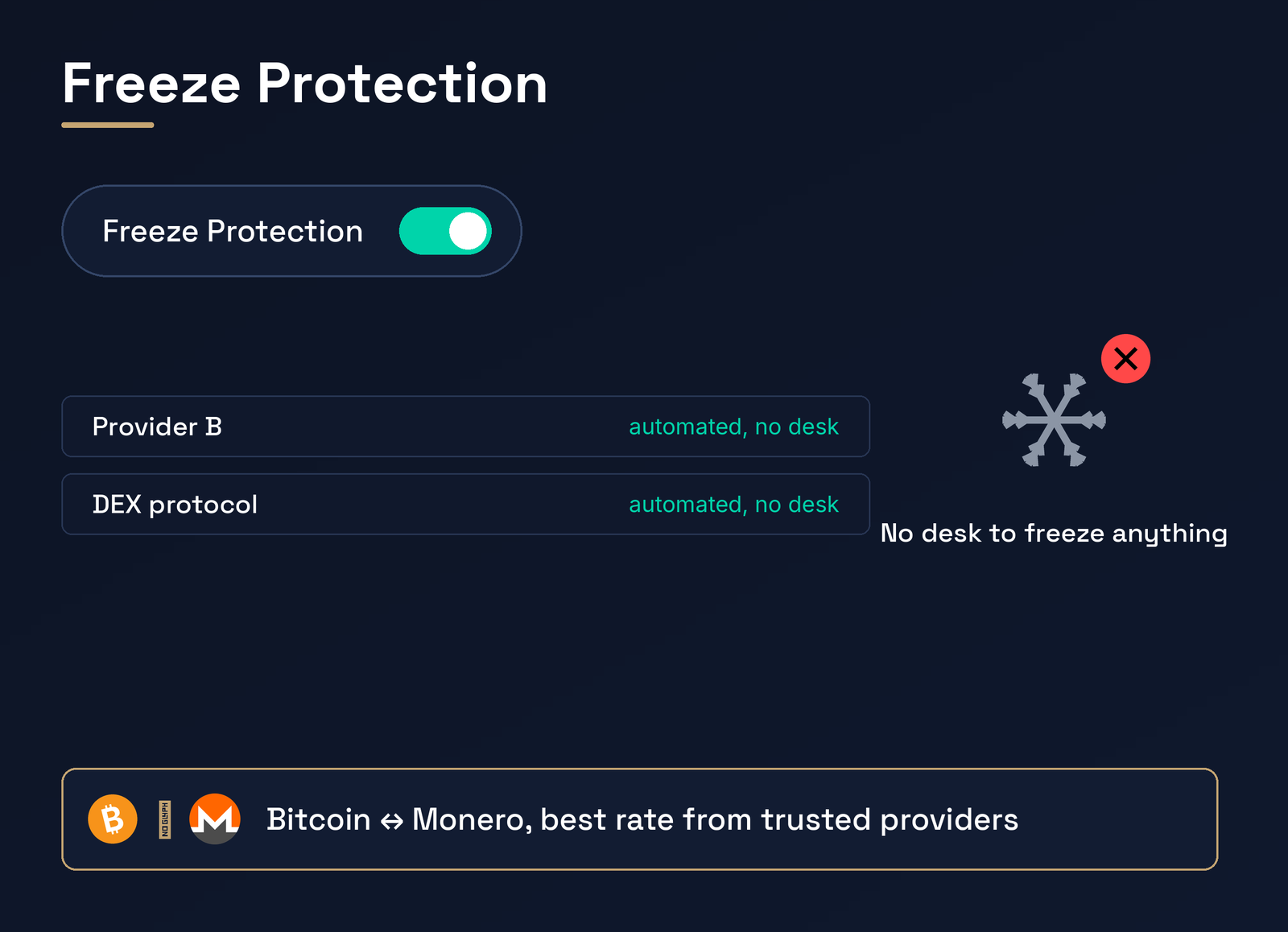
You can pick Bitcoin to Monero or Monero to Bitcoin and find the best rate from their trusted providers, straight into a self-custody wallet you control. Kotova is a real company based in Germany and is listed on Monerica.
The Lightning Network
Lightning is Bitcoin's answer to slow, expensive payments, and it went live in 2018. You and a counterparty lock bitcoin into a channel on the main chain, then pay each other back and forth instantly for almost nothing, because nothing touches the blockchain until the channel closes. Payments can also route through other people's channels to reach anyone on the network.
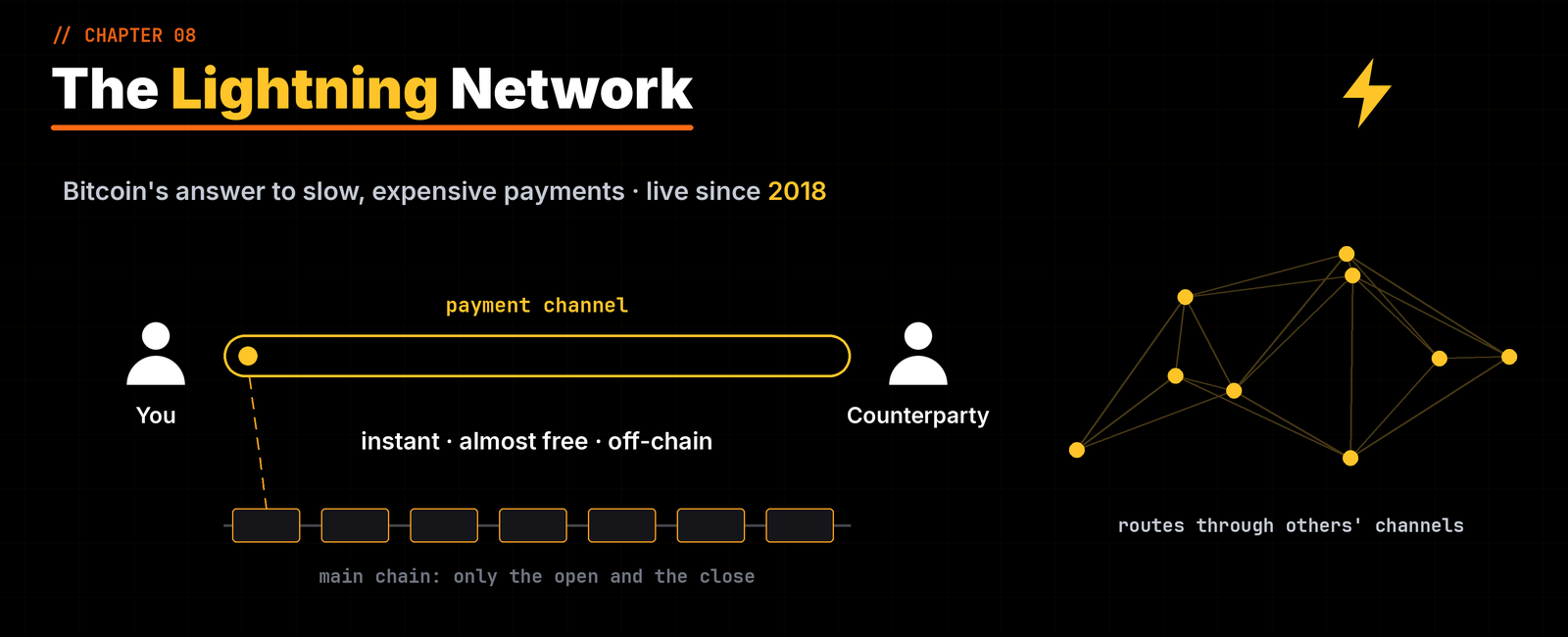
When it works, it's great: sub-second and sub-cent. That's the experience in apps like Strike or Wallet of Satoshi. But those apps are custodial — the company holds your bitcoin and runs the node. It's a bank with a bitcoin logo. Running your own node means managing channels, keeping liquidity flowing in the right direction, and staying online to receive. Lightning never became the self-custodial everyday payment rail it was pitched as, and most of the real volume runs through a few big custodians.
Can you be private on Lightning?
Partially if you're sending, much less if you're receiving. Lightning uses onion routing, so a node in the middle only knows the hop before and after it. That's better than an on-chain Bitcoin payment.
But it leaks in several places:
- Opening and closing a channel is a public Bitcoin transaction.
- Your channel partner sees every amount that passes through — and for most people that partner is a big hub that sees a huge slice of the network.
- Researchers have shown you can probe someone's channel balance just by sending fake payments.
- Standard invoices reveal the receiver's node to every sender. The newer BOLT12 standard with blinded paths hides your node from the sender, which is a real improvement, but it doesn't change what your channel partner sees or the public channel on-chain.
- On a custodial app none of this matters, because the company sees everything.
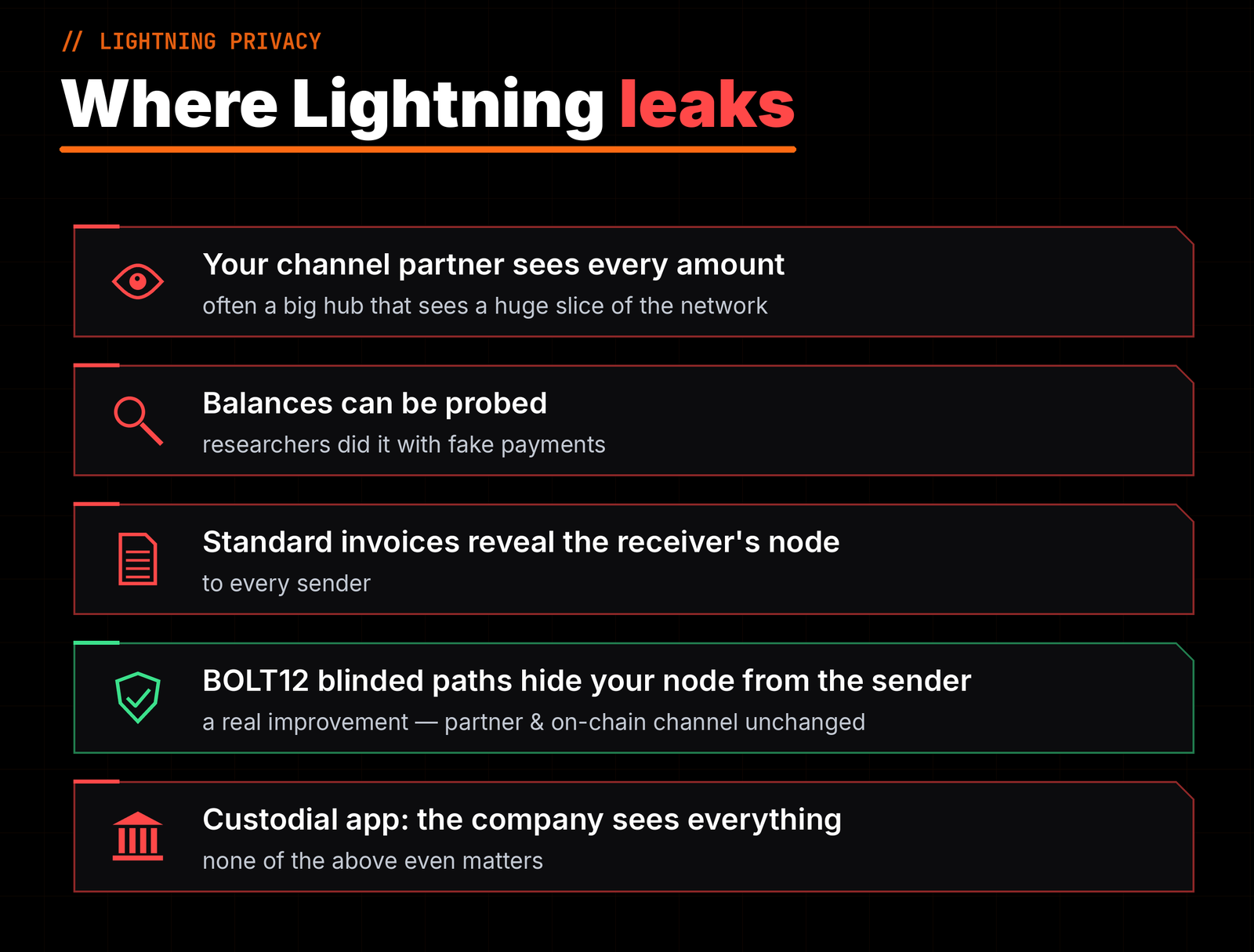
For the advanced crowd: Lightning's privacy is network-layer — it hides the route. Monero's privacy is protocol-layer — it hides the sender, receiver and amount in the ledger itself. Those aren't the same thing.
Which is best for paying?
- Bitcoin on-chain: ten-minute blocks, about an hour for confirmations, fees anywhere from $1 to over $100, and fully public. It's the worst option for spending privately.
- Lightning: instant and nearly free when it works, but it needs a custodian or channel management. Smooth if you trust an app; a lot of work for partial privacy if you don't.
- Monero on-chain: two-minute blocks, settled in about twenty minutes, fees of a few cents no matter how busy the network is, private every time, and nothing to configure. It's slower than Lightning, but as simple as any other crypto payment once your wallet is synced — and nobody can see the sender, receiver or amount.
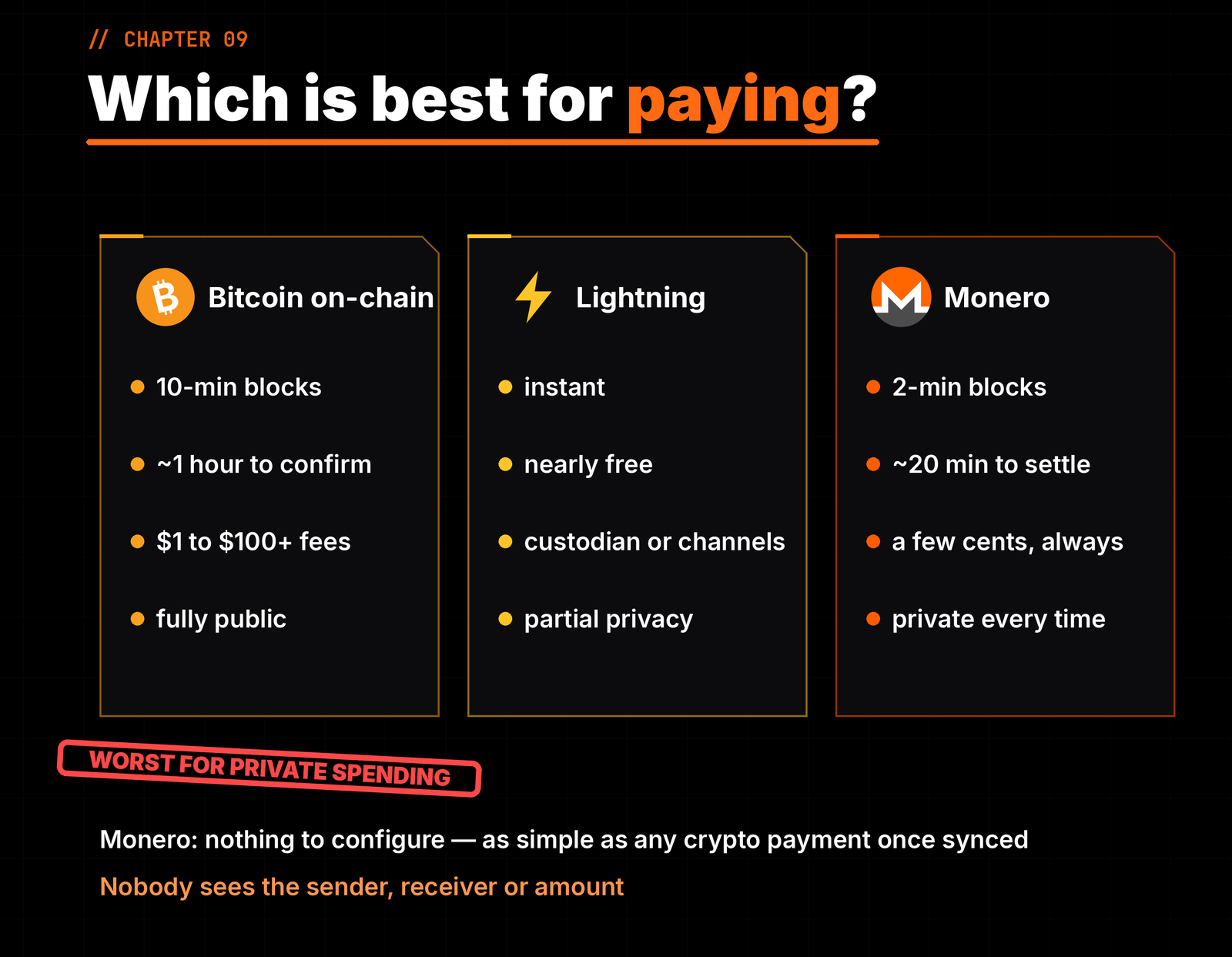
For a beginner: Bitcoin is digital gold, Lightning is a fast rail on top of the gold, and Monero is cash. Merchants want cash — and more businesses take Monero directly than most people think. Monerica lists hundreds of them.
How to get Monero
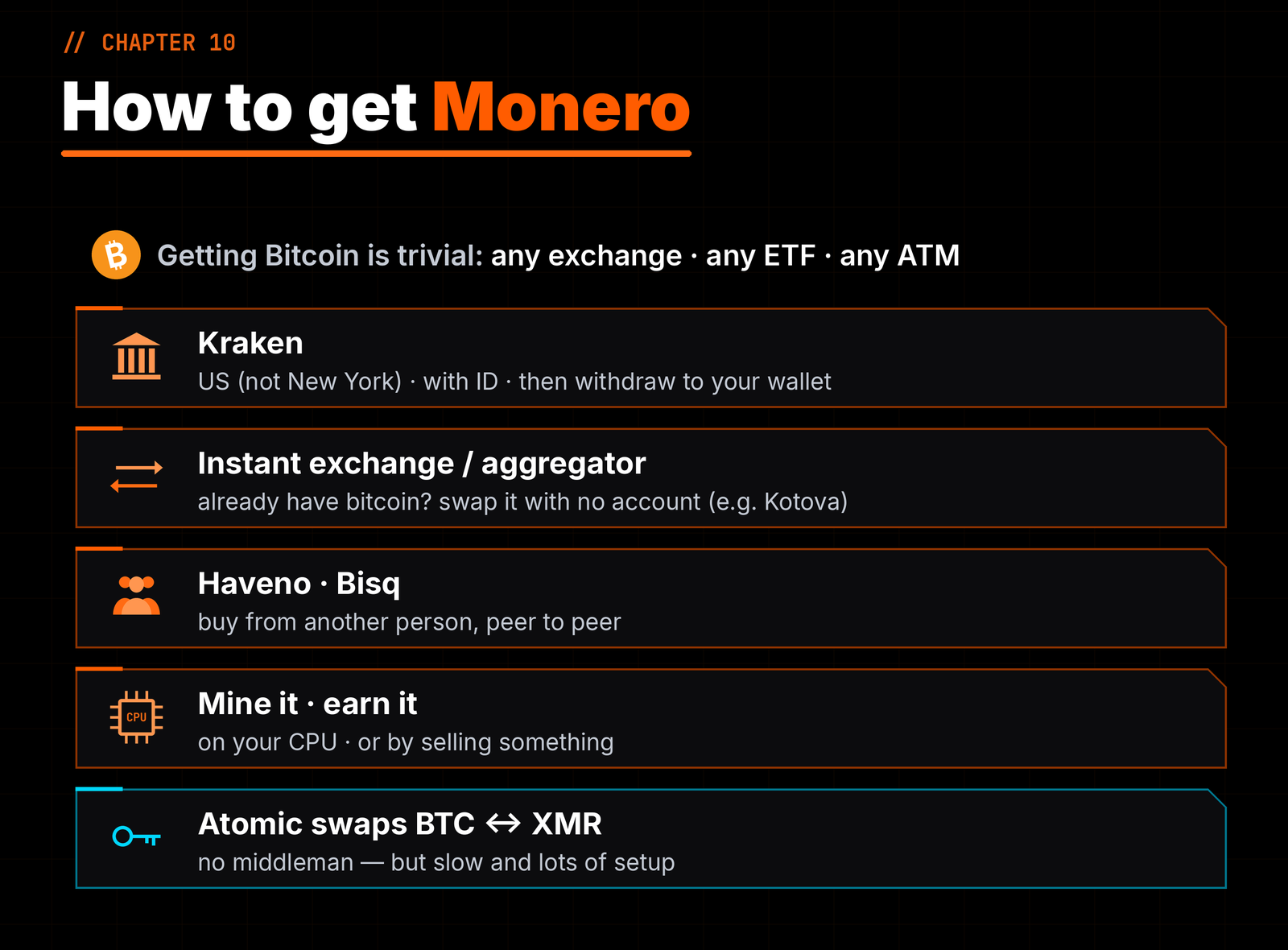
Getting Bitcoin is trivial: any exchange, any ETF, any ATM. “How do I get Monero?” is the number one complaint, so here's the path:
- Kraken: if you're in the US (outside New York), Kraken sells XMR once you verify your ID. Withdraw it to your own wallet afterward.
- Instant exchange or aggregator: if you already have bitcoin, a no-account swap — or a comparison site like Kotova — trades it for Monero.
- Haveno and Bisq: buy from another person, peer to peer.
- Mine it on your CPU, or earn it by selling something.
- Atomic swaps: for the advanced crowd, BTC–XMR atomic swaps exist and work with no middleman at all. They're generally slow and take a lot of setup, so they're much harder than an instant swap.
Regulation is Monero's big problem. Monero is legal practically everywhere, but places like the EU, with their new anti-money-laundering rules, will stop regulated exchanges from selling privacy coins in 2027. Using it stays legal; buying it from a licensed European exchange won't be. That's why the decentralized paths matter more every year.
The fair case against each
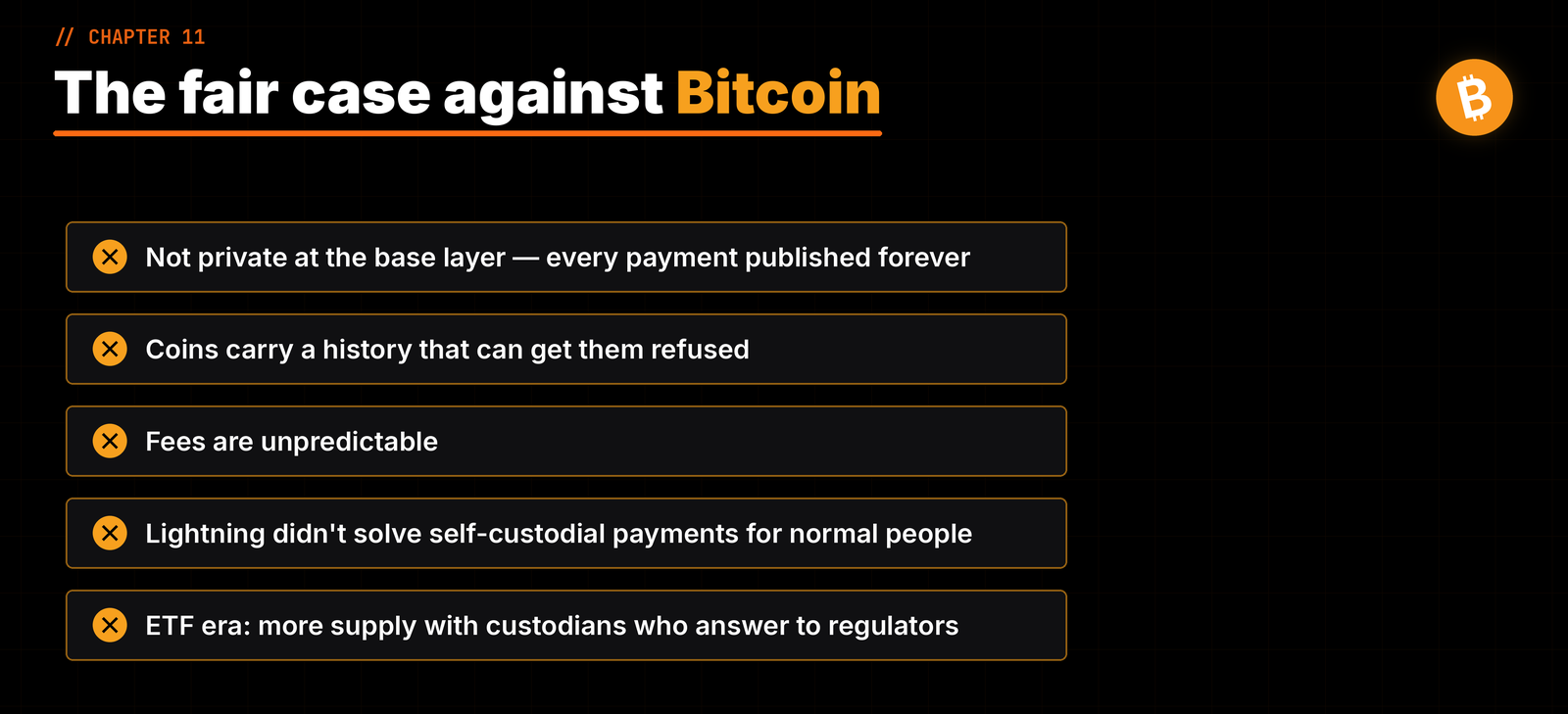
Against Bitcoin: it isn't private at the base layer and never will be, so every payment is published forever. Your coins carry a history that can get them refused through no fault of your own. Fees are unpredictable. Lightning didn't solve self-custodial payments for normal people. And in the ETF era, more of the supply sits with custodians who answer to regulators.
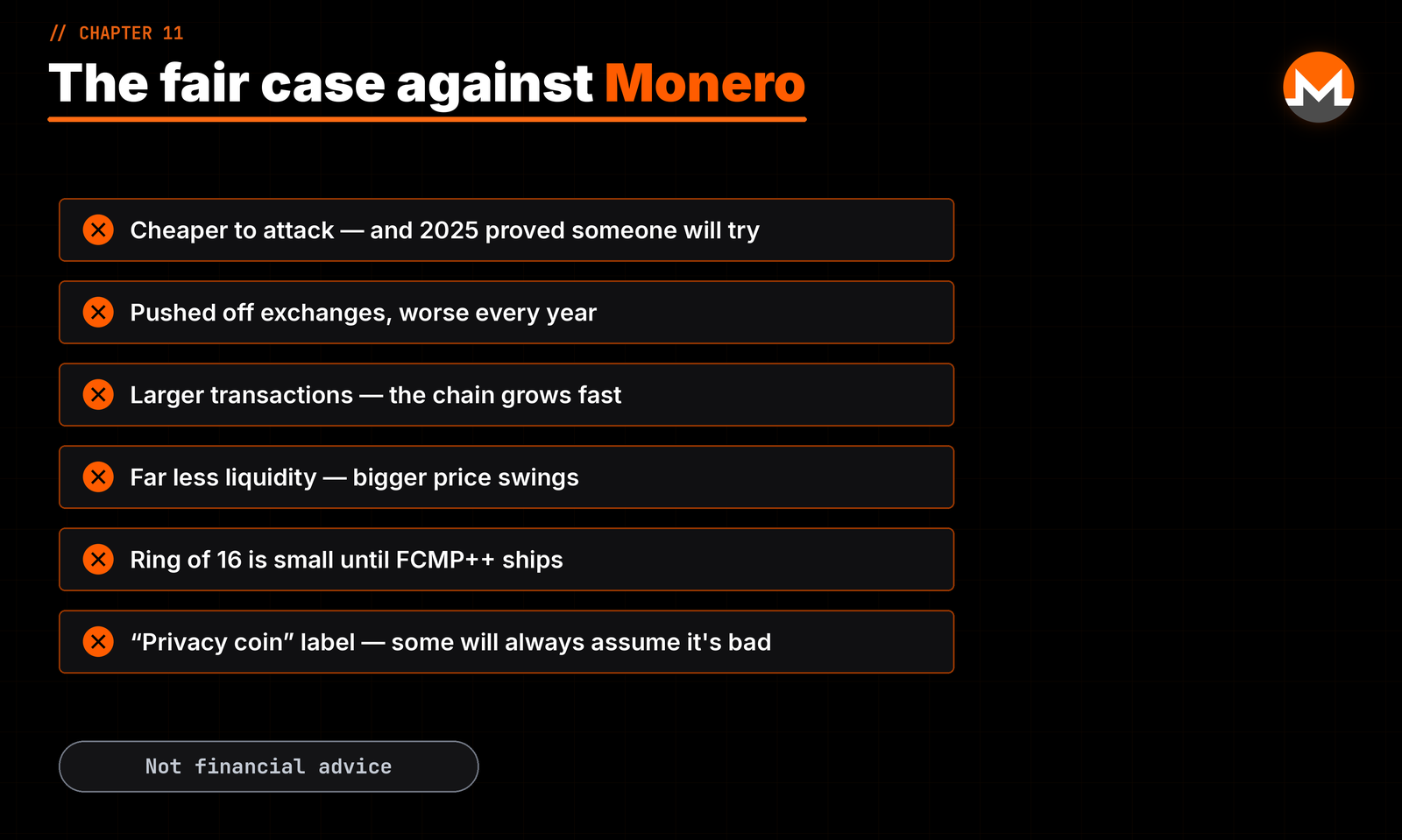
Against Monero: it's cheaper to attack, and 2025 proved somebody will try. It's being pushed off exchanges, and that seems to get worse every year. Transactions are larger, so the chain grows fast. There's far less liquidity, so prices swing harder. The ring of sixteen is small until FCMP++ ships. And the “privacy coin” label means some people will always assume it's for something bad.
It's important to see both coins for what they are if you plan to buy or sell them. This is not financial advice.
The final verdict
Bitcoin has already won the store-of-value narrative. It has the liquidity, the ETFs and the brand. If you want to hold something for ten years that institutions already accept, that's the one.
But money has two jobs — holding and spending — and spending in public is a bad idea. Every balance on a transparent chain is a target. Monero is the only major coin where you can't accidentally leak your financial history, because there's no public mode to accidentally use.
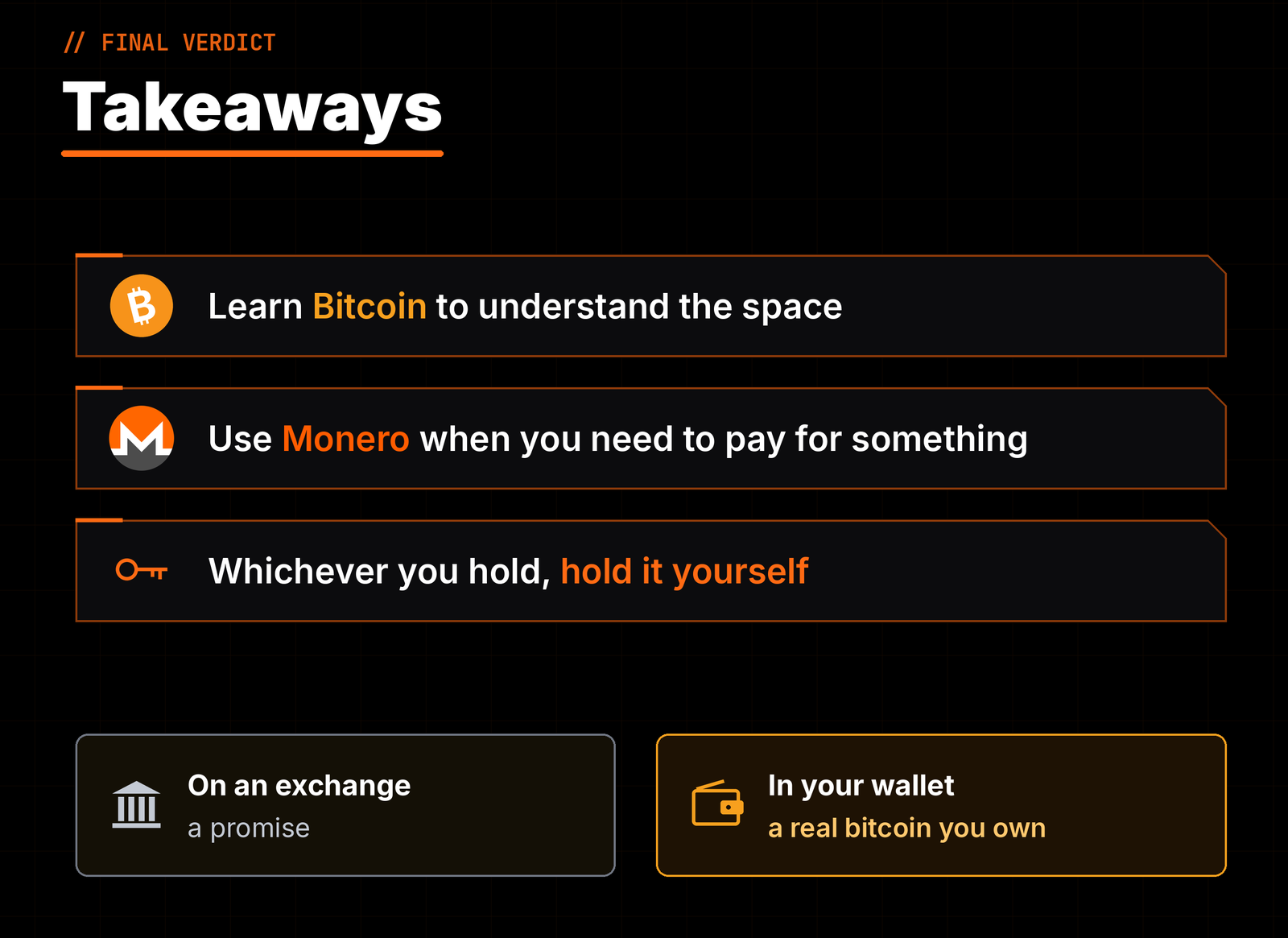
Learn Bitcoin to understand the space. Use Monero when you need to pay for something. And whichever one you hold, hold it yourself: a bitcoin on an exchange is a promise, while a bitcoin in your own wallet is a bitcoin you actually own.
Thanks to Kotova for sponsoring the video. For places to spend Monero, check out Monerica, the Monero economy directory.