Short answer: every company that holds your personal data is a future data breach. Sooner or later it gets hacked, bribed, sold, bankrupted, subpoenaed or simply misconfigured, and the data goes with it. The only information that cannot leak from a company is information you never gave it. So give as little as possible, and for everything you do hand over, assume a stranger will read it one day.
Disclosure: some links to services in this article are affiliate links, marked as sponsored. They cost you nothing, and Monerica may earn a commission if you sign up. The services were picked because they take little or no personal information, not because of the commission.
In this guide: why every database leaks · five real leaks · what thieves do with your data · how to give less · tools that ask for less · where you must give real information · FAQ
Why Every Database Eventually Leaks
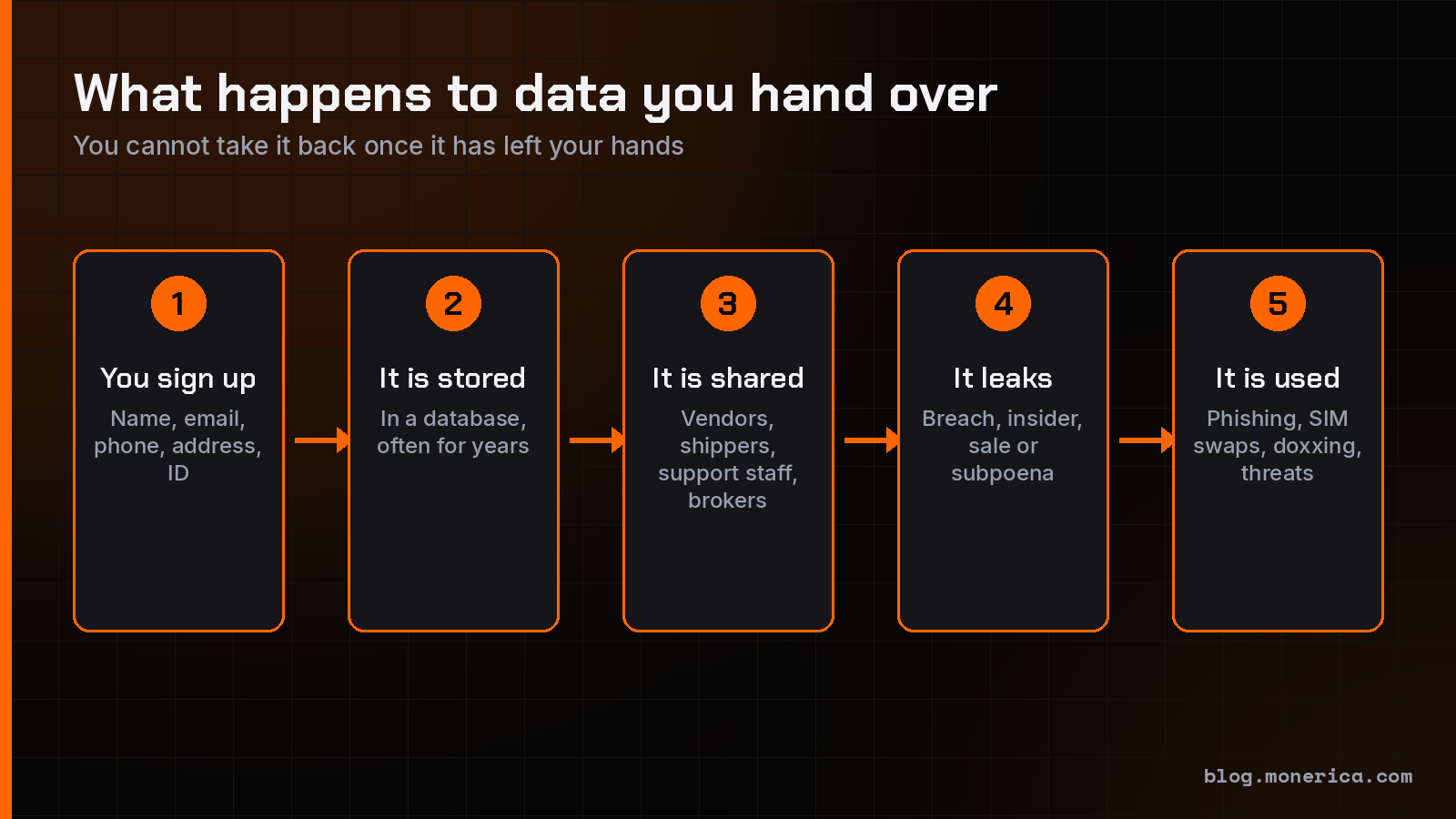
Most people think of a data breach as something that happens to careless companies. The record says otherwise. Large, well-funded companies with security teams leak too. A database does not need to be hacked from outside to leak. There are many ways out:
- Outside attackers. Phishing, stolen credentials, unpatched software and misconfigured cloud storage. The attacker needs to succeed once. The company has to succeed every day for as long as it keeps your data.
- Insiders. Support agents and contractors can see customer records because their job requires it. Criminals know this and pay them for it.
- Vendors and partners. Your data is rarely held by one company. It sits with the payment processor, the shipping partner, the support outsourcer, the email marketing tool and the cloud host. Each one is another place for it to leak from.
- Data brokers. Some companies collect and resell personal records as their whole business. You never signed up with them, but they hold your data anyway.
- Acquisitions and bankruptcies. When a company is sold or fails, its customer database is an asset that gets sold with it, under whatever new owner and whatever new security.
- Legal requests. Data a company holds can be demanded by courts and agencies. A company that never collected it has nothing to hand over.
- Long retention. Companies keep copies of ID scans and customer records for years, often longer than they need to. The longer it is kept, the more chances it has to leak.
You cannot judge from the outside which company will be next, and you cannot audit how any of them stores your data. So the sensible rule is not “trust the careful ones.” It is: assume it will leak, and hand over as little as you can.
Five Real Leaks, and What Was in Them
These are documented cases, each with a source you can read. They were picked because they show different ways data gets out.
1. Ledger (2020): customer names and home addresses
Ledger makes hardware wallets for crypto. In December 2020 a copy of its customer e-commerce database was posted publicly. Ledger’s CEO said the data appeared to come from a breach in July 2020. About 1 million email addresses had been stolen, and the dump contained roughly 272,000 customer records with postal address, first and last name and phone number. Ledger said its wallets and customer funds were not affected. It also confirmed that customers were then being targeted with email and SMS phishing campaigns. The lesson is simple: people who bought a privacy product gave their home address to a shop, and it ended up in public. Source: Ledger’s message from its CEO.
2. Coinbase (2024 to 2025): bribed support staff
Coinbase disclosed in May 2025 that criminals had bribed overseas customer support staff to hand over customer data. The company told regulators that 69,461 users would be notified. According to the filing, the breach took place on December 26, 2024 and was not discovered until May 11, 2025. The data included names, addresses, phone numbers, email addresses, the last four digits of Social Security numbers, masked bank account numbers, images tied to government IDs such as passports and driving licenses, and account balances and transaction histories. Passwords, seed phrases and private keys were not part of it. The attackers tried to extort Coinbase for $20 million, and Coinbase said it expected remediation costs of $180 million to $400 million. No firewall stops an employee who is paid to look the other way. Source: The Register.
3. National Public Data (2024): data on people who never signed up
National Public Data was a Florida background-check company that collected records on consumers. Its data was offered for sale in April 2024 and published in July 2024, and the company acknowledged a breach in August. The company said the information involved included names, email addresses, phone numbers, Social Security numbers and mailing addresses. Researchers at Atlas Data Privacy Corp. counted 272 million unique Social Security numbers in the record set, although the headline figure of 2.9 billion refers to rows of data, not people. Many of those affected had no relationship with the company at all. Its parent company then filed for bankruptcy in October 2024, so there was no company left to pay for the damage. Sources: Krebs on Security and The Record.
4. AT&T (2024): who you called and texted
In July 2024 AT&T told the SEC that a criminal had copied call and text records from its workspace on a third-party cloud platform. The records covered nearly all of its wireless customers for May 1 to October 31, 2022, plus January 2, 2023. They listed the phone numbers each customer had interacted with, the counts of calls and texts, and total call durations. AT&T said the data did not contain the content of calls or texts, names, Social Security numbers or dates of birth. But as Malwarebytes points out, it is easy to look up the name that belongs to a phone number. AT&T had already disclosed another incident that March affecting 73 million people. Source: Malwarebytes.
5. Discord (2025): ID photos from an age check
In October 2025 Discord said around 70,000 users had government ID photos exposed in a breach at a third-party customer service provider. The photos came from users who had submitted ID to prove their age. The Register noted that it was unclear why the outsourced supplier was still holding those images. The attackers claimed to have taken much more, but Discord has not confirmed the larger figures. An ID photo is one of the worst things to leak, because you cannot change your face or your passport number the way you can change a password. Source: The Register.
Look at what these have in common. None of the victims did anything careless. They bought a product, used a service or called a friend. The data was taken from someone else’s system, often a vendor or contractor they had never heard of.
What Leaked Data Is Used For
- Phishing that knows who you are. A message that has your real name, your address and the company you really use is far more convincing than a generic one. After the Ledger leak, customers were hit with phishing built to steal their seed phrases.
- SIM swaps. A phone number plus a name and a few personal details is often enough to talk a carrier into moving your number to a criminal’s SIM, which can then receive your login codes.
- Identity theft. Name, address, date of birth and a Social Security number are the raw material for opening accounts in your name. Unlike a password, they cannot be changed.
- Doxxing and harassment. Public leak sites make a home address and phone number searchable.
- Physical attacks. For people known to hold crypto, a leaked address can mean a visit. Security firm CertiK counted 72 verified physical attacks on crypto holders worldwide in 2025, up about 75% from 2024, with $40.9 million in confirmed losses (the real figure is probably higher), and France had the most with 19. These “wrench attacks” do not need a leak to happen, but a name tied to an address makes finding a target easy. Source: Cointelegraph, reporting on CertiK’s report.
- Resale. Leaks are combined with older leaks. Your email from one breach is joined to your address from another, and the profile grows every year.
Notice that the damage keeps coming for years. A leak in 2020 is still useful to a scammer in 2026. That is why “I have nothing to hide” is the wrong test. The question is not whether you are doing anything wrong. It is whether you want a criminal to have your address, phone number and ID.
How to Give Less: A Practical Playbook
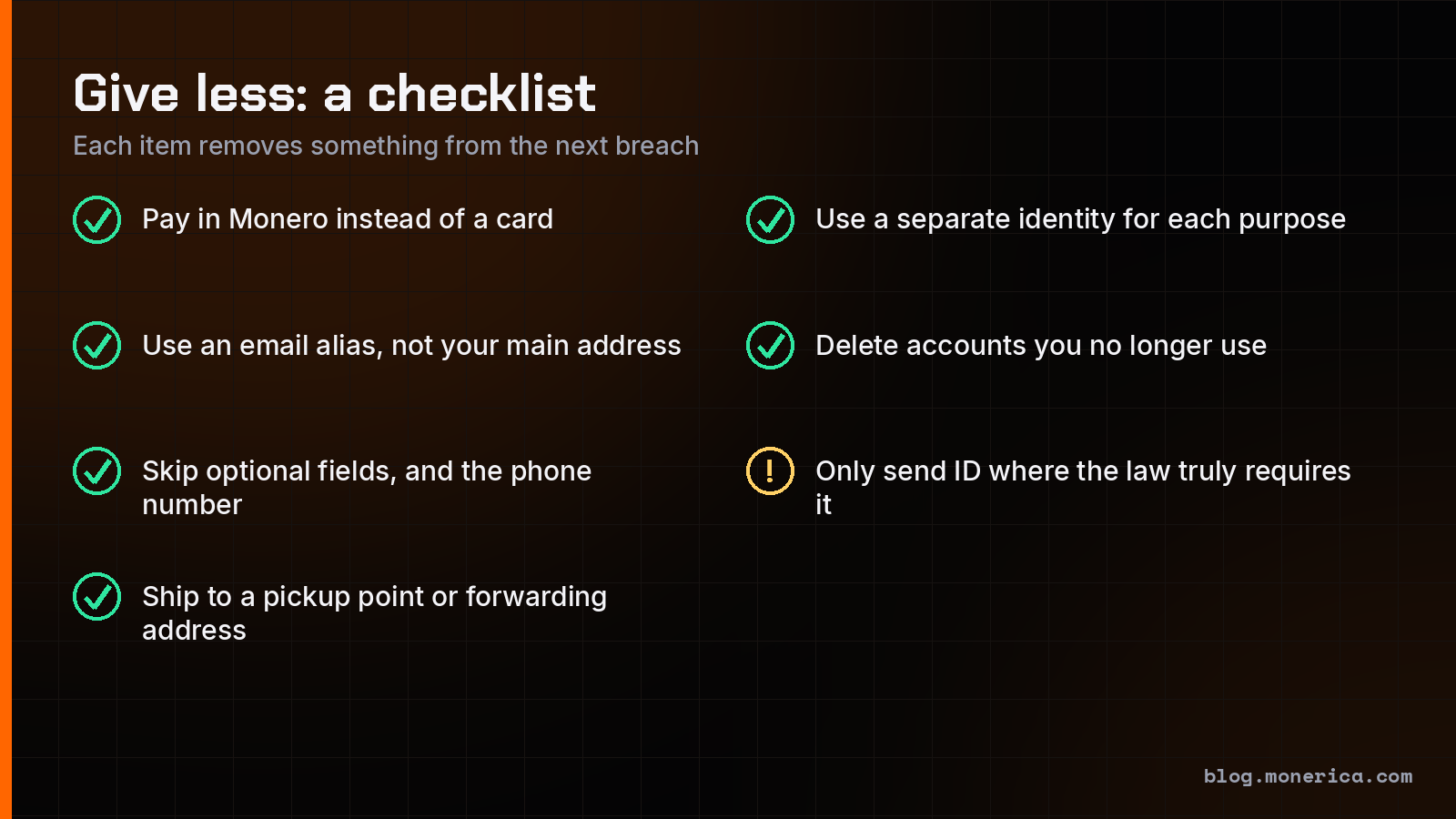
The goal is not to disappear. It is to make sure that when the next breach happens, there is little in it that points to you. Everything below is lawful.
Pay in Monero instead of a card
A card payment ties your legal name and billing address to every purchase, and it passes through several companies. Monero does not carry your name. A business that accepts it often never needs to learn who you are. See how to use Monero and how to buy it.
Use an alias for email
Your main email address is the key that connects your accounts across breaches. Use a separate address or forwarding alias for each business, so a leak at one tells nobody anything about the others, and so you can switch off an alias that starts getting spam. See our guide to no-KYC email providers.
Do not give your real phone number
A phone number is used to link accounts, to find your name, and to attack you through SIM swaps. Where a service wants a number only for verification, a virtual number works (see no-KYC SMS verification). For a real mobile line, a Monero-friendly eSIM can be bought without an account in your legal name. Be aware that rules differ by country, and some carriers must register SIMs by law.
Do not give out your home address
Ask whether a business needs your home address at all. For digital goods it never does. For physical goods, a pickup point, a PO box, a parcel locker or a mail forwarding service keeps your home address out of shop and courier databases. A shipping label is a record too, so use the same address you are comfortable seeing in a leak.
Skip optional fields and look at what checkout asks for
Many forms mark fields as optional, and many businesses ask for more than they need. Fill only the required ones. Some businesses that take Monero let you check out with any name and an optional email. Our review of Ward’s Ace & Country Store is an example of a real-world shop with a checkout that does not ask for much.
Prefer services that do not collect ID
Every ID scan stored is a future leak, as the Discord case shows. Where it is lawful in your country, choose services that do not require identity verification, and read what no-KYC means. For swapping coins, see how to buy Monero without KYC. Send an ID only when a law or a regulator truly requires it, and then only to a company you have reason to trust, ideally one that says how long it keeps the copy.
Keep separate identities for separate purposes
Do not use one email, one phone number and one username for everything. A shopping identity, a social identity and a financial identity mean that a leak from one does not unlock the other two.
Use a VPN, and do not expect it to do everything
A VPN hides your IP address from the sites you visit and from your local network. It does nothing about data you type into a form. It is one layer, not a replacement for giving less. Compare options in our no-KYC VPN guide and should you use a VPN?
Delete what you no longer use
Old accounts keep your data alive. Close accounts you no longer need and ask the company to delete your data. You may have a legal right to this where you live. It does not remove what has already leaked, but it stops the pile from growing.
Be quiet about what you hold
If you own crypto, the safest information is the fact that you own it. Do not tell strangers, do not post balances and do not ship hardware to your home address under your real name if you can avoid it.
If you were in a breach
Change the passwords for the affected account and anywhere you reused it, and turn on app-based two-factor authentication rather than SMS. Be suspicious of anything that arrives mentioning that company, because scammers use breach data within days. Never type a seed phrase into a website or reply to a message asking for one. A name and address cannot be reissued, so expect to stay careful for years.
Tools That Ask for Less
Monerica is a directory of businesses that accept Monero, with reader reviews. Here is where to find the tools above. All listed businesses should be checked on their Monerica profile first, and none of these is a guarantee.
| What you need | Where to look | Examples on Monerica |
|---|---|---|
| Email alias or private email | Email providers and forwarders | SimpleLogin, addy.io |
| Mobile data without an account in your name | eSIMs and SIM cards | Silent Link, Cloaked Wireless |
| A number for verification codes | SMS verification and virtual numbers | See the category for current listings |
| Hide your IP address | VPNs | Mullvad, IVPN, Xeovo |
| Shipping and postage | Postage and shipping services | Bitcoin Postage |
| Swap into Monero without an account | Instant swaps | Compare prices on MoneroPriceNow |
Phone numbers deserve special care. Silent Link sells eSIMs and numbers you can pay for in Monero, and Cloaked Wireless gives Monerica readers 50% off the first month with the code Monerica. Read the Silent Link phone number guide before you buy, and check each provider’s terms for what it collects in your country.
Get a Silent Link eSIM or number →
Browse eSIMs and SIM cards on Monerica →
Where You Must Give Real Information
Giving less does not mean lying. Some situations legally require real information: banks, tax authorities, regulated exchanges, employers, government services, many airlines and carriers in countries with SIM registration. In those cases give accurate information, and treat it as something that may leak one day, with the same care as above. Do not use false identity documents or give false information where the law demands the truth. That is fraud, and it also tends to get accounts closed and people in trouble. The aim is to avoid giving information that nobody needs, not to evade rules that apply to you. Laws differ by country, so check yours.
For the wider case for privacy, see why internet privacy matters.
FAQ
Will my data really be leaked?
Not every company’s data leaks, but you cannot tell which will. The safe approach is to assume any database holding your data will eventually be breached, and decide what you give accordingly.
I have nothing to hide. Why does this matter?
Leaked data is used for scams, identity theft and, in the worst cases, physical threats. None of that depends on whether you did anything wrong.
Can I get my data deleted after a breach?
You can ask a company to delete your records, and in some places you have a legal right to. It will not pull back a copy that is already in criminals’ hands.
Is using an email alias legal?
Yes. Aliases are common and legitimate. Using one only becomes a problem if a service legally requires your real identity and you give false details.
Is it legal to pay with Monero?
In most countries, yes. See Is Monero legal? and check your local law.
Does a VPN protect my personal data from leaks?
No. A VPN hides your IP address. It does not stop a company from leaking the name, address or phone number you gave it.
What is the single most useful thing to do?
Do not hand over the information in the first place. Skip optional fields, use an alias for email and keep your home address and ID scans out of company databases.
What is a wrench attack?
A physical attack, such as a robbery or kidnapping, aimed at someone to force them to hand over their crypto. See the CertiK numbers above.
Sources
- Ledger: a message from Ledger’s CEO about the data leak (December 2020)
- The Register: Coinbase confirms insiders handed over data of 70K users
- Krebs on Security: NationalPublicData.com hack exposes a nation’s data
- The Record: National Public Data bankruptcy
- Malwarebytes: “Nearly all” AT&T customers had phone records stolen
- The Register: Discord says 70,000 photo IDs compromised
- Cointelegraph: Wrench attacks increased by 75% in 2025, per CertiK
This article was written on November 27, 2026. Figures come from the sources above.