▶ Watch the full video on YouTube
Just about every YouTuber has a VPN sponsor, and every VPN ad says the same thing: hackers on public Wi-Fi, "military-grade encryption," become anonymous in one click. Most of that is marketing. But that doesn't mean the answer is no.
This article breaks down what a VPN actually does, what it doesn't do, and why it matters specifically if you use Monero. By the end you can decide whether a VPN belongs in your setup — and if it does, how to pick one that doesn't undo the privacy you were paying for.
Disclosure: the video this article is based on is sponsored by Xeovo, a VPN that accepts Monero and doesn't require any personal data. The sponsor section is clearly marked below.
What does a VPN actually do?
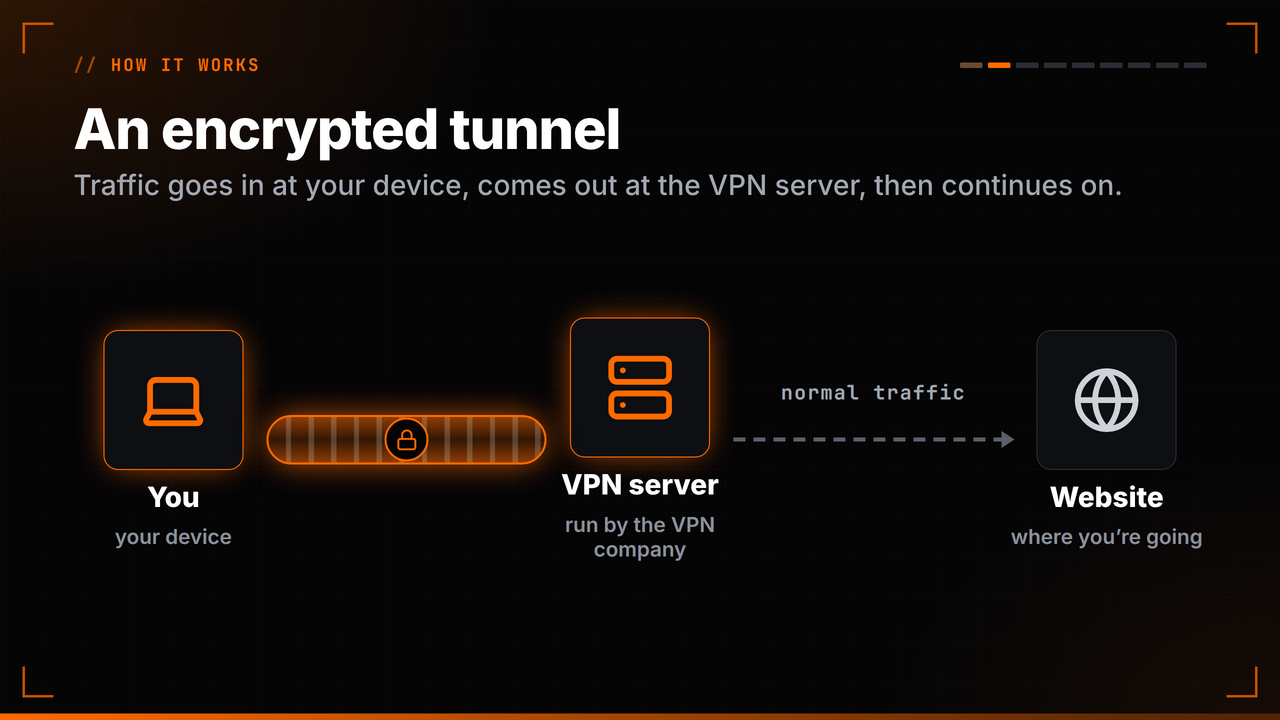
Without the marketing: a VPN is an encrypted tunnel between your device and a server run by the VPN company. Your traffic goes into that tunnel, comes out at the VPN server, and continues on to the site you're trying to reach. That's the whole product.
That one change does three things:
- Your internet provider goes blind. Without a VPN, your ISP sees every domain you connect to — not the contents (most sites use HTTPS), but which sites, when, and how often. In the United States, ISPs are allowed to sell that data. In many other countries they're required to keep it for years. With a VPN, all your ISP sees is encrypted traffic going to one IP address.
- Websites see the VPN's IP instead of yours. Your home IP is tied to your name and address. The VPN's IP is shared with everyone else on that server. You're one face in a crowd.
- It gets you around blocking — geo-restrictions, a school or work network, or an actual government firewall.
Here's the honest way to think about it: a VPN doesn't remove trust, it moves it. Right now your ISP sees everything. With a VPN, the VPN company sees it instead. The real question is whether you'd rather trust a company that knows your name and answers to your local government, or one you picked on purpose because of how it handles privacy.
What a VPN doesn't do
Now the part the ads leave out.
- It doesn't make you anonymous. Connect to a VPN and then log into Google, Amazon, or your bank, and they know exactly who you are — you told them. Cookies and browser fingerprinting still work too. A VPN changes your IP, not your browser, accounts, or habits.
- It doesn't stop malware or phishing. It's a network tool, not antivirus.
- "Military-grade encryption" is a marketing phrase. HTTPS already encrypts the contents of almost everything you do. What a VPN hides is the metadata: which sites, from which IP, at what time.
- "No logs" is a promise, not a proof. Some VPNs have been caught logging after swearing they didn't. Others have had servers seized by police with nothing on them. The difference is a track record and transparency reports.
- Free VPNs are worse than no VPN. If you're not paying, your browsing data is the product.
And the one that matters most for Monero users: a VPN does nothing for your privacy if you paid with a credit card in your name and signed up with your main email. The VPN company now has your identity on file — which is exactly why you want one that takes Monero.
Why Monero users should care
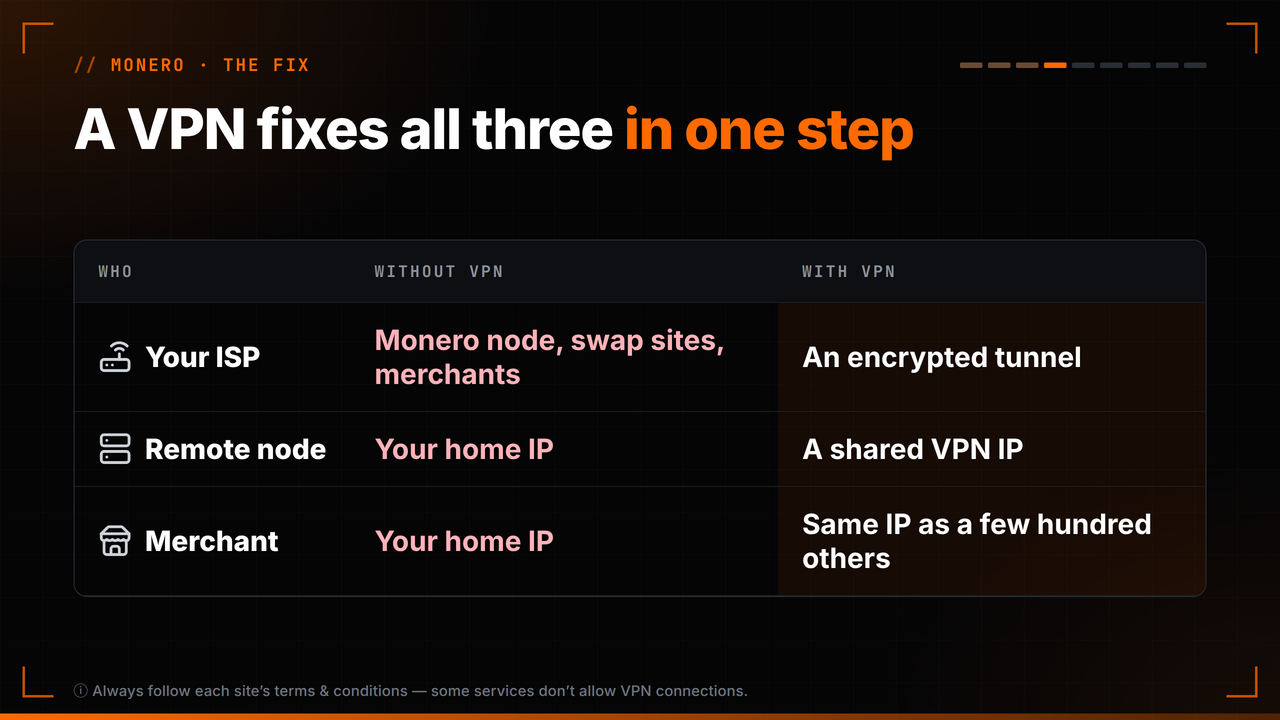
Monero already hides the sender, the receiver, and the amount. The blockchain is covered (see Monero vs. Bitcoin privacy). But the network layer isn't on chain, and that's where three leaks remain.
1. The remote node
Most people don't run their own node — they use a remote node. When your wallet connects to one, that node sees your IP address, which transactions you broadcast, and which outputs you're scanning for. A node operator who logs that can tie a real IP to Monero activity: not the amounts or the recipient, but the fact that this IP sent a transaction at this time. Malicious public nodes exist; this is a known attack.
Dandelion++ helps hide which node a transaction originated from as it spreads through the network. It does not hide your IP from the remote node your wallet is talking to.
2. Your ISP
Even if the node is honest, your ISP can see you connecting to a known Monero node on port 18081. They can see you visiting Monerica, swap sites, or a Monero merchant. They don't know what you did — they know you're a Monero user, and that goes in a database kept for years.
3. Merchants and services
Instant swaps, peer-to-peer trades, every vendor in the Monerica directory — each one could log your IP. If you paid in Monero to stay private and then handed them your home IP, you've done half the job.
A VPN fixes all three in one step:
Running your own node is still the real privacy upgrade. But even then, a VPN hides the fact that you're running a node from your ISP. The two aren't competing — they stack.
Sponsored: Xeovo
This section is sponsored. The link below is a plain link, not an affiliate link.
Xeovo (pronounced "Zeovo") is a great fit for exactly what we just talked about.
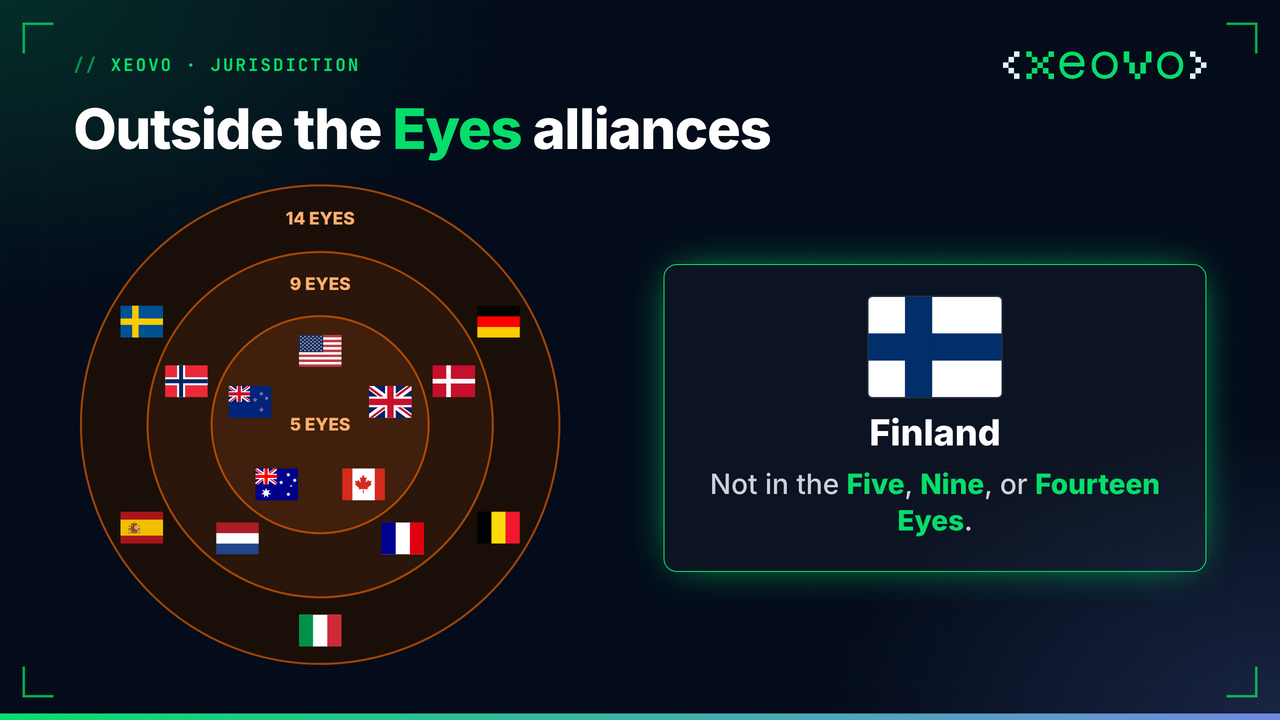
Jurisdiction: Xeovo is headquartered in Finland. Where a company lives decides which government can knock on its door, and Finland is outside the Five, Nine, and Fourteen Eyes surveillance alliances, with strong privacy law. A no-logs company based there has very little a court order can reach. Xeovo is also bootstrapped and independent — no venture capital, no outside shareholders, nobody upstream pressuring them to log.
No email, pay in Monero: Xeovo doesn't require an email address to sign up — no email, no name, no phone number. You can pay with Monero (they also take Bitcoin, Litecoin, and cash by mail). Send XMR from your own wallet and nothing on the account points back to you.
The details: a strict no-logs policy with yearly transparency reports; open-source WireGuard and OpenVPN; stealth proxies that make VPN traffic look like ordinary HTTPS where VPNs are blocked; 25+ locations across Europe, North America, and Asia; five devices, unlimited bandwidth, and human support. They also run their own Tor onion address, so you can sign up and pay over Tor without touching their clearnet site.
Pricing: about €2.99/month on a yearly plan (under $3.50) or €4.99 for a single month (under $6), with a 30-day money-back guarantee. Check xeovo.com for current pricing.
Real-world use cases
So where does a VPN actually earn its keep?
Traveling
Hotel and airport Wi-Fi is a network you don't control, and it can log everything you connect to. A VPN turns that into one encrypted tunnel they can't read.
Showing up from the right region
Land in another country and half your sites are blocked or behave differently — pick a server back home and you're there. It works the other way too: if a Monero service only serves certain regions, a VPN lets you show up from the right one.
You don't even have to leave the country. In the United States, laws differ state by state. Some states require ID uploads for whole categories of sites; sports betting, certain apps, and certain content all depend on which state your IP says you're in. A VPN lets you pick the state, so you decide which rules you browse under without handing your driver's license to a random website.
Paying less
This is the one most people don't think about. Many websites show a different price depending on where they think you are — hotels, car rentals, airline tickets, software and streaming subscriptions. If you're browsing from the United States, you're usually in the most expensive bucket.
So shop from somewhere else. Check a price from your home connection, then connect to Istanbul, Tirana, or Bucharest and load the same page in a private window. Then try London or Stockholm. Independent testers found most hotel prices come back the same, but some hotels on some booking sites drop by a real amount depending on the country you search from, and Northeastern University researchers caught booking sites sorting people into pricing tiers based on their cookies. Airline fares are set by point of sale, so another country's version of the same airline site can show a different number. Subscriptions are the easy win: plenty of streaming and software services charge a fraction of the US price in countries like Turkey.
Be straight with yourself: it doesn't work every time, and some services check your payment method. But it costs nothing to look — five minutes, three or four locations, one private window. Save the cost of a yearly VPN plan on a single booking, and everything else it does is free.
Censorship
Some countries block VPN protocols entirely. That's what stealth proxies are for.
Your ISP's data business
The boring one, and the biggest one: every site you visit, every day, logged under your name. A VPN ends that for a few dollars a month.
Why not just use Tor or I2P?
Those are real options that do different jobs — a full "VPN vs. Tor for Monero" comparison is coming in a future video. The short version: a VPN is the fast, everyday layer. Tor is slower and for the things that actually need it. They stack; they don't compete.
Always follow each site's terms and conditions — some services don't allow VPN connections.
How to pick a VPN
Here's the checklist:
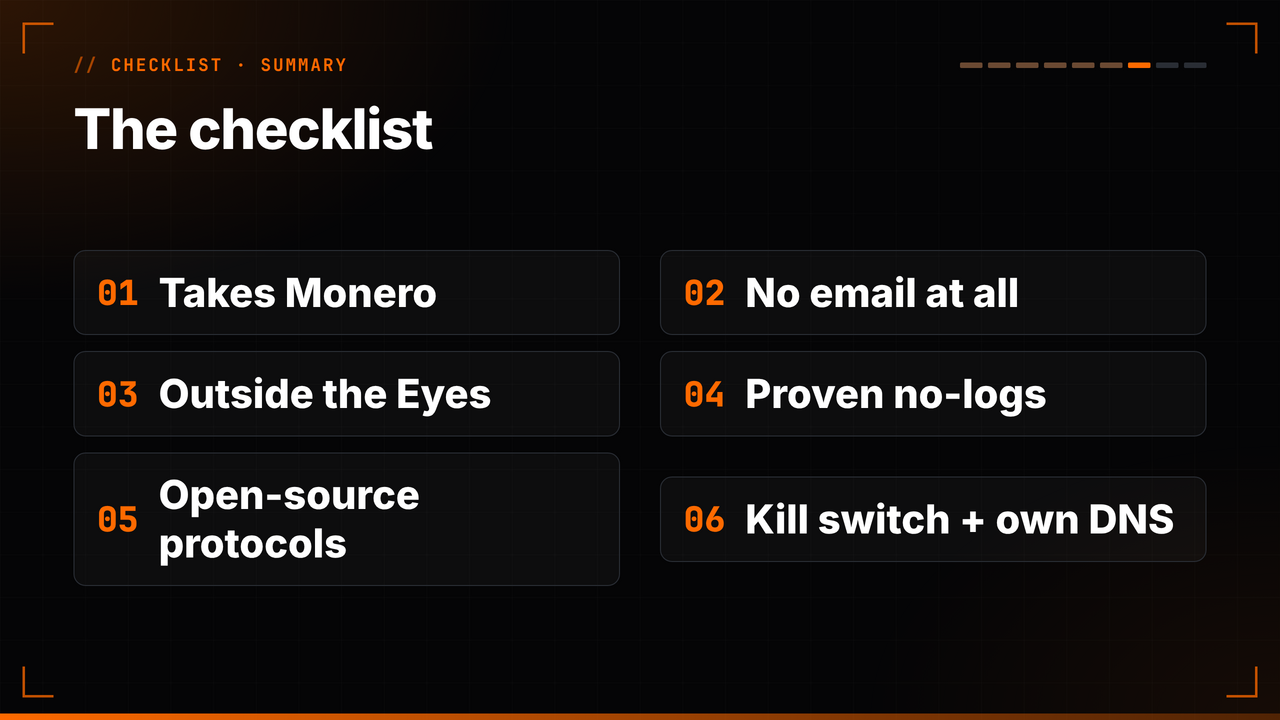
- Does it take Monero? Cash in the mail works too, but Monero is the best way to pay for a VPN, period. If the only option is a card, your name is on the account before you've connected once. That alone disqualifies most of the big names you see advertised.
- Can you sign up with no email at all? Not a throwaway — none. An account with no email and a Monero payment has nothing on file to hand over. (If a service does need one, see our guide to no-KYC email providers.)
- Jurisdiction. Where is the company legally based? A US-based VPN answers to US courts and the Five Eyes; the UK, Germany, and France are inside the Fourteen Eyes. Outside all of that — Switzerland, Finland, Iceland — is the baseline. Check where the company is registered, not where the marketing says the servers are.
- No logs, with something to back it up. Yearly transparency reports, an independent audit, or a server seizure where nothing turned up. Any of those beats a badge on the homepage.
- Open-source protocols. WireGuard or OpenVPN. A proprietary protocol they won't show you the code for is a skip.
- A kill switch and their own DNS. If the VPN drops, your real IP shouldn't leak. If your DNS goes to Google, you've handed your browsing history right back.
Red flags: lifetime deals; free tiers with no visible business model; "military-grade" anything; thousands of five-star reviews on affiliate sites that all recommend the same three brands; and holding companies that run a dozen VPN brands at once. If you can't tell who owns it, you can't tell who's reading the logs.
One more thing: send the Monero from your own wallet, not from an exchange. The whole point is that the payment doesn't connect to you. For options, see our ranking of the best no-KYC Monero VPNs or browse the VPNs category on Monerica.
When a VPN is the wrong tool
- Your threat model is a nation-state. A VPN is one subpoena away from your IP. That's a job for Tor — and for not doing the sensitive thing from your home connection in the first place.
- You're logged into your real accounts all day. A VPN still blinds your ISP, but it's hiding your IP from companies that already know your name.
- You need maximum speed. A VPN slows you down a bit, depending on where you connect.
- The only VPN you'll use is a free one. Don't bother. No VPN beats a VPN that sells your data.
- You run a node at home that accepts incoming connections. A VPN can get in the way unless it supports port forwarding. Check before you commit.
None of those are reasons the average Monero user shouldn't have one. They're just the limits.
The verdict: should you use a VPN?
For most Monero users, yes.
Not because it makes you anonymous — it doesn't. But for a few dollars a month, paid in Monero, it takes your ISP out of the picture, keeps your home IP off the logs of every node, swap, and merchant you use, lets you choose which country or state you're browsing from, and gives you a shot at paying less for things you were going to buy anyway. Those are real problems, and a VPN is the cheapest fix for them.
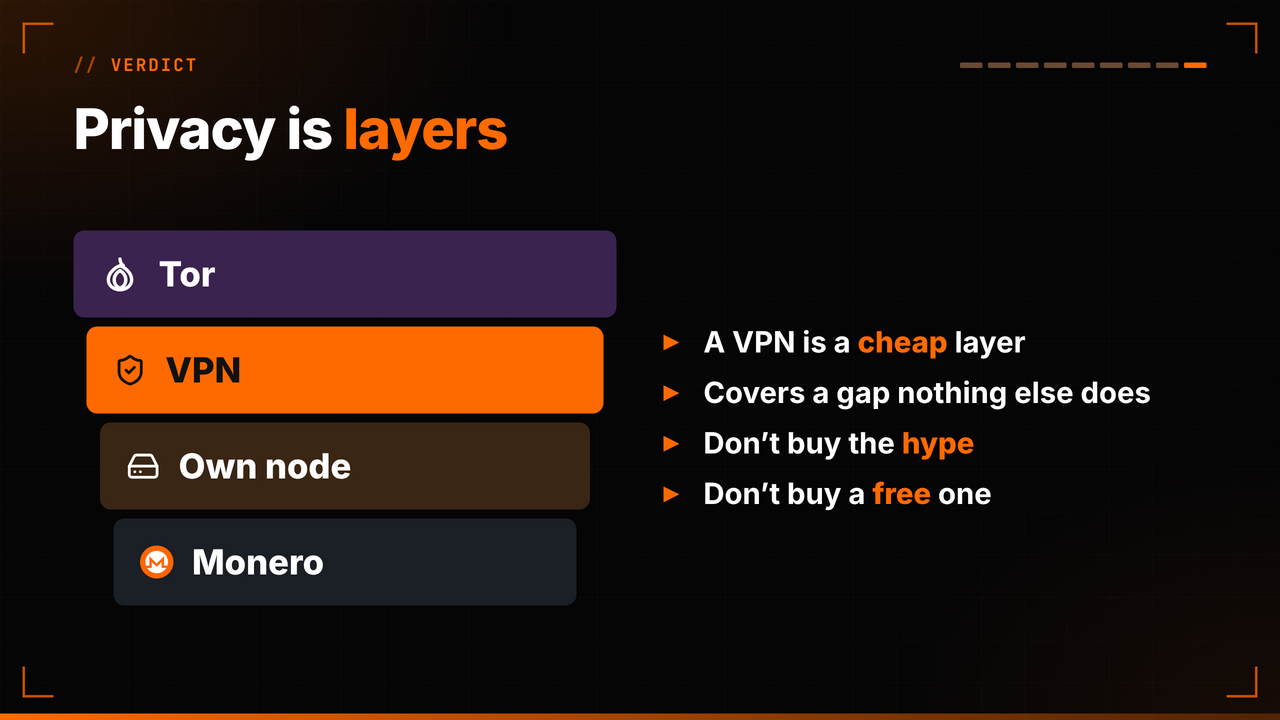
What it isn't is a replacement for the rest of your setup. Run your own node. Use Tor for the things that actually need it. And pay for the VPN in Monero, from your own wallet, with no email attached — that's the single biggest difference between a VPN that protects you and one that just has your name on a different list.
Privacy isn't one tool, it's layers, and a VPN is a cheap layer that covers a gap nothing else does. Just don't buy the hype, and don't buy a free one.
Once your VPN is on, put it to use: Monerica is a directory of businesses and services that actually take Monero. Find somewhere to spend — and the merchant never sees your home IP.
▶ Watch "Should You Use a VPN?" on YouTube