Yes, Monero can reach $1,000, but nothing guarantees it will. With about 18.83 million XMR in circulation (November 2026), $1,000 per coin means a market cap of roughly $18.8 billion. That's about 64% above the early-November price of around $610, and about 25% above Monero's all-time high of roughly $798 from January 2026. For context, Zcash, another privacy coin, already had a market cap of about $23 billion in early November 2026. So $1,000 XMR is within the range of what crypto markets have done before. Whether it happens depends on demand, liquidity, and regulation that no one can predict.
This is scenario math, not a forecast, and it isn't financial advice. Check the live price at moneropricenow.com.
The Numbers You Need
Price targets only make sense once you know two numbers: how many coins exist and what they're worth today.
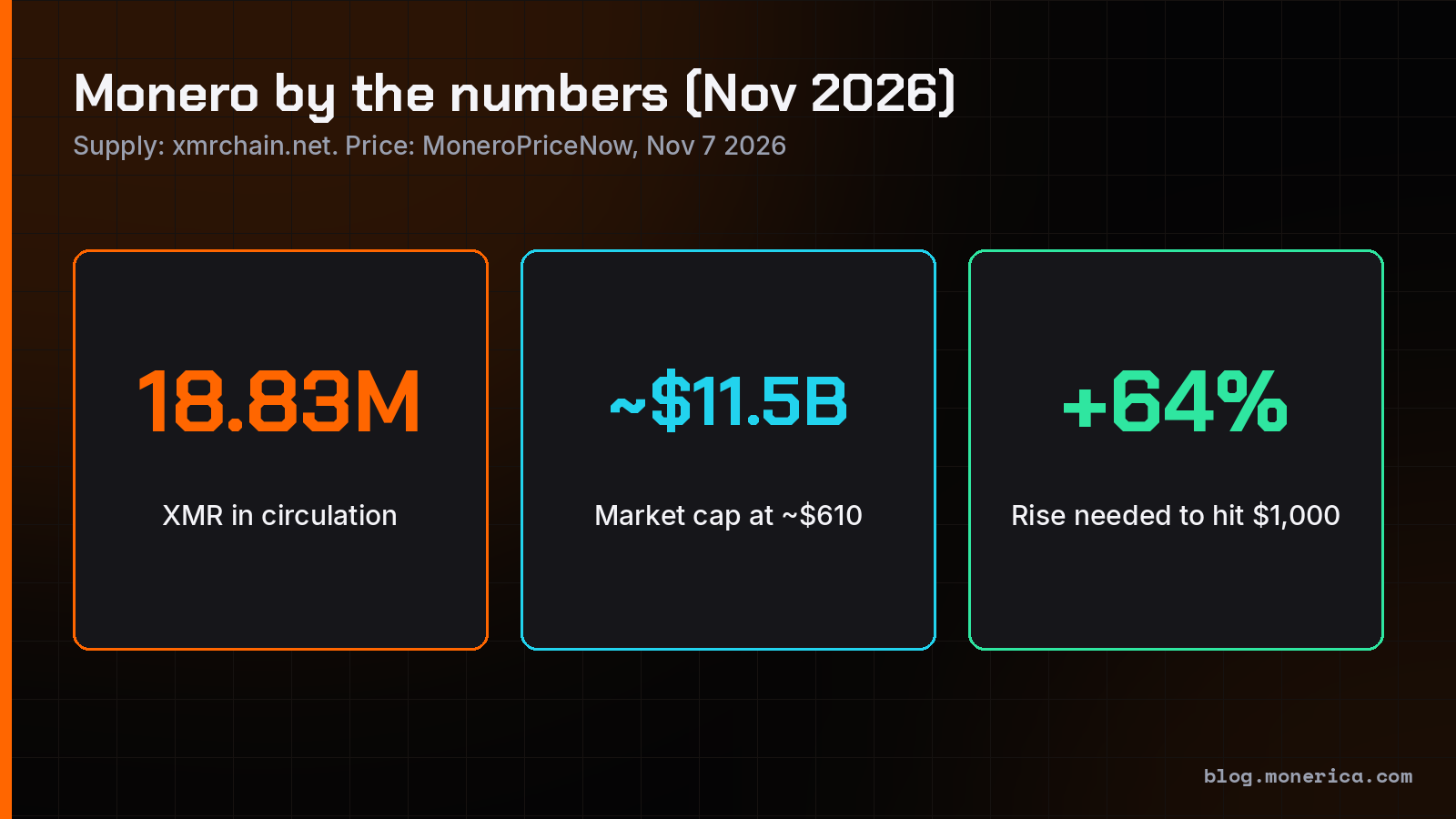
- Circulating supply: about 18,827,700 XMR. The xmrchain.net block explorer's emission API reported 18,827,685 XMR at block 3,800,850 on November 7, 2026. CoinGecko showed 18,827,642 XMR the same day. The tiny gap is just timing.
- Price: about $610 per XMR on November 7, 2026 (MoneroPriceNow API: $610.20).
- Market cap: 18.83 million × $610 ≈ $11.5 billion. CoinGecko ranked Monero 12th among all crypto assets that day.
Want more on supply? See How Many Monero Exist? For the current price in BTC and what it means, see our companion piece, How Much Is 1 Monero Worth?
Monero's Supply Grows Slowly, Forever
Unlike bitcoin, Monero has no hard cap. Its main emission ended in June 2022, and since then every block pays a fixed "tail emission" of 0.6 XMR. Blocks come about every two minutes, around 720 a day.
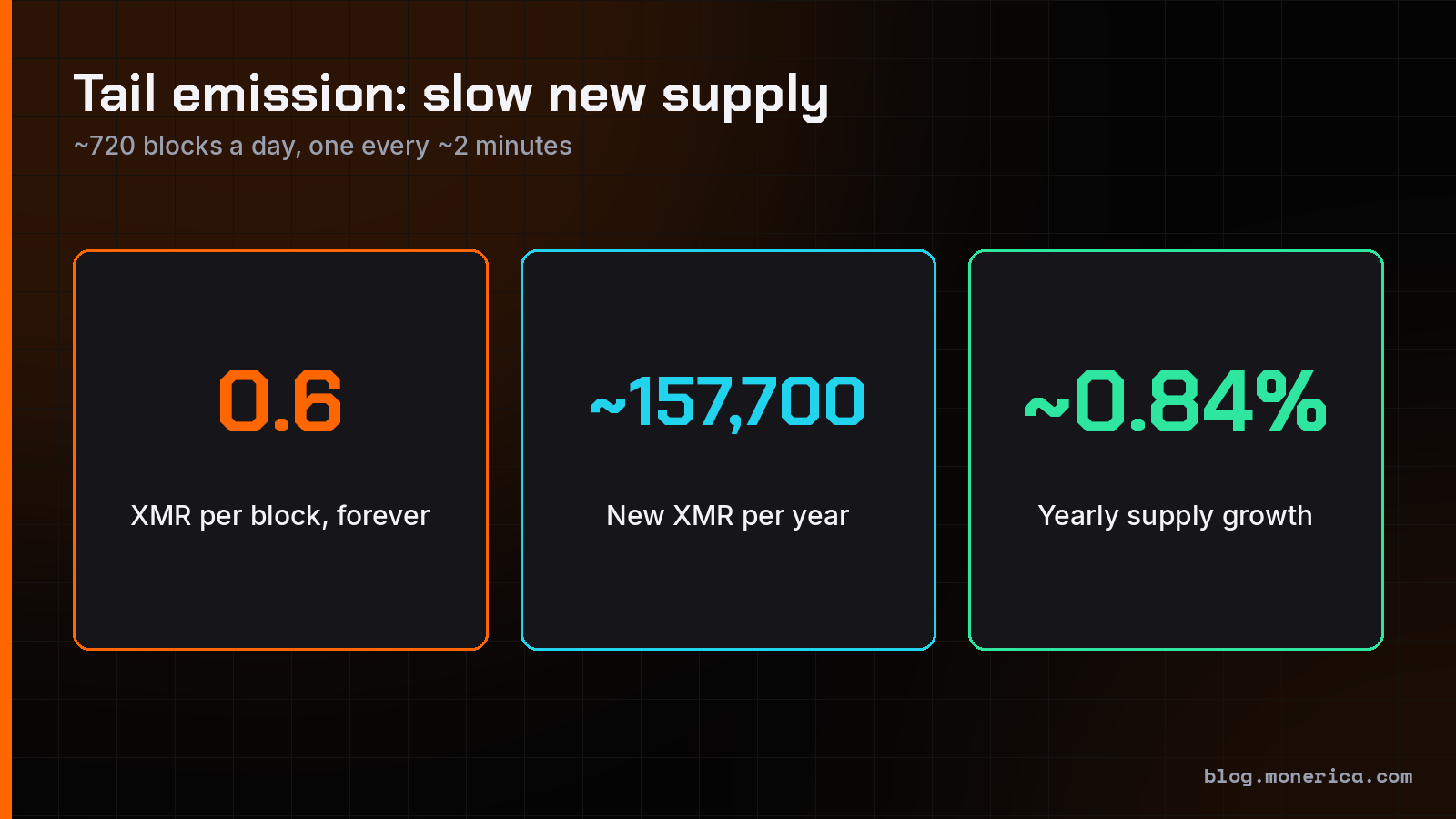
The math: 0.6 × 720 × 365 ≈ 157,700 new XMR per year. Against 18.83 million coins, that's about 0.84% a year, and the percentage shrinks a little every year because the amount stays fixed while the supply grows.
Why does this matter for a price target? Two reasons:
- The target moves a little. In a year, there will be about 18.99 million XMR. At $1,000, that's a $19.0 billion market cap instead of $18.8 billion. Small, but real.
- New coins need buyers. At $610, the yearly emission is worth about $96 million. Miners sell much of it to pay for electricity. The market has to absorb that just to keep the price flat.
That's a small number compared with Monero's market cap, and far lower than many coins that unlock large insider allocations. Monero had no premine and no founder allocation, so there's no big holder waiting to dump coins on schedule.
Scenario Math: $1,000, $1,500, $2,000
Market cap is just price × supply. Using today's supply of about 18.83 million XMR:
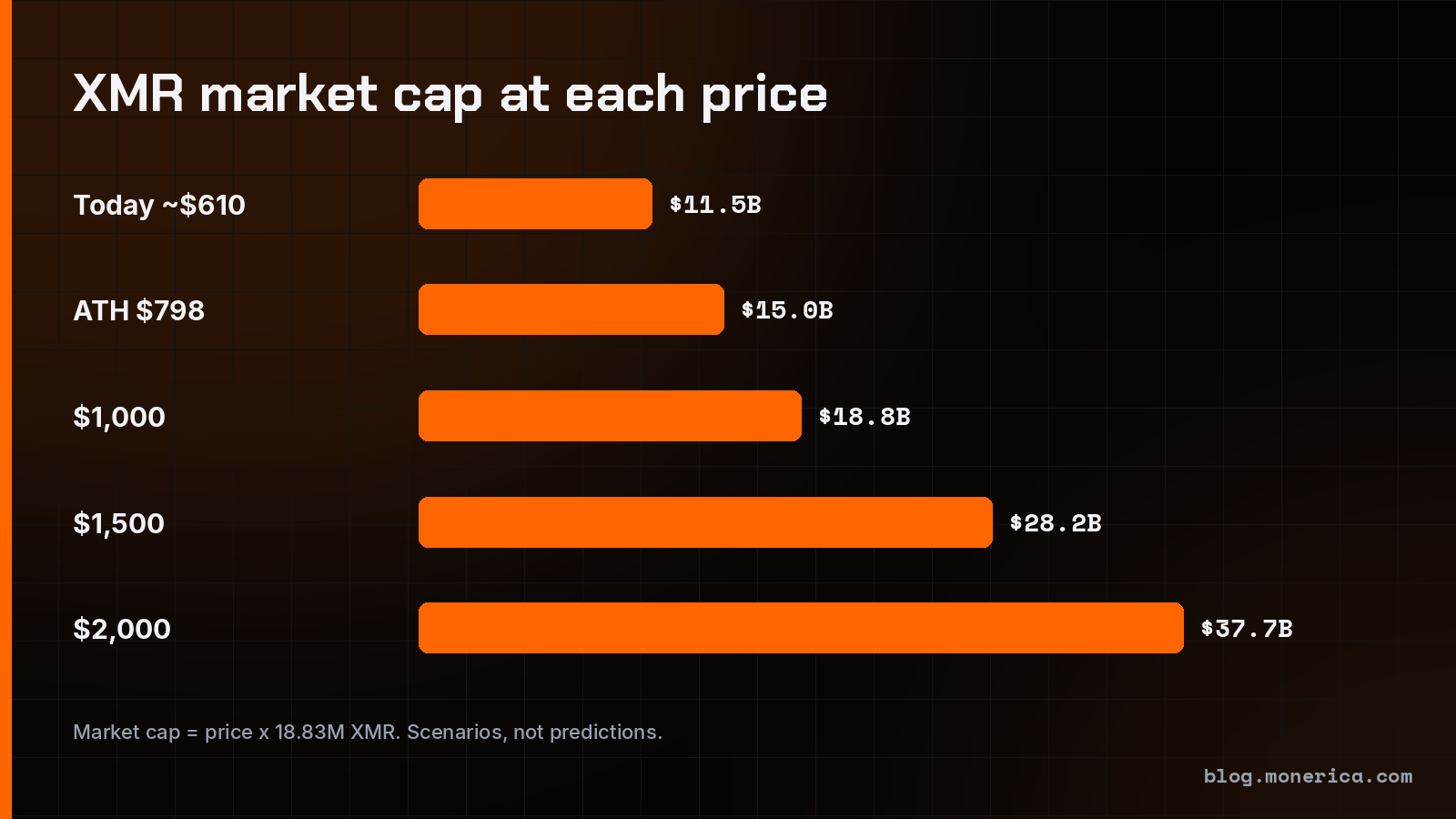
- Today (~$610): about $11.5 billion.
- All-time high ($798): about $15.0 billion at today's supply. That's +31% from $610.
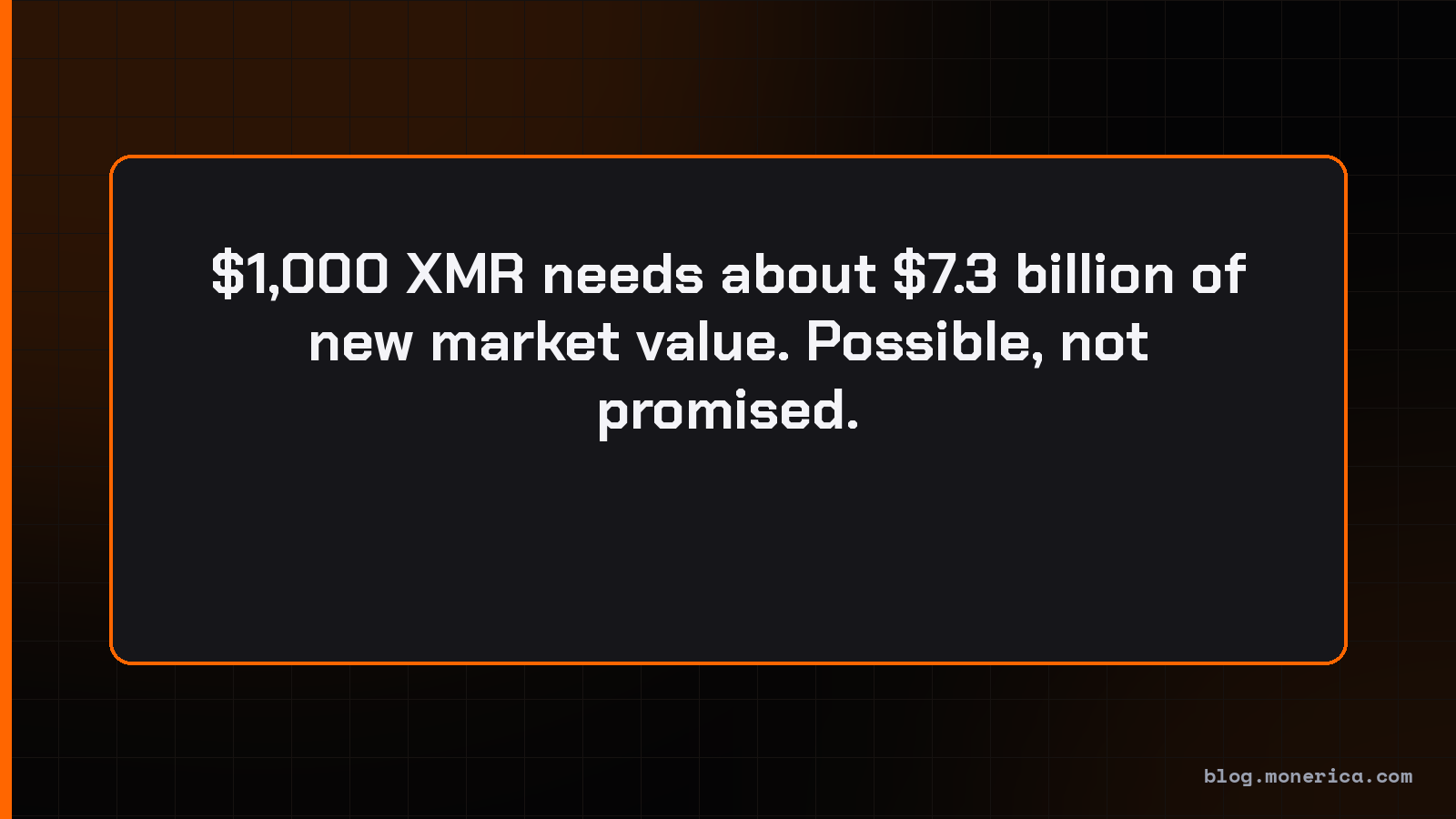
- $1,000: about $18.8 billion. That's +64% from $610, or about $7.3 billion of new market value.
- $1,500: about $28.2 billion. That's +146%.
- $2,000: about $37.7 billion. That's +228%.
A note on what market cap means: it isn't the amount of money that has to flow in. Prices are set at the margin, by the last trades. In a thin market, a modest wave of buying can move the price a lot, in either direction. That cuts both ways for Monero, which trades on fewer big venues than it used to.
How Big Is That Compared With Other Assets?
Here's how those scenarios stack up against other crypto assets, using CoinGecko market caps from November 7, 2026:
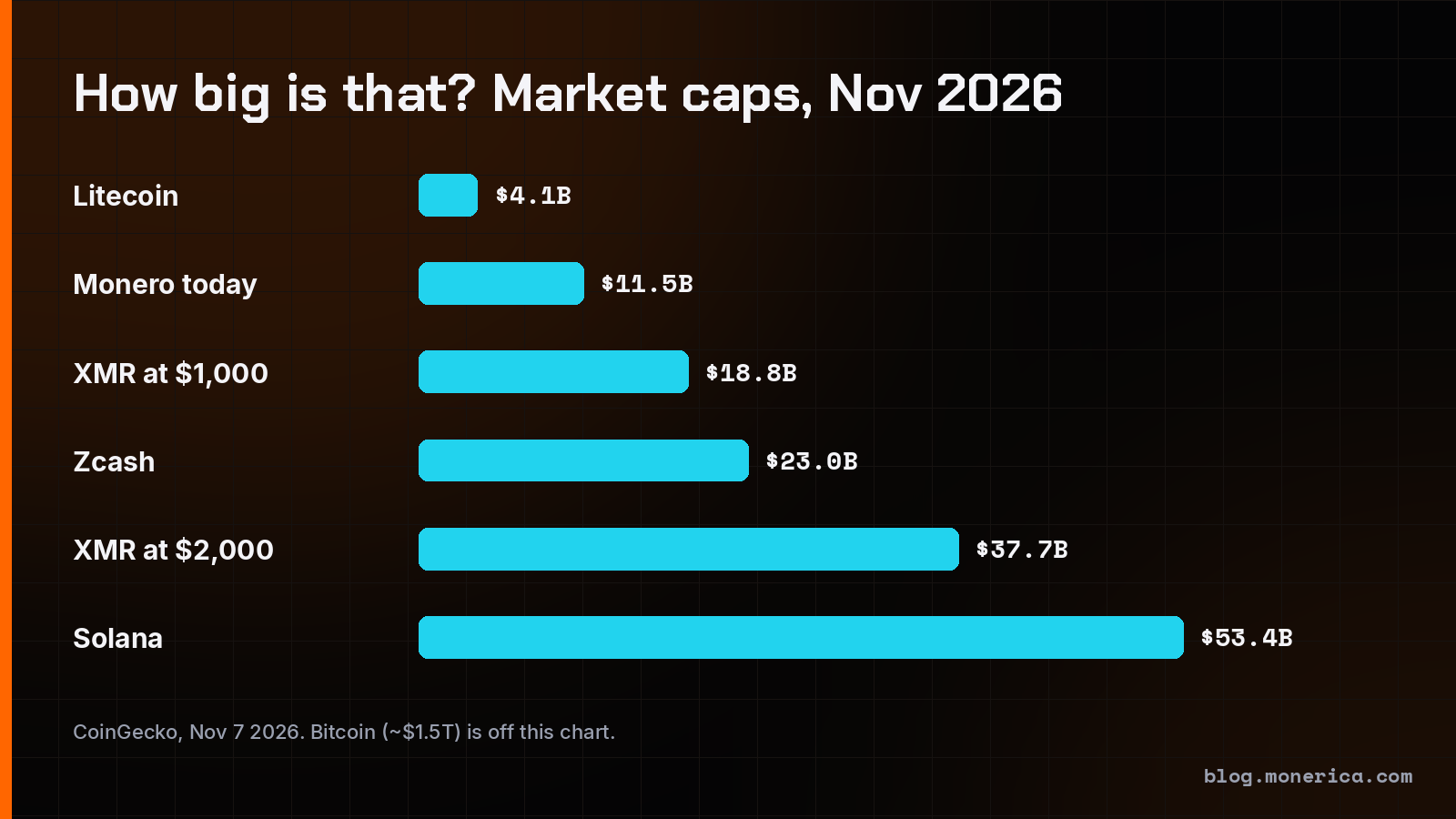
- Bitcoin: about $1.53 trillion. Monero today is under 1% of that.
- Ethereum: about $274 billion.
- Solana: about $53.4 billion.
- Zcash: about $23.0 billion (ZEC traded near $1,350).
- Dogecoin: about $11.4 billion, nearly level with Monero.
- Litecoin: about $4.1 billion.
The Zcash comparison stands out. A rival privacy coin was valued about twice as high as Monero in early November 2026. If Monero were valued the same as Zcash that day, XMR would be around $1,220. That doesn't mean it will happen. It does show that a privacy coin with a ~$20 billion valuation isn't unheard of right now. For how the two coins differ, see Monero vs. Zcash.
Bitcoin is a different story. If XMR reached just 2% of bitcoin's current market cap, it would be worth about $1,620 per coin. Ratios like that are fun, but they assume bitcoin stays where it is, which it won't.
Where Monero Has Been
Monero has already traded within about $200 of $1,000. Here are the key moments:
- January 2018: an early-cycle peak (roughly $470–$540 depending on the data source). It stood as the record for years.
- February 2024: Binance announced it would delist XMR; the price fell more than 15% on the news.
- January 14, 2026: the current all-time high of about $798 (CoinGecko lists $797.73). Coverage linked the move to rising demand for privacy.
- Early February 2026: a fast drop to under $300 (CoinGecko daily closes), more than 60% below the peak.
- August–November 2026: a climb from about $350 back above $600.
Two things stand out. First, Monero came within about $200 of $1,000 less than a year ago. Second, it gave back more than half of that within weeks. Big targets come with big swings.
What Could Push Monero Higher
Demand for financial privacy
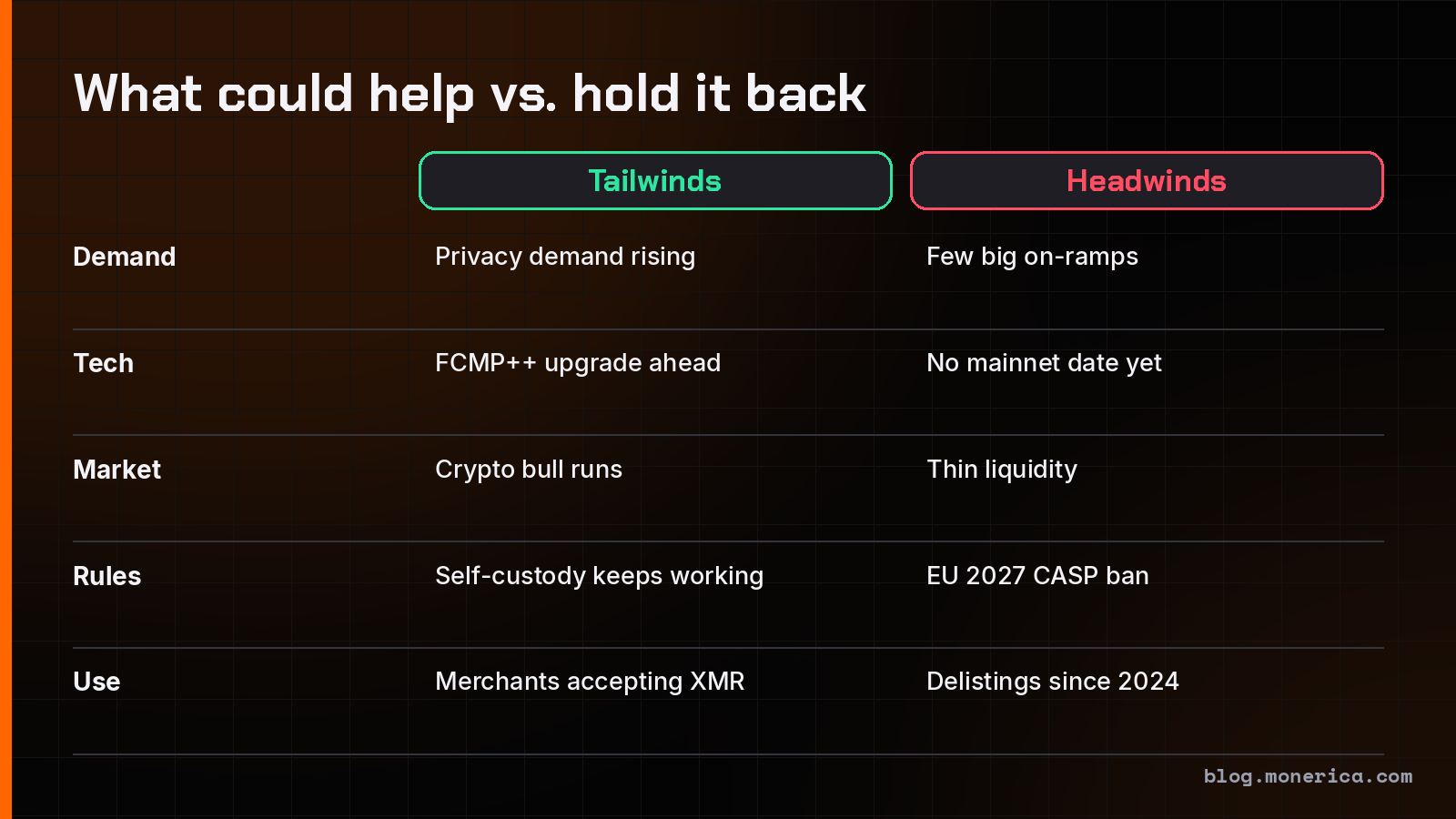
Monero is private by default: sender, receiver, and amount are hidden on-chain. As bank and exchange monitoring tightens, more people look for money that doesn't broadcast their balance. That demand is Monero's core value proposition. It's also hard to measure, because private transactions don't show up in public analytics. See Is Monero Private?
The FCMP++ upgrade
FCMP++ (Full-Chain Membership Proofs) would replace Monero's ring signatures, which hide your real input among 15 decoys (a ring of 16), with a proof that hides it among every output on the chain. It's the biggest privacy upgrade in Monero's history.
Status as of November 2026: FCMP++ is not live on mainnet, and no official fork date has been announced. As of November 2026 it is being tested on a separate public test network, and there is still no mainnet date. The latest release on getmonero.org is 0.18.5.4, a regular release with no hard fork. Some sites claim FCMP++ already activated; that's wrong. A successful launch could draw attention, but markets often "sell the news," and an upgrade doesn't guarantee a price move.
Merchant adoption and real use
Coins that people spend tend to have sturdier demand than coins people only trade. Monero already pays for VPNs, hosting, eSIMs, gift cards, and physical goods; the Monerica directory lists businesses that accept it. More merchants means more reasons to hold XMR. It's slow work, though. See Why Monero Merchant Adoption Is So Hard.
A broad crypto bull market
Honestly, the biggest single factor is often the whole market. When bitcoin and the rest of crypto rally, most coins rise with them. Monero's January 2018 peak, for example, came at the height of that era's broad crypto boom.
What Holds Monero Back
Delistings and fewer on-ramps
Since 2024, many large exchanges have dropped XMR, often citing regulatory pressure. Binance's February 2024 delisting was the biggest. That makes Monero harder for newcomers to buy with a bank card and keeps it off many institutional platforms. Track the list in Monero Delistings: Which Exchanges Still Support XMR.
Regulation
The EU's Anti-Money Laundering Regulation (EU) 2024/1624 prohibits regulated crypto-asset service providers from handling anonymity-enhancing coins, with the rules applying from July 2027. That doesn't ban owning Monero, but it closes another set of regulated doors in a big market. Our Is Monero Legal in 2026? article covers country-by-country rules. (Not legal advice.)
Liquidity
Thin markets amplify moves in both directions. The January–February 2026 round trip from about $798 to under $300 shows how fast Monero can fall when buyers step back. Spreads between exchanges can also be wider than for bitcoin; compare rates on MoneroPriceNow before you swap.
No institutional products
Bitcoin and Ethereum have spot ETFs and other regulated products that bring in large, steady flows. Monero has nothing like that, and given its privacy features, it's unlikely to get them soon. Its demand comes from individuals.
How to Read Price Predictions You See Online
Search for Monero price predictions and you'll find confident numbers for 2027, 2030, and beyond. Keep a few things in mind:
- Check the market cap. Multiply any target by about 18.8 million XMR (a little more each year). If the result is larger than Ethereum's market cap, ask what would have to change for that to happen.
- Look for a date and a reason. "XMR to $5,000" with no timeline and no argument is a headline, not an analysis.
- Watch for conflicts of interest. Many prediction pages are written by exchanges or sites that earn money when you trade.
- Check the facts they rely on. Several articles in 2026 claimed FCMP++ had already launched. It hadn't. If the basic facts are wrong, the forecast is worth little.
Scenario math like the numbers above is more useful than a single target. It tells you what a price would mean, so you can judge for yourself how likely it is.
So, Can Monero Reach $1,000?
Here's the honest summary:
- It's mathematically ordinary. $1,000 means an ~$18.8 billion market cap, smaller than Zcash's in November 2026 and a fraction of the large-cap coins.
- It needs a 64% rise from about $610 and a new all-time high, about 25% above January 2026's peak.
- Monero has done moves this size before, in both directions, within months.
- The risks are real. Delistings, EU rules taking effect in 2027, and thin liquidity could keep the price down or push it lower.
- No one knows the timing. Anyone who promises a date is guessing.
If you decide to hold some XMR, keep it in a wallet you control, buy only what you can afford to lose, and remember that Monero's main value is as private money you can actually spend. Start with How To Buy Monero. Monerica sponsors such as GhostSwap, SageSwap, and CCE Cash offer swaps into XMR, and xmr2cex handles selling XMR. Their Monerica profiles list the details, and you can browse more in the exchanges category.
FAQ
Can Monero reach $1,000?
It's possible. At about 18.83 million XMR, $1,000 equals an ~$18.8 billion market cap, about 64% above the early-November 2026 price. It isn't guaranteed, and this isn't financial advice.
What is Monero's all-time high?
About $798, set on January 14, 2026 (CoinGecko lists $797.73).
How many Monero are there?
About 18.83 million XMR as of November 2026. Supply grows by 0.6 XMR per block, roughly 157,700 XMR a year.
What would Monero's market cap be at $2,000?
About $37.7 billion at today's supply, roughly 3.3 times the early-November 2026 market cap.
Is FCMP++ live yet?
No. As of November 2026, FCMP++ is being tested on a separate network and has no official mainnet fork date.