Monero and Zcash are the two best-known privacy coins, and they're constantly compared — but they take fundamentally different approaches to the same goal. The one-line answer: Monero makes privacy mandatory for every transaction, while Zcash makes it optional — and in practice most Zcash transactions are transparent. This guide breaks down their history, technology, supply, and where each project is heading, so you can see why that distinction matters.
A Quick History of Both
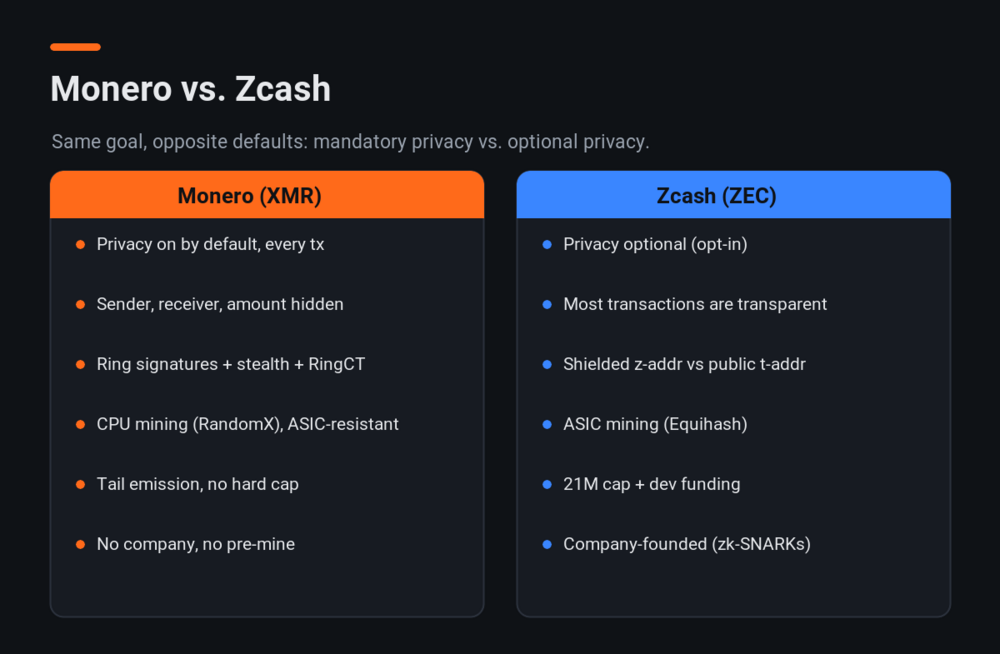
Monero launched in 2014, forked from Bytecoin and built on the CryptoNote protocol. It has always been community-driven, with no company, no pre-mine, and no founder's reward — funded by donations and developed in the open.
Zcash launched in 2016, growing out of the academic Zerocoin/Zerocash research and built by a company (originally the Electric Coin Company) with backing from investors. Its headline innovation was zk-SNARKs — zero-knowledge proofs that let a transaction be verified without revealing its details.
The Core Difference: Privacy by Default vs. Optional
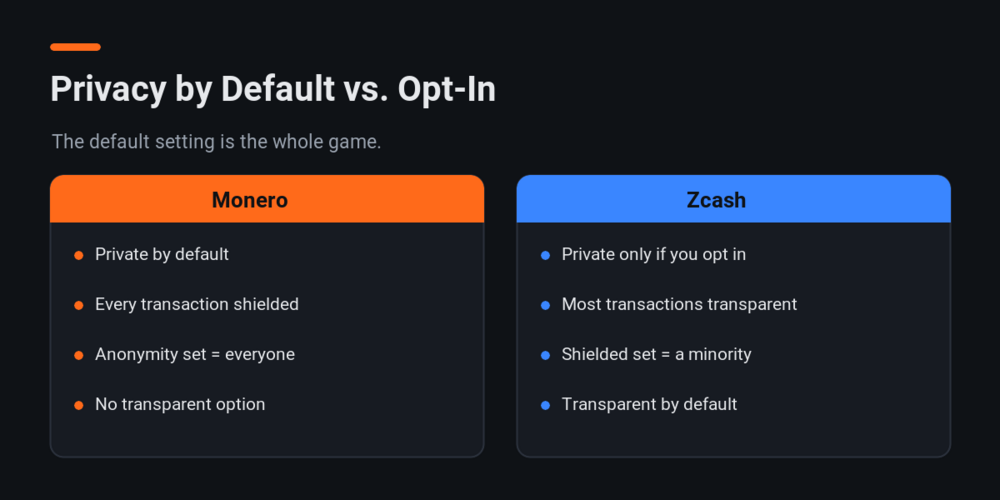
This is the whole ballgame. Monero is private by default: every transaction hides the sender, receiver, and amount using ring signatures, stealth addresses, and confidential transactions (RingCT). There is no transparent option, so there is no way to stand out by choosing privacy — everyone is in the same anonymity set.
Zcash is private by choice. It has two kinds of addresses: transparent (t-addresses, which behave like Bitcoin and are fully public) and shielded (z-addresses, which use zk-SNARKs). The technology is powerful, but historically the majority of Zcash activity has been transparent, which shrinks the shielded anonymity set and weakens real-world privacy. For more on why default matters, see is Monero private.
Where Zcash's Approach Can Win — and Where It Leaks
To be fair to the technology, the two coins take genuinely different roads to privacy, and Zcash’s is not a downgrade in every respect. Monero hides transactions with ring signatures, stealth addresses, and RingCT: your real output is mixed with decoys, so privacy comes from plausible deniability inside an anonymity set. Zcash’s fully shielded (z‑to‑z) transactions use zk-SNARKs, which use no decoys at all — they prove a transaction is valid while revealing nothing about sender, receiver, or amount. In the best case — a fully shielded transaction inside a large, active shielded pool — that cryptography is extremely strong, and some argue it is a cleaner guarantee than a decoy-based system.
The catch is the pool boundary. Because Zcash keeps a transparent side, coins constantly move into the shielded pool (t→z, “shielding”) and back out of it (z→t, “deshielding”). Those crossings are visible on-chain, and the amounts and timing at the boundary leak information. Academic analysis — notably “An Empirical Analysis of Anonymity in Zcash” (Kappos et al., USENIX Security 2018) — found that a large share of shielded activity could be de-anonymized with simple heuristics. A classic example: a user who shields an amount and then deshields the same amount a short time later effectively links their transparent addresses straight through the “private” pool. Round-tripping in and out of the shielded pool often buys little real privacy.
So the honest summary: a disciplined user who keeps funds shielded and never touches a transparent address can get very strong privacy on Zcash — but that demands near-perfect behavior, a healthy shielded set to hide in, and counterparties who also stay shielded. Monero removes the footgun entirely: there is no transparent pool to cross, so there is no shielding/deshielding step to leak amounts or timing, and no way to accidentally out yourself. With Monero the private path is the only path; with Zcash it is a setting you have to use flawlessly, every time, or lose the protection.
Supply and Economics
- Zcash: a Bitcoin-style hard cap of 21 million coins, with a portion historically directed to development. Disinflationary via halvings.
- Monero: no hard cap. Its main emission is finished, and a fixed tail emission of 0.6 XMR per block continues forever to keep miners paid — a small, shrinking rate that keeps the network secure indefinitely.
Mining
Both are proof-of-work. Monero uses RandomX, deliberately tuned for ordinary CPUs and resistant to ASICs, which keeps mining decentralized and accessible. Zcash uses Equihash, which became dominated by specialized ASIC hardware — more centralized among industrial miners.
Why Many Monero Users Distrust Zcash
Beyond the technical “default vs. optional” gap, much of the Monero community’s skepticism toward Zcash is about who controls it and how it launched. Where Monero has no company, no pre-mine, and no founder’s cut, Zcash’s history reads very differently.
A built-in developer tax
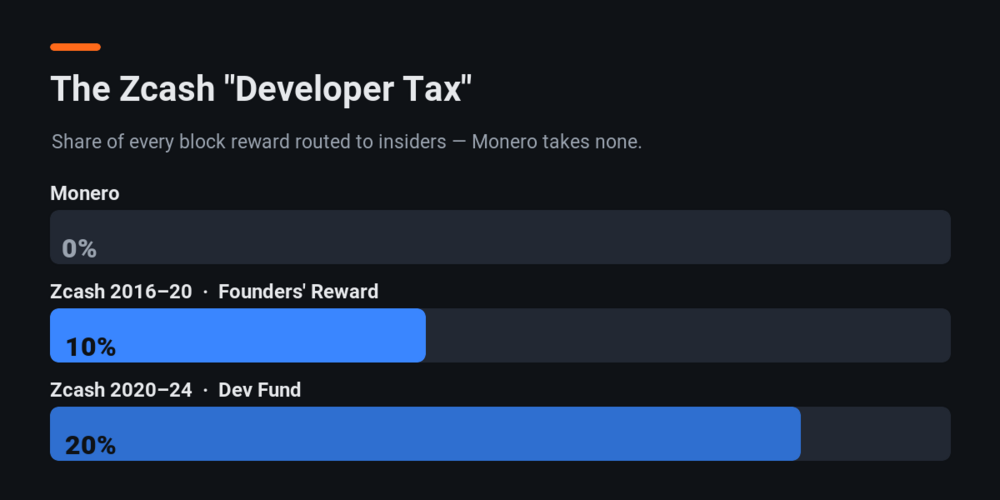
Zcash didn’t pre-mine coins before launch, but critics put its Founders’ Reward in the same bucket: a hard-coded cut to insiders. For the first four years (2016–2020), 10% of every block reward went to the founders, early investors, employees, and the Zcash Company. When that expired it was renewed as the “Dev Fund,” redirecting 20% of block rewards (2020–2024) to the Electric Coin Company (ECC), the Zcash Foundation, and a grants program. Critics call this a developer tax — every miner effectively pays a cut to a corporation and its backers. Monero launched with no pre-mine and no founder reward, and is funded purely by voluntary donations to a community-run Community Crowdfunding System.
Run by a corporation, backed by VCs
Zcash is steered by the Electric Coin Company, a for-profit business, alongside the non-profit Zcash Foundation, and it took venture-capital funding from firms and individuals positioned to profit from its success. That is exactly the structure many privacy advocates want to avoid: a single company with outsized influence over a “privacy” coin, and investors who benefited from the founders’ reward. Monero has no company, no CEO, and no equity — it is built by a distributed, largely pseudonymous community.
The trusted setup and the “toxic waste” problem
Zcash’s original zk-SNARK privacy relied on a trusted setup ceremony that generated secret parameters. If that secret — the so-called “toxic waste” — was ever kept rather than destroyed, whoever held it could counterfeit Zcash undetectably, silently inflating the supply. Zcash later moved to the Halo 2 system to remove the trusted setup, but the original ceremony still fuels distrust: users had to trust that a small group destroyed a secret no one else could verify. Monero’s privacy uses no trusted setup at all.
Suspicion about who is really behind it
Because Zcash pairs a corporate parent and VC money with cryptography rooted in academic and government-funded research, parts of the privacy community have long speculated about ties to intelligence agencies — from the CIA to Israeli intelligence — and questioned whether a “privacy” project with that pedigree can be trusted. To be clear, these are allegations and suspicions, not proven facts, and the Electric Coin Company rejects any such control. But the mix of a founders’ reward, corporate governance, and origins that most users can’t independently verify is enough that many Monero users simply won’t touch it — when the goal is escaping surveillance, “trust us” is not a feature.
Hijacking the privacy narrative
For years Zcash was marketed as the cutting-edge privacy coin, and its zk-SNARK cryptography earned real headlines and academic respect. But the branding outran reality: because privacy is opt-in and the majority of transactions have been transparent, the typical Zcash transaction has offered no more privacy than Bitcoin. Critics argue this let a corporate, pre-funded coin capture the “privacy” spotlight — along with the investment and attention that came with it — while delivering default privacy to almost no one. Monero took the opposite path: no marketing company, no token sale, just privacy that is on for everyone, every time.
The clearest signal: almost nobody uses it for real privacy
Maybe the most damning point isn’t technical at all — it’s adoption. In the places where privacy is a matter of safety, Zcash is essentially absent. Darknet markets, whose users face some of the highest-stakes threat models anywhere, overwhelmingly moved to Monero — several dropped Bitcoin entirely — while Zcash sees virtually no usage there at all. When the people with the most to lose vote with their coins, they don’t pick optional, corporate-run privacy. The same pattern shows up in the legitimate economy: browse a directory of businesses that accept cryptocurrency, like Monerica, and you’ll find Monero accepted widely and Zcash almost nowhere. A coin marketed as cutting-edge privacy but trusted for real privacy by almost no one tells you how much the market actually believes the pitch.
Where Each Is Heading
Both projects keep pushing their cryptography forward. Zcash has shipped the Orchard shielded pool and Halo 2 (removing the need for a trusted setup) and is working to make shielded usage the norm rather than the exception. Monero is preparing FCMP++ (full-chain membership proofs), which will replace its decoy ring with an anonymity set of the entire blockchain — a major leap that only strengthens the already-default privacy. See Monero vs Bitcoin privacy for how Monero's model compares to a transparent chain.
Which Should You Use?
If you want privacy that's automatic, uniform, and doesn't depend on you (or the other party) choosing the right address type, Monero is the stronger practical choice — its whole design assumes everyone wants privacy. If you value the flexibility of optional transparency (for audits or compliance) and cutting-edge zk-proof research, Zcash is compelling — but you have to actively use shielded addresses to get the benefit. For everyday private money, default-on wins.
Frequently Asked Questions
Is Monero more private than Zcash? In practice, usually yes — because Monero's privacy is mandatory, its anonymity set includes every transaction, while Zcash's depends on people choosing shielded addresses.
Is Zcash's zk-SNARK tech better than Monero's? It's excellent cryptography, but privacy that's optional and under-used delivers weaker real-world protection than privacy that's always on.
Do both get delisted from exchanges? Yes — both are privacy coins and face similar regulatory delisting pressure.