If you have tried to buy XMR on a major platform recently and found it missing, you are not imagining things. The topic of Monero delisted exchanges has been in the news for years, as compliance pressure pushed several large centralized platforms to drop or restrict privacy coins. But delisting is not the whole story — Monero remains very much buyable, just increasingly through channels that do not depend on the biggest exchanges. Here is an honest look at what has happened and where XMR still trades.
Why Exchanges Delist Monero
The reason is almost always regulatory and banking pressure rather than any technical flaw. Centralized exchanges must satisfy regulators, banking partners, and sometimes chain-analysis requirements. Monero's privacy-by-default design makes the kind of transaction monitoring those parties expect much harder, so some exchanges decide it is simpler to remove XMR than to build special processes around it. Importantly, a delisting is a company's business decision, not a declaration that Monero is illegal — in most places it remains perfectly legal to own and use.
Notable Delistings and Restrictions
The list of Monero delisted exchanges has grown over time. A few widely reported examples:
- Binance removed XMR trading in February 2024, one of the most significant delistings given its size.
- Kraken has restricted Monero for users in certain regions, such as parts of Europe and the UK, while support has varied elsewhere.
- Various other regional and mid-size exchanges have dropped or limited XMR to reduce compliance exposure.
Because these decisions shift with the regulatory climate, any snapshot goes stale quickly. Treat specific names as examples of a trend rather than a permanent map, and always verify current availability in your own region before relying on a platform.
Monero Delistings Timeline: Past to Present
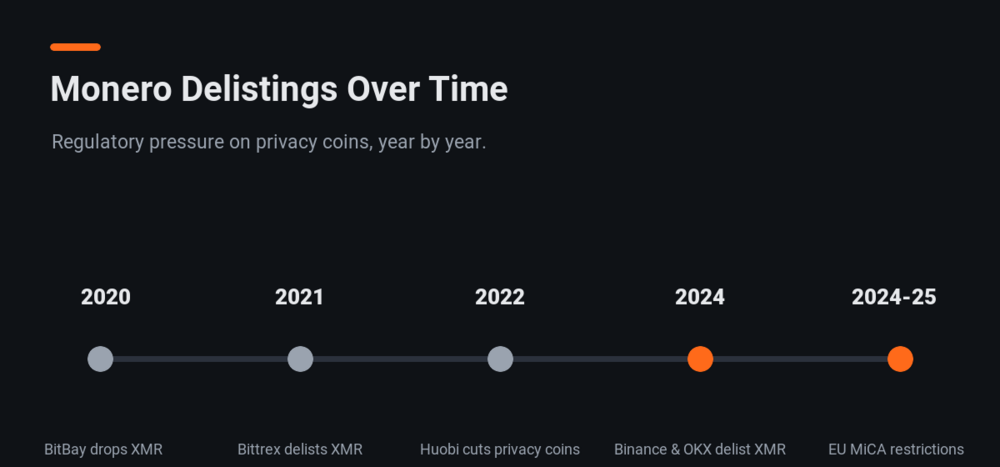
Privacy-coin delistings have arrived in waves, driven mostly by regulatory pressure. Here is the arc of the major ones:
- 2018–2019: The first restrictions appear — several regional and Japanese exchanges drop privacy coins under regulator pressure, and some UK-facing platforms limit XMR.
- February 2020: BitBay delists Monero, citing anti-money-laundering concerns.
- January 2021: Bittrex delists Monero, Zcash, and Dash together.
- September 2022: Huobi removes a range of privacy tokens, including XMR.
- January 2024: OKX delists several privacy coins.
- February 2024: Binance — the world's largest exchange — delists Monero (effective 20 February 2024), the highest-profile removal to date.
- 2024: Kraken restricts or delists XMR for users in parts of the EU, such as Belgium and Ireland, amid tightening rules.
What's Coming: Future Delistings to Watch
The trend is not finished. The EU's Markets in Crypto-Assets (MiCA) framework and its anti-money-laundering companion rules are pushing exchanges that operate in Europe to drop privacy coins through 2024–2025, so expect more EU-facing delistings and account restrictions. Any exchange leaning heavily on regulated Western markets is a candidate to follow — which is exactly why no-KYC swaps matter more than ever.
The hard deadline is 2027. MiCA set up the EU's crypto-licensing regime, but the decisive blow for privacy coins comes from its anti-money-laundering companion, the Anti-Money Laundering Regulation (AMLR), which applies from July 2027. Under Article 79 of the AMLR, banks and crypto-asset service providers (CASPs) operating in the EU will be prohibited from handling anonymity-enhancing coins such as Monero, and from keeping anonymous accounts at all. In practice that means every EU-licensed exchange will have to delist XMR by mid-2027 or risk its license. The delistings so far have been a voluntary compliance trend; from 2027 it becomes a legal mandate across the entire European bloc, so expect a wave of EU-facing XMR delistings in the run-up to that date.
Where XMR Still Trades
Here is the reassuring part: delistings from big centralized players have not stopped people from buying Monero. If anything, they accelerated the shift toward channels that suit Monero's nature better:
- No-KYC swap aggregators let you trade another crypto for XMR without an account, comparing rates across many providers.
- Atomic swaps allow trustless BTC–XMR trades with no custodian, using tools built on the COMIT and Farcaster protocols.
- Peer-to-peer trading connects buyers and sellers directly, often with escrow, for cash or other payment methods.
- Some centralized exchanges in certain regions still list XMR — availability depends on where you are. See the centralized exchanges listed on Monerica that still support XMR.
In other words, the Monero delisted exchanges story pushed activity toward decentralized and privacy-preserving venues that no single company can shut down.
Paper Monero: Perpetual Swaps and Price-Manipulation Concerns
There is a wrinkle that makes Monero delistings more complicated than they look. Even exchanges that dropped spot XMR trading — where you actually take custody of real coins — often keep derivatives alive. Binance, for example, delisted spot XMR in February 2024 but has continued to offer an XMR perpetual swap (a futures contract with no expiry), and platforms such as Phemex also list XMR perpetual contracts.
The catch is that these products let traders bet on Monero's price without ever holding or delivering a single real XMR. Critics call this "paper Monero" — synthetic positions settled in stablecoins rather than in the underlying coin. Because Monero's on-chain supply is private and its liquidity on regulated venues is thin, a large volume of paper trading can push the quoted price in directions that have little to do with real, settled demand for the coin.
That is why many in the community suspect the reported XMR price can be manipulated: when the tradable market is dominated by cash-settled perpetuals instead of genuine spot delivery, the price you see may reflect leverage and positioning games more than people actually buying and moving Monero. It is one more reason privacy-minded users prefer no-KYC spot swaps and atomic swaps, where every trade delivers real coins to a real wallet.
The Silver Lining of Delistings
It sounds paradoxical, but exchange delistings highlight exactly why Monero was built the way it is. A currency whose usefulness depended on the goodwill of a handful of corporations would be fragile. Monero's peer-to-peer network keeps running regardless of who lists it, and atomic swaps guarantee it can always bridge to the broader crypto economy through Bitcoin. Delistings are an inconvenience, not an existential threat — they simply route committed users toward the self-sovereign tools that Monero's community has been building all along.
What This Means for You
If your favorite big exchange no longer offers XMR, do not conclude that Monero is unavailable or illegal. Instead:
- Check whether any exchange serving your region still lists it.
- Learn to use a no-KYC swap or an atomic swap — skills that keep you independent of any single platform.
- Always withdraw to your own wallet, since self-custody is the entire point.
The Bottom Line
The landscape of Monero delisted exchanges will keep shifting as regulations evolve, and specific platforms may add or drop support at any time. The durable truth is this: Monero does not need permission from centralized exchanges to function. Between no-KYC aggregators, atomic swaps, and peer-to-peer trades, buying and using XMR remains entirely possible — and arguably more aligned with Monero's privacy-first mission than ever.
Related Articles
- Best Monero Exchanges
- BTC to XMR Instant Exchanges
- Monero Anonymous Exchanges (2025): Best No-KYC XMR Swaps, Aggregators,
- Where to Exchange Monero (XMR) in 2025
- Monero Peer-to-Peer Exchanges