
FCMP++, short for Full-Chain Membership Proofs (the "++" is the improved variant), is the biggest privacy upgrade on Monero's roadmap. In one sentence: it replaces Monero's small decoy ring with an anonymity set of the entire blockchain. This guide explains what it is, the concrete benefits it brings, and why such an important upgrade keeps getting pushed back.
The Problem FCMP++ Solves
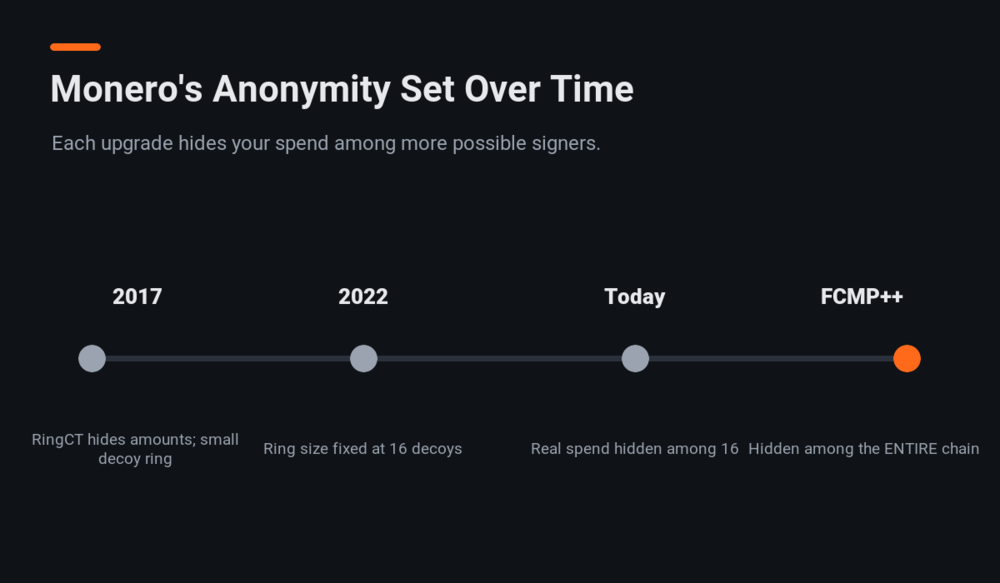
Today, Monero hides the true sender of a transaction inside a ring of decoys, currently 16 possible signers. That is strong, but it is a fixed, relatively small set, and researchers spend a lot of effort making sure the decoys are indistinguishable from the real spend. A bigger anonymity set is simply better privacy.
For background on how today's privacy works, see our guide on whether Monero is private.
What FCMP++ Actually Does
Instead of proving "the real spend is one of these 16," FCMP++ proves "the real spend is one of every output that has ever existed", without revealing which one. It uses an efficient cryptographic structure (curve trees) to make that proof practical. The upgrade also modernizes Monero's transaction model and improves forward secrecy, laying groundwork for future gains.
Ring Signatures vs FCMP++ at a Glance
| Monero today (ring signatures) | Monero with FCMP++ | |
|---|---|---|
| What each input proves | "I am one of these 16 outputs" | "I am one of all the outputs on the chain" |
| Anonymity set per input | 16 (1 real spend, 15 decoys) | The whole chain, on the order of 100 million outputs |
| Decoy selection | The wallet picks 15 decoys for every input | No decoys to pick |
| Proof technology | Ring signatures | Membership proofs built on curve trees |
| Hidden amounts and one-time addresses | Yes | Yes, unchanged in purpose |
| Status | Live on mainnet | Public test network (stressnet), not on mainnet |
The "100 million" figure comes from the Monero project's own announcement of the design, which describes every input going "from an immediate anonymity set of 16 to 100,000,000". The exact number is simply however many outputs exist when you spend.
The Benefits
- Maximum anonymity set. Your transaction hides among all outputs on the chain, not just 16.
- Stronger against decoy analysis. It removes the entire class of "guess the real spend from the decoys" concerns.
- Better forward secrecy and a cleaner foundation for future upgrades.
- Ends the ring-size debate. There is no ring size to tune anymore.
What Is Carrot, and What Else Comes With FCMP++?
FCMP++ is being tested together with Carrot, a proposed upgrade to Monero's addressing protocol, which is the set of rules for how wallets derive keys and recognise their own payments. The test software is released as "FCMP++ and Carrot", and the plan is for both to arrive in the same network upgrade.
The project's announcement also lists features the new design supports at the protocol level. Wallets would add them on their own schedule, without another hard fork:
- Forward secrecy. The announcement defines this as privacy that holds even against an adversary who can break the discrete log problem, for example with a quantum computer.
- Outgoing view keys. A key that lets its holder see with certainty when received funds are spent. Today's view key shows incoming payments only.
- Transaction chaining. Signing a transaction that spends another one before the first is mined, which is a building block for second-layer designs such as payment channels.
FCMP++ does not depend on Seraphis, an older and larger redesign proposal. The first full-chain membership proof idea was meant to ship with or after Seraphis. The "++" version was proposed in March 2024 so that the privacy gain could arrive sooner, on top of Monero's existing transaction format.
Why It Keeps Getting Delayed
FCMP++ is not a config change: it is a deep cryptographic overhaul of how Monero proves ownership, and it touches consensus rules that every node must agree on. That invites caution for good reasons:
- New cryptography needs auditing. A brand-new proving system is independently reviewed and audited before it can be trusted with real money; rushing that would be reckless.
- Performance and size must be tuned so proofs stay fast to make and verify.
- Coordination. Wallets, hardware wallets, and node software all have to be ready for the network upgrade at once.
- Correctness over speed. Monero's contributors prioritize getting a privacy change right over shipping it on a deadline: a bug here could undermine the whole point of the coin.
So the repeated delays are less a red flag and more a sign of the careful, review-heavy culture that privacy money demands.
FCMP++ Status and Timeline (November 2026)
- 2023: full-chain membership proofs for Monero are first presented, at MoneroKon.
- March 2024: FCMP++ is proposed. The Monero project publishes its explainer the following month, while the design is under review and an audit fund is being raised.
- October 2025: the first public test network, the FCMP++ and Carrot alpha stressnet, goes live.
- 5 October 2026: the beta stressnet v3 hard forks from Monero's testnet at block 3,102,800. Its release notes call it the second live public network testing the FCMP++ and Carrot integration.
- 26 October 2026: beta stressnet v3.1 is released. It fixes a bug found on the test network after the fork and adds faster wallet scanning. The notes list hardware wallet support, multisig and transaction proofs as not yet working.
- Mainnet: no activation date has been announced. Monero's current mainnet release, 0.18.5.4 (October 2026), still uses ring signatures.
A stressnet is a separate network with coins that have no value. Its job is to find problems like the one fixed in v3.1 before real money is involved, so a bug caught there is the process working. Any mainnet date you see quoted before an official announcement is an estimate, and earlier estimates have slipped.
What Will Change for You When FCMP++ Activates
- You will need to update. Like every Monero network upgrade, it is a hard fork: nodes and wallets must run the new version to keep following the network. Update the official wallet, Feather or your mobile wallet when its developers publish a compatible release (see the wallet guide).
- Hardware wallets need new firmware or apps. Hardware wallet support is still listed as unfinished on the test network, so check before the upgrade if you use one (see Monero hardware wallets).
- Node operators must upgrade. If you run a node, install the new release before the fork height.
- Sending should feel familiar. You will still paste an address and an amount. The test notes mention that building a transaction with many inputs currently takes some time.
- Exchanges and merchants pause briefly. Services usually stop deposits and withdrawals around a hard fork until they have upgraded.
What FCMP++ Does Not Fix
FCMP++ strengthens one layer: who could have sent a transaction, as seen on the blockchain. Other leaks sit outside the blockchain and stay your responsibility:
- Network metadata. A remote node or network observer can still see your IP address unless you use your own node or Tor (see VPN vs. Tor for Monero).
- Records held by services. An exchange that knows your identity still knows what you bought and where you withdrew it.
- Behaviour. Moving the same unusual amount in and out within minutes, or reusing identities across services, can link activity whatever the cryptography does.
Our guide to the most private way to use Monero covers those layers.
How to Follow Progress
Development happens in the open. The official getmonero.org site and the r/Monero community track milestones, audits, and the eventual network-upgrade date. For a plain-English refresher on the coin itself, start with what is Monero.
Frequently Asked Questions
What does FCMP++ stand for? Full-Chain Membership Proofs. The "++" marks the improved variant. It replaces Monero's small decoy ring with an anonymity set of the entire blockchain.
Will FCMP++ change my Monero address or wallet? Wallets will need an update to support it, but your funds and seed remain yours. It's a protocol upgrade, activated network-wide.
Is FCMP++ live yet? Not at the time of writing (November 2026). It's in public testing and audit, with no mainnet date announced. The repeated delays reflect the care required for a deep cryptographic change, not a problem with the coin.
Does it make Monero slower? A goal of the work is to keep proofs practical to create and verify; performance is part of what's being tuned before release.
Is FCMP++ the same as Seraphis? No. Seraphis is a separate, larger redesign proposal. FCMP++ was designed so that it does not depend on Seraphis and can be deployed on its own.
Does FCMP++ make Monero quantum-proof? Not fully. The stated goal is forward secrecy for privacy: an adversary who could break discrete logs later should still not be able to unmask past transactions. That is a narrower claim than making every part of Monero quantum-resistant.
Do I need to move my coins before the upgrade? Nothing published by the Monero project asks holders to do that. The practical step is to update your wallet when the upgrade release is out, and to follow getmonero.org for instructions as the date gets closer.
Can I try FCMP++ now? Yes, on the stressnet, using the test software from the developers' GitHub releases. Its coins are for testing and have no value, and it must not be used with a real wallet.
Will the ring size still matter? No. Ring size is the number of possible signers per input, currently 16. With a membership proof over the whole chain there is no ring to size.