Every few years someone declares that this is the year crypto goes mainstream at the checkout. It never quite happens. If you strip away the optimism and look honestly at how real businesses operate, merchant adoption of Monero — and of crypto generally — is genuinely hard, and for reasons that are structural rather than temporary. This is an honest look at why, from someone who wants Monero to succeed: not every use case is a good fit, and pretending otherwise helps no one.
The good news is at the end, because there are places crypto works beautifully — just not, mostly, as a day-to-day payment rail.
The Checkout Reality: Confirmations vs. a Card Swipe
A credit card authorizes in about a second, and the merchant is done. A crypto payment has to be broadcast, sit in the mempool, and wait for confirmations. Even fast chains take longer than a tap, and Monero's outputs lock for ten blocks (~20 minutes) before they can be re-spent. No cashier is going to hold a line while a customer waits for network confirmation, so in practice merchants either accept zero-conf risk or route through a processor — adding a middleman to the "peer-to-peer cash" pitch.
Then there is the human layer. Staff have to be trained to handle a payment type they use for maybe one transaction a week. They have to recognize it, generate an invoice, verify it arrived, and troubleshoot when it doesn't. Every point-of-sale system does this differently — there is no consistent, universal way to accept crypto across terminals the way there is for cards — so training doesn't transfer between the plugin, the tablet app, and the QR printout.
There is also a hard infrastructure dependency. Accepting Monero means a device with a live internet connection talking to a node that is fully synced. Card terminals fail rarely and degrade gracefully; a crypto point of sale needs the network up, the wallet online, and the blockchain current. If the shop's connection is spotty, or the node is catching up after being offline — Monero has to sync every block it missed before it can even see an incoming payment — the checkout simply stalls.
A customer standing at the counter while the wallet reads "connecting" or "synchronizing" is a delayed line, a frustrated buyer, and sometimes a lost sale. That operational fragility — a payment method that can be knocked out by a bad connection or a node that fell behind — is exactly what a busy business can't tolerate at the register.
Volatility Against Razor-Thin Margins
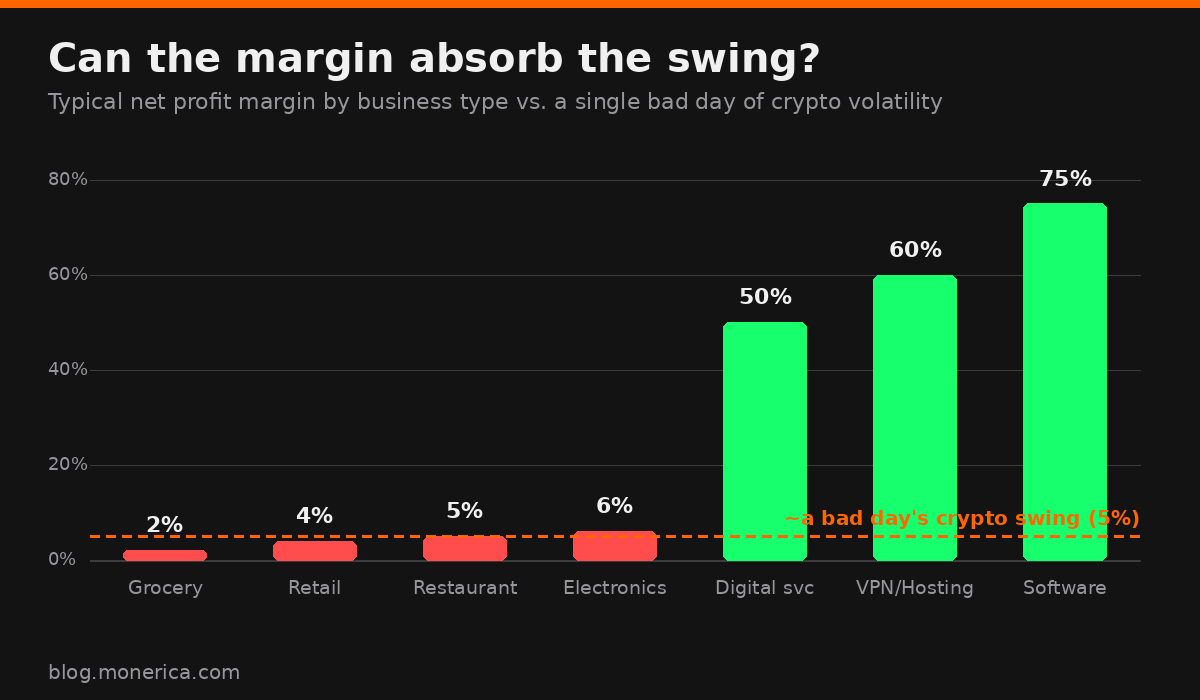
Most real businesses run on thin margins — a grocery store might net 1–3%. Crypto can move several percent in an hour. If a merchant prices in fiat and gets paid in XMR, a swing between the sale and the cash-out can erase the entire profit on the order, or more. The usual fix is to instantly convert to fiat via a processor — but that means the business isn't really "using crypto," it's using a payment processor that happens to accept crypto, with fees and a company in the middle.
The alternative — pricing natively in XMR — is worse for a merchant. Their costs, rent, payroll, and taxes are all in fiat. Denominating a menu in Monero means re-pricing constantly and doing accounting in a unit their suppliers and government don't use. Almost nobody prices natively, which quietly concedes that crypto here is a payment method, not a currency.
Edge Cases: Over- and Under-Payment, and Refunds
Cards mostly just work or decline. Crypto invoices generate a long tail of edge cases a business has to staff for:
- Underpayment: the customer sends slightly too little (fees, a typo, a wallet quirk). Now the invoice is unfilled and someone has to decide whether to refund, ask for the difference, or void it.
- Overpayment: they send too much and expect the difference back.
- Refunds: crypto is irreversible, which merchants like for fraud — but it makes legitimate refunds manual. And if the price moved, do you refund the same number of coins or the same fiat value? Either choice makes someone unhappy.
- Late or stuck payments that confirm after the invoice expired.
None of this is unsolvable, but each case is labor, and labor is exactly what a thin-margin business can't spare for a payment type that is a rounding error of its volume.
Online Isn't Much Easier
E-commerce removes the line-at-the-register problem but keeps the rest: volatility, refunds, accounting, and the same over/under-payment cases. Checkout-conversion also matters — adding a crypto option that 1% of buyers use, and which confuses the other 99%, is a hard sell to anyone optimizing a funnel. Digital-goods sellers fare best, because they can wait for settlement and have nothing to ship — more on that below.
A History of Trying and Failing
This isn't pessimism; it's the track record. The 2013–2014 "Bitcoin accepted here" wave saw big names sign up through processors, then quietly drop it when the volume never came and fees/volatility made it more trouble than it was worth. Major platforms added and later removed crypto checkout: Overstock was the first big retailer to accept it, while Steam and others later dropped it as usage stayed negligible. Each cycle repeats the same arc: enthusiasm, integration, negligible usage, removal.
The pattern is consistent enough that it should be treated as information, not as a series of one-off mistakes.
Even a national mandate hasn't cracked it. El Salvador made Bitcoin legal tender in 2021 and pushed it through the government-issued Chivo wallet — but Chivo is custodial, so the state, not the user, effectively holds the keys and can watch the activity, the opposite of self-sovereign money. Adoption stayed low: a study found six in ten Salvadorans stopped using Chivo once they'd claimed the free $30 sign-up bonus, and the country later walked back the legal-tender requirement. If a government handing out free Bitcoin through its own app couldn't spark real payment usage, a corner store won't either.
There is a darkly funny pattern layered on top of this: the loudest waves of "merchant adoption is finally here" have tended to crest near market tops — 2017 and 2021 — when prices, hype, and press coverage all peak together. In practice the merchant-adoption story has been less a leading indicator of real usage than a contrarian top signal: when everyone suddenly insists stores are about to accept crypto en masse, it usually just means the same lesson hasn't been learned yet, and the cycle is about to turn.
Marketing Theater vs. Real Adoption
Complicating the picture: a lot of "we accept crypto" is marketing, not a payment strategy. Announcing crypto acceptance earns a press cycle and signals being tech-forward, even when the actual option is buried, barely used, and quietly routed through a processor that converts to fiat instantly. The headline is the product; the payments are almost incidental.
There are real, at-scale exceptions. In May 2025, Steak 'n Shake rolled out Bitcoin payments over the Lightning Network across its roughly 400 US locations. It worked as well as it did for concrete reasons: Lightning settles in seconds (defeating the confirmation-delay problem), the company reported around 50% lower fees than credit cards, and the novelty drove genuine press and traffic. But the caveats are the whole point of this article.
A backend processor converts the Bitcoin to USD at the register, so the chain isn't really holding a volatile asset for operations; the crypto share of sales is tiny next to cards; it runs on Bitcoin/Lightning, not Monero (whose privacy makes that kind of instant point-of-sale tooling much scarcer); and it's entangled with a corporate Bitcoin-treasury strategy as much as a checkout convenience. It proves crypto payments can work at scale — with the right chain, a processor, a fee story, and a marketing motive — which is a far narrower set of conditions than "merchants will simply start accepting it."
Gresham's Law: People Want to Hold It, Not Spend It
There is a deeper reason transaction volume stays low, and it predates crypto: Gresham's law — "bad money drives out good." People spend the money they expect to weaken and hold the money they expect to keep or gain value. Most Monero and Bitcoin holders behave exactly this way: they pay for everyday things with depreciating fiat and hold their crypto. So even when a merchant does accept it, the payments rarely come — the very people who own it are the least likely to spend it.
A rail almost nobody wants to pay with is a hard thing to build a business around, and it's a structural headwind no integration can fix.
Why It Simply Isn't Attractive to Businesses
Put yourself in the owner's chair. Crypto payments offer no chargebacks at all — the payment is irreversible and there is no third-party middleman who can claw it back — plus access to a small, motivated customer segment. Against that: volatility, training, refunds, accounting complexity, tax reporting, regulatory optics, and a processor fee anyway. For the vast majority of businesses the ledger doesn't balance — the upside is real but tiny, and the friction is real and constant.
That is the honest core of why merchant adoption is unlikely to grow much: it isn't a marketing problem, it's a cost-benefit problem.
Credit-Card Fees Aren't the Motivator They Sound Like
The most-repeated pitch for accepting crypto is dodging the 2–3% credit-card processing fee. On paper that's free margin; in practice it rarely moves the needle. A single day's crypto price swing can be larger than the whole fee you saved, so the "savings" are swamped by volatility unless you instantly convert — and instant conversion means paying a crypto processor a fee anyway. The math that looked like a win quietly nets out to about zero.
The second-order costs make it worse, not better. Card fees also buy things merchants quietly rely on — fraud handling, dispute resolution, and predictable settlement — none of which a raw crypto payment provides. Thin-margin businesses have already priced card fees into their prices, so shaving them doesn't change behavior; it just adds operational risk for a couple of points that the next bad swing or bad-debt write-off can erase. For most owners, "save on fees" is a slogan, not a reason to change how they get paid.
No One Is Paid to Sign Merchants Up
Card acceptance spread because an entire industry profits from spreading it: hardware makers sell terminals, processors take a cut of every swipe, and armies of sales agents earn commissions signing up shops and providing support. Monero's whole design removes that middleman — funds settle peer-to-peer straight into the merchant's own self-custodied wallet, with no processor skimming a fee. That's great for the merchant, but it means there is no one with a financial reason to go sell it. Nobody gets rich convincing a diner to accept XMR, so nobody tries.
The only way to bolt the incentive back on is to reintroduce a third-party processor — which claws back a fee, adds a company that can freeze funds, and undoes the self-custody that made crypto worth accepting in the first place. Next to a card salesperson who earns a commission, sells a terminal, and bills for support, a crypto pitch offers the seller no fee, no hardware, and no support contract. There is simply no business model in pushing merchant adoption — a quieter but decisive reason it never scales.
The Accounting and Tax Burden
Even setting payments aside, crypto creates real back-office pain. In most jurisdictions every crypto transaction is a taxable event: the business must record the fiat value at the moment of each sale, track cost basis, and report gains or losses when it later converts or spends the coins. Intraday price moves mean the books rarely reconcile cleanly, mainstream accounting software often doesn't handle it natively, and a privacy coin like Monero — where you can't just point an auditor at a public block explorer — demands careful, deliberate record-keeping. For a lot of owners this alone is the dealbreaker; it's specialized work most bookkeepers won't touch.
If you do accept crypto, line up help early — Monerica lists privacy-friendly accountants & accounting services that understand it.
Stablecoins and the Centralized-Platform Trap
Some merchants prefer stablecoins to dodge volatility, accepting slow inflation as the price of a steady unit. But that reintroduces the very thing crypto was meant to avoid: stablecoins depend on centralized issuers and platforms that can freeze funds, blacklist addresses, and demand KYC. You trade volatility for counterparty and censorship risk — and for a privacy-minded merchant, that's no bargain. It also does nothing for Monero, whose entire value proposition is fungible, private, decentralized cash.
Monero's Specific Hurdles
On top of everything above, Monero faces extra headwinds as a merchant rail:
- Cash-out friction: exchange delistings make converting XMR to fiat harder for a business than for BTC, which matters if you don't want to hold it.
- No price oracles by design: privacy means less tooling and fewer plug-and-play processors than transparent chains.
- Regulatory optics: some businesses shy away purely because "privacy coin" sounds risky to their bank, however unfair that is.
- The 10-block lock and ~20-minute finality are fine for savings, awkward for a register.
An Alternative Path: Pay a Stablecoin Invoice With Monero
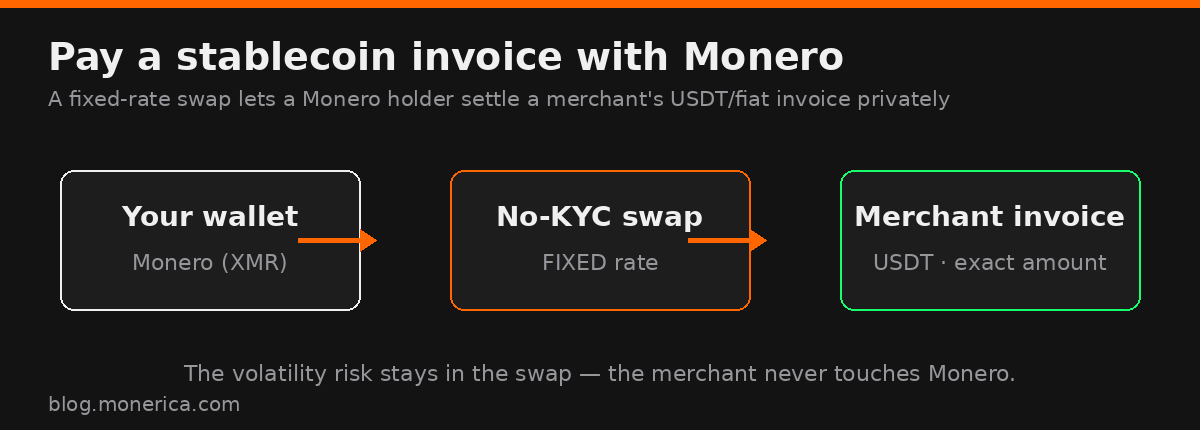
There is a pragmatic middle road that sidesteps most of the merchant-side problems. If a business invoices in a stablecoin or fiat — as nearly every "crypto-accepting" merchant effectively does through a processor — a Monero holder can still pay privately by using a fixed-rate swap on a no-KYC exchange: send XMR, and set the payout to the merchant's stablecoin (say USDT) invoice address for the exact amount owed. Because the rate is fixed, the invoice receives precisely the number of USDT it asked for — the volatility risk lives in the swap, not with the merchant, who never touches Monero, never holds a volatile asset, and changes nothing about its accounting. The customer keeps the privacy of spending XMR; the business keeps the simplicity of a stablecoin invoice.
It isn't "Monero merchant adoption" in the purist sense, but it's how a great deal of real spending already happens. See how instant swaps work, and browse no-KYC swap exchanges that offer fixed rates.
Another Middle Ground: Sell Gift Cards for Crypto
A business can also sidestep the register problem entirely by selling its own gift cards for crypto, away from the checkout line. A customer buys a store gift card online, or from an in-store kiosk, using Monero — the slow part (confirmations) happens off to the side, and the actual line never waits on a blockchain. The business then decides what to do with the crypto on its own schedule: hold it, or exchange it to fiat whenever it likes. It turns an awkward point-of-sale moment into an ordinary gift-card sale the staff already know how to handle.
This is genuinely practical, and mainstream retailers already sell gift cards this way through crypto gift-card marketplaces. Yet very few small businesses do it themselves yet — it takes a little setup, and the same "why bother for tiny volume" calculus applies. Still, of every option here it may be the least disruptive: no line delays, no forced conversion, and full control over the funds. See our guide to buying gift cards with Monero.
Where Crypto Actually Works
Here is the honest flip side: the failure of the merchant-payment dream doesn't mean crypto failed — it means we've been measuring it against the wrong yardstick. Monero and crypto shine where their real strengths line up with a genuine need:
- Self-custody and private savings. Holding your own keys, outside the banking system, with balances nobody can see — this is the core win, and it needs no merchant at all.
- Swapping and trading. No-KYC instant swaps and moving between assets without an account is something crypto does better than anything else.
- Settlement certainty online. For digital goods, cross-border payments, hosting, VPNs, and anything where you can wait a few minutes and value irreversibility over chargebacks, crypto is excellent — the merchant ships nothing physical and gets final, unbankable settlement.
- Censorship resistance. When cards and banks say no — lawful businesses debanked, cross-border transfers blocked — permissionless money is the only option, and that's where adoption is real and sticky.
Notice these have little to do with buying coffee. The genuine market is savings, exchange, and settlement-certain online payments — not replacing the card network at the corner store.
The Businesses It Does Work For: The Monero Circular Economy
There is a real Monero circular economy — merchants who genuinely accept XMR, and some who pay suppliers and staff in it. But look at who they are and a pattern appears: overwhelmingly businesses with high profit margins and a privacy-aligned customer base — VPNs, hosting, digital services, software, niche shops — not thin-margin physical retail. A 60% software margin shrugs off a few points of volatility; a 2% grocery margin cannot. These businesses can hold some Monero, ride the swings, and often prefer being paid privately, so acceptance is a feature rather than a cost.
That is the honest shape of Monero merchant adoption: not everywhere, but a durable niche of high-margin, privacy-minded businesses. For how to build and take part in it, see How to Build a Monero Circular Economy and Best Types of Monero Businesses (What Actually Makes Money).
You can see the pattern in Monerica's businesses directory: the categories that actually thrive on Monero are privacy-aligned by nature — web hosting and VPS, VPNs, SMS and phone plans, and physical stores of value like gold and silver that people specifically want to buy without a third party logging it. When the product itself is about privacy or self-sovereignty, paying with private money isn't friction — it's the whole point, and both sides are glad to transact.
The Honest Bottom Line
Mainstream, physical-retail merchant adoption of Monero is, mostly, a failed experiment — not because the technology is bad, but because the checkout is the one job crypto is worst suited for. That's fine. Cash didn't need to win e-commerce to be useful, and Monero doesn't need to win the register to matter. It needs to be the best private money for saving, swapping, and paying online where settlement certainty counts — and at those jobs, it's hard to beat.
If you do run a business that fits, our merchant guide and payment-processor rundown cover doing it well.
Further Reading
Reporting and analysis on merchant crypto adoption — and its struggles — from other sites:
- CNBC — Steam drops Bitcoin support, citing high fees and volatility
- Benzinga — Dogecoin's founder on why businesses are reluctant to accept crypto
- Swapin — The top concerns businesses have about accepting crypto payments
Related Articles
- How to Accept Monero as a Business
- Best Monero Payment Gateway & Processor
- Who Is the Monero User?
- How to Swap Monero Instantly