Not all Monero businesses are created equal. Some quietly print money year after year; others list a product on a marketplace and never make a sale. After watching what actually thrives across the Monerica directory, a clear pattern emerges: the winners are high-margin, recurring, privacy-aligned services that can afford to advertise.
This guide ranks the best types of Monero businesses — roughly in the order you see them dominate — explains what separates a good Monero business from a bad one, and points to untapped markets worth building.
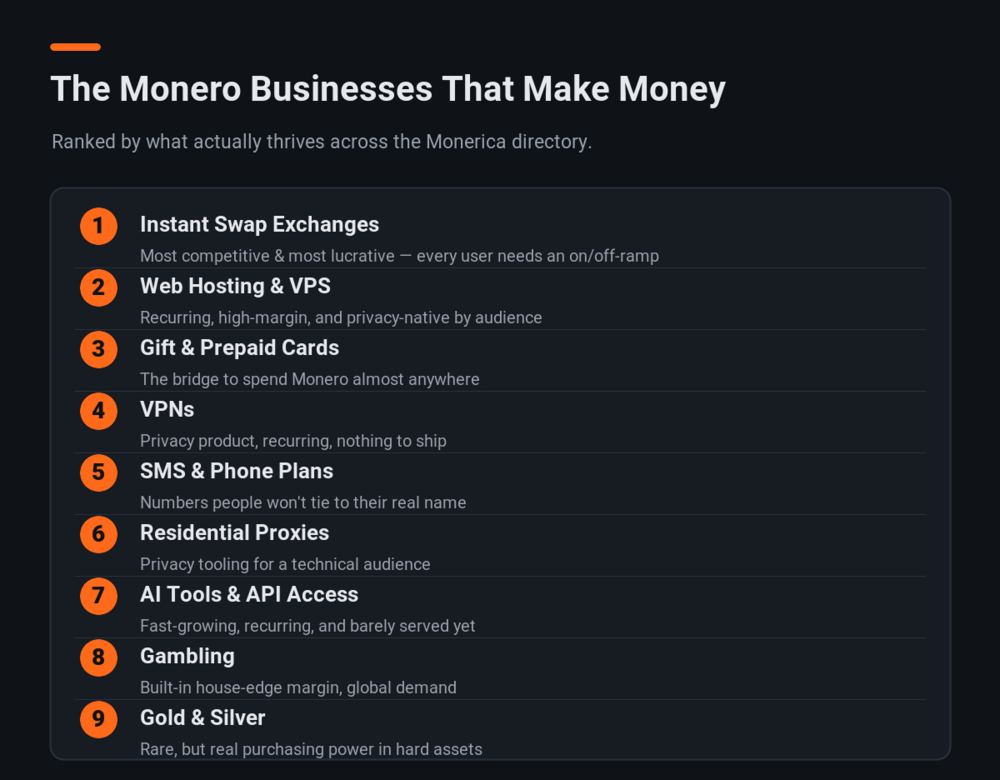
1. Instant Swap Exchanges — The Most Competitive and Lucrative
Nothing else comes close. Instant swap exchanges and aggregators — the no-KYC services that convert BTC, USDT, or LTC into Monero and back — are the single most lucrative and most fiercely contested category in the ecosystem. Every Monero user needs an on-ramp and an off-ramp, the volume is enormous and recurring, and the margin lives in the spread and fees on every trade.
How competitive? There are well over a hundred of them fighting for the same users, and they advertise everywhere:
- Wallet integrations: swap providers are built directly into the wallets people already use — Cake Wallet, Monero.com, Edge, and others surface a "buy/exchange" button powered by one of these services.
- Conference sponsorship: they underwrite the community's biggest events, like MoneroKon and Monerotopia.
- Network sponsorship: they sponsor Monerica and the wider Monero web, because reaching privacy-first users is worth real money to them.
The problem they solve: getting into and out of Monero privately, instantly, without an account. That's the most universal need in the whole economy — which is exactly why it's the most valuable business. See our guides on the best Monero exchanges and exchange aggregators.
2. Web Hosting and VPS
Privacy-focused web hosting, VPS, dedicated servers, and domains are the second-strongest category, and it's easy to see why. The customer is, by definition, someone who cares about privacy and self-hosting — a perfect match for paying with Monero. The revenue is recurring (monthly plans renew forever), the margins are high (you're selling compute, not a physical good), and there's nothing to ship. A no-KYC host that accepts XMR is selling exactly what its audience wants, in exactly the way they want to pay.
The problem it solves: giving privacy-conscious people the servers, websites, and infrastructure they need — without a card, a real name, or a paper trail behind their online presence. Browse where to buy a VPS with Monero.
3. Gift and Prepaid Cards
Gift cards and prepaid Visa/Mastercard bought with Monero are the bridge between XMR and the entire mainstream economy. This matters enormously: it lets someone holding private money spend it at millions of stores that will never accept crypto directly, without the merchant ever touching it. Demand is constant, the service is digital and instant, and the provider earns a margin on every card.
The problem it solves: letting someone spend private money at the millions of mainstream stores that will never accept crypto directly — the closest thing to "spend Monero anywhere." See the best Monero prepaid and gift cards.
4. VPNs
No-KYC VPNs paid for with Monero are a textbook fit. A VPN is a privacy product by definition, so the customer already values anonymity — and paying with a card would tie the whole subscription straight back to their identity. The revenue is recurring (monthly and annual plans), the margins are high, there is nothing to ship, and the audience actively seeks out providers that take XMR. It is one of the most natural and competitive Monero categories there is.
The problem it solves: hiding your IP and encrypting your traffic without a name, card, or bank record linking the VPN account to you — privacy end to end, from payment to connection. See how to buy a VPN with Monero.
5. SMS and Phone Plans
Virtual phone numbers, no-KYC SIMs, and data eSIMs are a natural fit. A phone number is one of the strongest identity links there is, so privacy-minded users actively want to pay for one without tying it to their name — and Monero is the obvious way. The service is digital, recurring, and high-margin.
The problem it solves: passing SMS verification and staying connected without tying a phone number — one of your strongest identifiers — to your real identity. See our guide to the best Monero eSIM.
6. Residential Proxies
Residential, datacenter, and mobile proxies serve a technical, privacy-focused audience that already thinks in terms of IP addresses and anonymity. Billing is usage-based or subscription (recurring again), margins are strong, and the product is privacy — so paying with Monero is the natural checkout.
The problem it solves: giving people privacy, geo-access, and scraping capability without tying that activity back to their name or home IP. It's a smaller category than hosting, but a healthy, competitive one. See how to buy a proxy with Monero.
7. AI Tools and API Access
AI chat and API access paid for with Monero is one of the fastest-growing categories — and a rare case where the private option barely exists yet, so demand far outstrips supply. Mainstream AI services demand an account, a phone number, and a card, tying every prompt you send to your real identity. Providers listed in Monerica's AI services section flip that model: you buy access with XMR and no profile follows you.
The problem it solves: using powerful AI for coding, writing, and research without an account, a card, or a permanent, personally-identifiable log of everything you ask. Margins are healthy, usage is recurring, and demand is exploding — making it one of the best openings on this whole list.
8. Gambling
No-KYC casinos, dice, and sportsbooks are a major Monero category for blunt reasons: the house edge gives them a built-in margin, players want privacy, and the audience is global and willing to spend. It's more regulated and controversial than the others, but the economics are undeniable.
The problem it solves: letting people gamble privately and globally — no KYC, no deposit limits, and no bank watching what they wager — which is why so many XMR casinos advertise heavily. See the best Monero gambling sites.
9. Gold and Silver
Precious metals for Monero round out the list — and this one is honest about its limits. Very few vendors actually do it, margins on bullion are thin, and there's real-world shipping and custody to manage. But it earns a place because it offers something rare: genuine purchasing power and a store of value you can hold, bought with private money and without a third party logging it. A small niche, but a meaningful one for people converting XMR into hard assets.
The problem it solves: turning private digital money into a tangible store of value you actually hold, bought without a third party logging the purchase. See buying gold with Monero.
What Makes a Good Monero Business vs. a Bad One
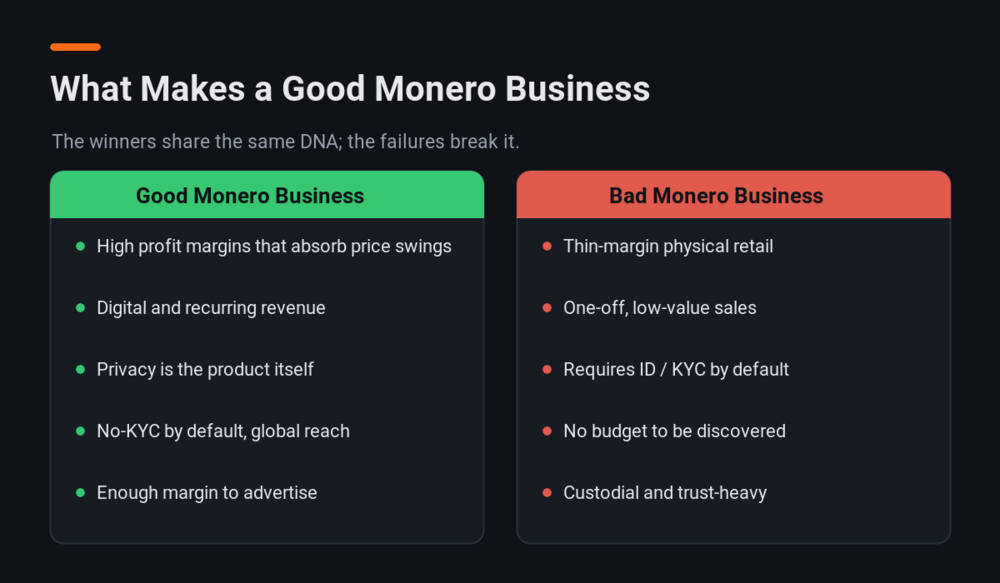
Notice what every winner above has in common. The good ones share the same DNA:
- High profit margins that can absorb Monero's price swings without wiping out the sale.
- Digital and recurring — no shipping, and revenue that renews.
- Privacy is the product, so paying privately is a feature, not friction.
- No-KYC by default, global reach, and self-custody friendly.
- Advertisable — enough margin to sponsor, integrate, and reach the audience.
The bad ones fail on those same axes: thin-margin physical retail that can't survive volatility, one-off low-value items, no budget to be found, and — the cardinal sin — requiring personal information or KYC by default. A "Monero business" that demands your ID, real name, or address up front has defeated the entire reason the customer reached for Monero in the first place. If privacy isn't respected at checkout, the XMR option is just decoration.
There is one more quiet killer for physical-goods businesses: shipping. The moment an order has to be mailed, the buyer usually has to hand over a real name and street address — and that single step unwinds most of the privacy Monero provided at checkout. Digital services never touch this problem, which is a big part of why they dominate: nothing is delivered, so nothing has to be de-anonymized to complete the sale. Any business built on shipping tangible items to a home is fighting an uphill battle that hosting, cards, and software simply do not.
The XmrBazaar Lesson
You can see the flip side on peer-to-peer marketplaces like XmrBazaar. It's a great idea, but a lot of the random one-off listings simply don't sell — they're scattered, miscellaneous, and get little traction. The reason isn't the platform; it's that individual sellers of random goods have no advertising budget and no recurring demand. It's the perfect illustration of why the categories above win: they're not one-off sales, they're services people need again and again, run by businesses that can afford to be seen.
This isn't even the first attempt. At least two earlier Monero-focused marketplaces launched with the same promise and quietly went offline — other companies that simply couldn't build enough buyer-and-seller traction to keep the lights on. The model is genuinely hard to sustain: even XmrBazaar leans on off-site sponsor links to stay funded, rather than the marketplace itself turning a profit.
Underneath the economics sits an even harder problem: content moderation. Open, privacy-first marketplaces tend to drift toward listings for illegal goods, and policing that at scale is brutal — XmrBazaar itself has been knocked offline by its hosting provider over exactly this. Running one responsibly — clean listings, a stable host, real moderation — is something no Monero marketplace has managed for long, and there is simply no track record of it working.
And yet the interest is undeniable. These sites pull steady traffic, people clearly want a place to trade privately, and real sales do happen. So the demand isn't in question — the viable, profitable business model is. As it stands, a Monero marketplace is unproven and low-profit at best; maybe someone eventually cracks it, but so far nobody has shown it can be a good business.
Physical delivery is the deepest problem of all. Shipping tangible goods and keeping the buyer private is nearly impossible: a package needs a real, deliverable address, so buyers end up leaning on private mailboxes, PO boxes, parcel lockers, or forwarding services — or simply trusting the seller with their real details. Each workaround adds cost, friction, and risk, and none of it scales. It is a core reason marketplaces of physical goods struggle where digital, no-shipping services thrive.
Untapped Markets Worth Building
The best news: the map is far from full. Plenty of high-margin, privacy-aligned niches are barely served and wide open for someone to build:
- Privacy-first SaaS — invoicing, analytics, note apps billed in XMR.
- Encrypted communication and email that's truly no-KYC from signup to payment.
- Decentralized or offshore storage and backup.
- Privacy-respecting freelancing and escrow for remote work paid in Monero.
- Travel and residency services
- Digital media and subscriptions — courses, memberships, communities, publications.
Every one of these shares the winning traits: high margin, recurring, digital, and privacy as the point. If you're thinking of starting something, build there — and build it no-KYC by default.
Marketing Is the Hardest Part — and Where the Winners Separate
Here's the piece most would-be Monero businesses miss: marketing is as important as the product, and it's genuinely hard. Privacy-focused people are almost impossible to reach with conventional paid ads — they run ad blockers, avoid Facebook and Instagram, and use browsers and search engines built specifically to never show them a Google ad. Pour money into those channels and your ideal customer will never see it. That's exactly why the categories at the top of this list don't advertise that way.
Instead, the winners reach the Monero community where it actually gathers: sponsoring conferences like MoneroKon and Monerotopia, sponsoring community sites like Monerica, and being present in the forums and communities where privacy users spend their time. It's word-of-mouth, trust, and being seen in the right places — not impressions bought on platforms your audience refuses to use. If you build a privacy business, budget for this kind of reach from day one.
The most accessible starting point costs nothing: get a free listing on Monerica so the people actively looking to pay with Monero can find you — and when you're ready to grow, Monerica's sponsor options put you in front of exactly the audience that paid ads can't.
The Bottom Line
The Monero businesses that make money aren't the ones selling random objects — they're the recurring, high-margin, privacy-first services that solve a universal need and can afford to advertise. Instant swaps lead, hosting and cards follow, and there's real room below for new builders. If that's you, launch it, keep it private, and list it on Monerica so the people who want to pay with Monero can actually find you. For the wider picture, see how to build a Monero circular economy and why merchant adoption is hard.