Quick answer: to swap XMR to USDT, first decide which network the Tether has to land on: the one your next wallet, exchange or merchant accepts (usually Tron, Ethereum, BNB Chain or Arbitrum). Then open an instant swap, choose XMR to USDT on that network, paste a receiving address from that same network and send your Monero to the one-time deposit address. Most swaps finish 20 to 40 minutes after you send, because the service waits for about 10 Monero confirmations.
The receiving wallet also needs a little of the network's own coin (TRX, ETH or BNB) before you can move the USDT again. That is the step most people miss.
Disclosure: the swap services named here are current Monerica main sponsors. Each name links to its Monerica profile, where its reviews, terms and full details are listed. Facts in this guide were checked on each service's own site in November 2026.
Why people swap Monero to Tether
Swapping XMR to USDT is usually about leaving Monero for a while, not for good. The common reasons:
- Paying someone who wants dollars. A freelancer, a supplier or a merchant that prices in USD and takes USDT on Tron or Ethereum.
- Parking value without price swings. USDT aims to stay at one US dollar, so some people hold it between trades or before a known expense.
- Reaching an exchange or app that lists USDT but not XMR. Many exchanges have delisted Monero, but nearly all of them accept USDT deposits.
- Cashing out. USDT is often the easiest coin to sell for local currency. If cash is the end goal, also read how to cash out Monero and how to sell Monero.
Keep in mind what you give up. USDT is issued by a company, every transfer is public on its blockchain, and Tether can freeze tokens at any address. Stablecoins vs Monero explains that trade-off in full. If you are going the other way, from USDT into XMR, see how to swap stablecoins for Monero.
Step zero: choose the USDT network
USDT is not one coin on one chain. Tether issues it on more than a dozen networks, and each one is a separate token with its own addresses and its own fee coin. Tether's supported-protocols page lists Tron, Ethereum, Solana, TON, Avalanche, Aptos and others, and it has stopped issuing or redeeming USDT on Omni (Bitcoin), Bitcoin Cash SLP, EOS, Algorand and Kusama. If an old wallet shows USDT on one of those, do not use it as a destination.
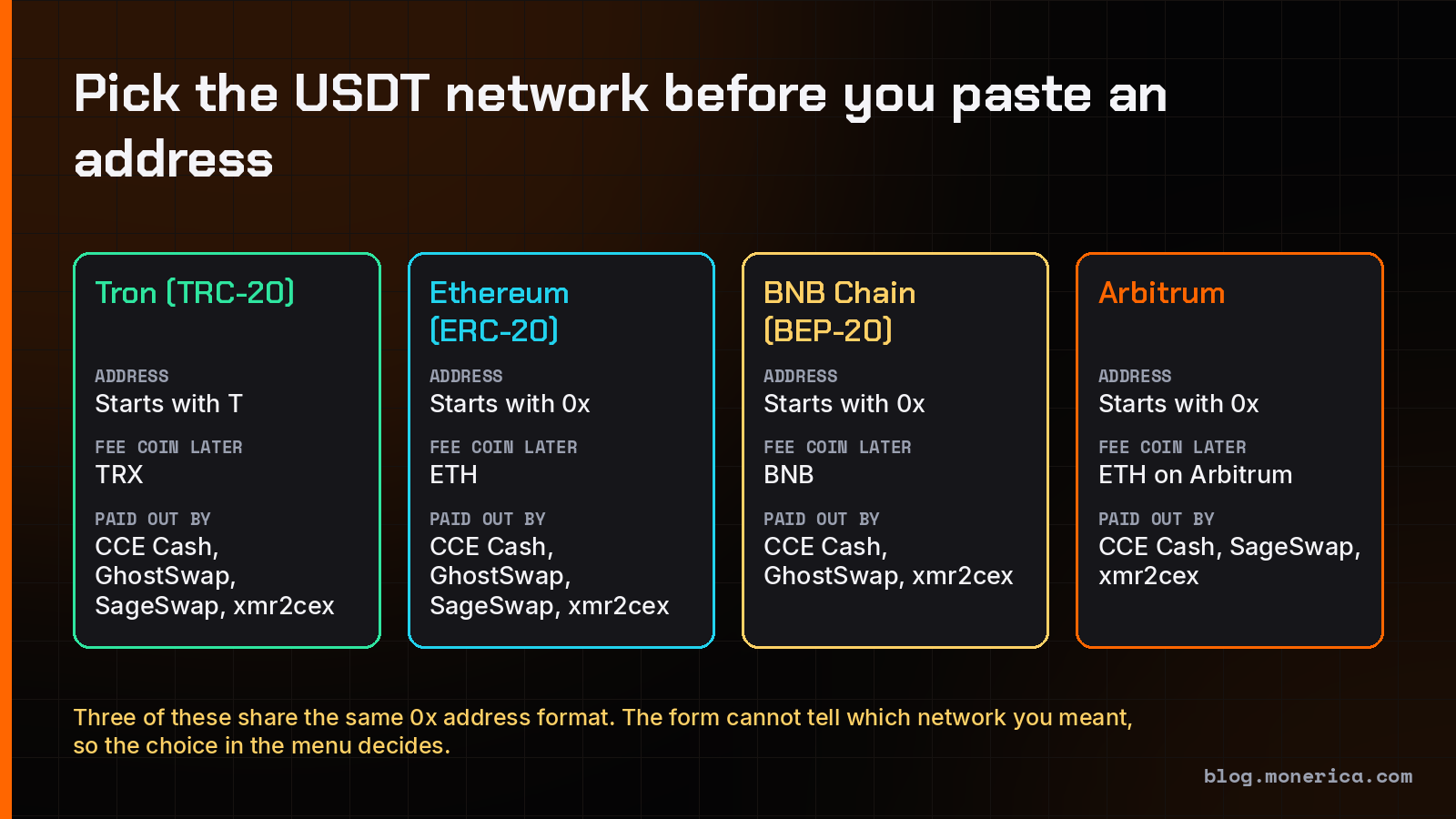
The right network is whichever one your next stop accepts. Open the deposit page of the exchange, or ask the person you are paying, before you start the swap. A rough guide:
| Network | Address looks like | You need for fees later | Good fit when |
|---|---|---|---|
| Tron (TRC-20) | Starts with T, 34 characters |
TRX (energy and bandwidth, or TRX burned) | Paying people and exchanges that ask for "USDT TRC20", which is the most common request |
| Ethereum (ERC-20) | Starts with 0x |
ETH for gas | Using DeFi apps or a wallet that only holds Ethereum tokens; larger amounts where the gas cost matters less |
| BNB Smart Chain (BEP-20) | Starts with 0x |
BNB | Depositing to an exchange that credits BEP-20 |
| Arbitrum | Starts with 0x |
ETH on Arbitrum | Low fees inside the Ethereum ecosystem |
| Solana, TON, Polygon and others | Different formats per chain | SOL, TON, POL | Only when the destination asks for that exact network and the swap offers it |
Two details that catch people out:
- Three of these share one address format. An address starting with
0xis valid on Ethereum, BNB Chain and Arbitrum alike, so the swap form cannot warn you if you choose the wrong network. The network you pick in the menu is what decides where the USDT goes. - USDT on BNB Chain is a different issuer's token. On Tether's own supported-protocols page, BNB Chain carries a contract address for Tether Gold but not for USD₮. The "USDT" on BNB Chain is a bridged token (CCE Cash lists it as Tether BSC-USD). Exchanges treat it as USDT, but it is worth knowing if you care who stands behind the token.
Where to swap XMR to USDT
These four main sponsors of Monerica pay out USDT. None requires an account to swap. People often search for "XMR to USDT no KYC": whether a service ever asks for identity documents is set by each service and listed on its Monerica profile, and any exchange can pause a transaction it flags for review, so read the profile before a large swap.
| Service | USDT networks it pays out on | Rate type | Worth knowing |
|---|---|---|---|
| CCE Cash | Tron, Ethereum, BNB Chain, Arbitrum, Polygon, Avalanche, TON, Aptos | Fixed or floating | Fixed quotes are held for 10 minutes and the deposit must match the order exactly |
| GhostSwap | Tron, Ethereum, BNB Chain, TON | Floating, fees shown in the quote | Minimum around 0.06 XMR for XMR to USDT (TRC-20) when checked |
| SageSwap | Tron, Ethereum, Solana, Arbitrum | Fixed or floating | 1 to 2% fee built into the quote (up to 6% under $50); no JavaScript needed |
| xmr2cex | Tron, Ethereum, BNB Chain, Arbitrum | Quote per order | Sells XMR only; minimum 1 XMR, acts after 5 confirmations, average fee about 3.4% per its site |
Rates change by the minute. Before a swap, get a quote for the same amount on two services and compare the USDT you would receive. The full list of no-account services is in Monerica's instant swaps category, and exchange aggregators compare many of them in one screen.
How to swap XMR to USDT, step by step
The general mechanics of an instant swap are covered in how to exchange Monero. What is specific to this pair:
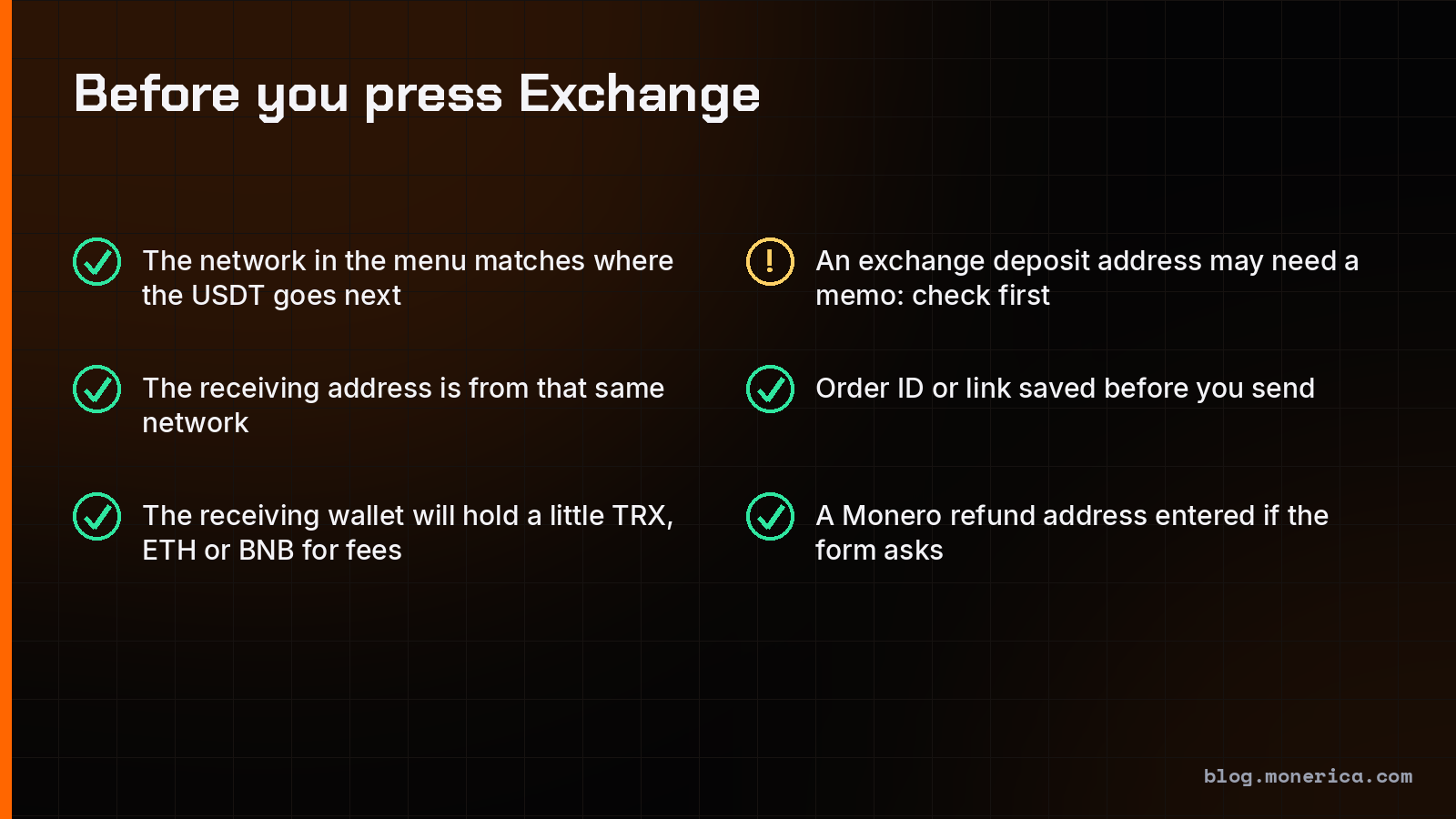
- Get the receiving address from the destination, on the right network. In a self-custody wallet (TronLink, Trust Wallet, MetaMask and others), make sure the account is on the network you chose. If the destination is an exchange account, open its USDT deposit page and select the same network there. A fresh address you have not used before keeps the payout apart from your other activity, because every transfer to it is public.
- Check whether the destination needs a memo or tag. Tron, Ethereum, BNB Chain and Arbitrum deposits do not use memos. TON deposits to an exchange often do. Most swap forms have no memo field, so if your exchange insists on a memo, pick a different network for this swap.
- Open the swap and choose XMR to USDT on that network. The menu entry must name the network ("USDT TRC20", "USDT (Ethereum)"), not just "USDT".
- Enter the amount and pick a rate. A floating rate settles when your deposit confirms; a fixed rate locks the USDT amount if you send in time. With a 20-minute Monero wait, a fixed rate removes the price risk for a small premium.
- Paste the address, plus a Monero refund address if asked. Use a subaddress (it starts with 8) from your own wallet, so a refund comes back to you and not to an exchange.
- Save the order ID before you send. SageSwap, for example, says it cannot recover a lost order ID. Bookmark the order page or write the ID down.
- Send the exact XMR amount from your own wallet to the deposit address shown, then wait. The order page updates as Monero confirmations come in.
Worked example
You hold 2 XMR in Feather Wallet and need to pay a supplier who asked for USDT on Tron. On 15 November 2026 the market rate was close to 500 USDT per XMR.
- You ask the supplier for their Tron address. It starts with T. They confirm it is a personal wallet, so no memo.
- You request quotes for 2 XMR to USDT TRC20 on two services. One shows about 982 USDT, the other about 975. The difference is the spread each service builds into its rate.
- You take the better quote on a fixed rate, paste the supplier's T-address and a fresh Monero subaddress as the refund address, and copy the order ID.
- You send 2 XMR. Feather shows the transaction straight away; the order page shows it after the first confirmation, about 2 minutes later.
- About 20 minutes later the service has its confirmations and sends the USDT. Tron confirms it within a minute or two, and the supplier sees roughly 982 USDT.
Two things to notice. First, the supplier receives the amount the swap quoted: the Tron network fee for the payout is already inside the rate. Second, your remaining XMR balance in Feather is locked for 10 blocks after you send, because the change from your transaction has to wait like any other received output. If you planned a second swap, wait about 20 minutes. How many confirmations Monero needs explains the lock.
What it costs
- The spread. The main cost, built into the quoted rate. SageSwap states 1 to 2%; xmr2cex shows an average of about 3.4%. Compare the USDT you receive, not the headline fee.
- Your Monero network fee. A fraction of a cent to a few cents. See Monero network fees.
- The payout network fee. Paid by the service and included in the quote.
- The cost of moving the USDT later. This one is yours. On Tron a USDT transfer uses energy and bandwidth; if your address has not staked TRX for them, the network burns TRX from your balance. On Ethereum you pay gas in ETH; on BNB Chain in BNB. A wallet that holds only USDT cannot send it. Either have the swap service send a small amount of the fee coin to the same address in a second swap, or move some in from elsewhere.
If the swap is late, short or stuck
- Nothing after 30 minutes. Check the order page first: if it still shows fewer than about 10 Monero confirmations (5 at xmr2cex), it is simply waiting. Monero blocks average two minutes but can bunch up or spread out.
- You sent a different amount. On a fixed-rate order at CCE Cash, a deposit that is late or does not match exactly is not executed at the locked rate; you are offered a refund or the market rate instead. SageSwap says it adjusts the order automatically when the amount differs, as long as it is above the minimum. Below a service's minimum (1 XMR at xmr2cex), expect a refund minus fees, so check the minimum before sending.
- Wrong network chosen. If the USDT was sent on a network your destination does not support, it is not lost as long as you control the private keys: import the same wallet on the network it arrived on. If the address belongs to an exchange, only that exchange's support can recover it, and some will not.
- Proving you paid. If support asks, give them the order ID and your Monero transaction ID. Most wallets can also show the transaction key, which lets the service confirm that your payment reached its address without seeing anything else in your wallet.
- Paused for review. Any exchange can hold a swap it flags. Contact support with the order ID; the options are usually a refund to your Monero address or completing the swap after their check.
FAQ
Which USDT network is cheapest to receive on?
Receiving is free on every network: the swap service pays the payout fee. The real difference is what it costs you to move the USDT afterwards. Tron, BNB Chain and Arbitrum transfers usually cost less than Ethereum mainnet, but the network your destination accepts matters more than a few cents.
Can I swap XMR to USDT without an account?
Yes. All four services above work without an account: you give a receiving address and send Monero to a one-time deposit address.
Is "XMR to USDT no KYC" really possible?
The services above do not ask you to register before a swap. Each one's identity-check rules are stated on its Monerica profile, and any service can hold a transaction it flags. Nothing on a public blockchain is anonymous by default: once the USDT arrives, its movements are visible on Tron or Ethereum explorers.
How long does an XMR to USDT swap take?
Usually 20 to 40 minutes. Most of that is the wait for Monero confirmations; Tron and the other USDT networks confirm the payout within minutes.
Can Tether freeze the USDT I receive?
Yes. Tether can freeze tokens at any address, and does so at the request of law enforcement and to follow sanctions lists. This is one reason to keep USDT only for as long as you need it.
Can I send the USDT straight to an exchange?
Yes, if the exchange credits USDT on the network you chose and does not require a memo for that network. Use the deposit address the exchange shows for that exact network.
What about USDC or DAI?
The same steps apply. CCE Cash, SageSwap and xmr2cex also pay out USDC on some networks; check the menu for the exact network.
Sources
- Tether: supported protocols (networks where USD₮ is issued and where it was discontinued)
- TRON developer docs: resource model (energy, bandwidth and TRX burned for token transfers)
- CCE Cash FAQ (fixed rate held 10 minutes, exact amount required) and its list of supported networks
- SageSwap FAQ (fees, amount adjustment, order IDs, swap times)
- xmr2cex (payout assets, minimum, confirmations, average fee)
- GhostSwap's XMR to USDT (TRC-20) pair page (minimum and timing, checked 15 November 2026)
- Monero Research Lab: the 10-block lock
Nothing here is financial advice. Swap rates, minimums and supported networks change; confirm them on the service before you send.