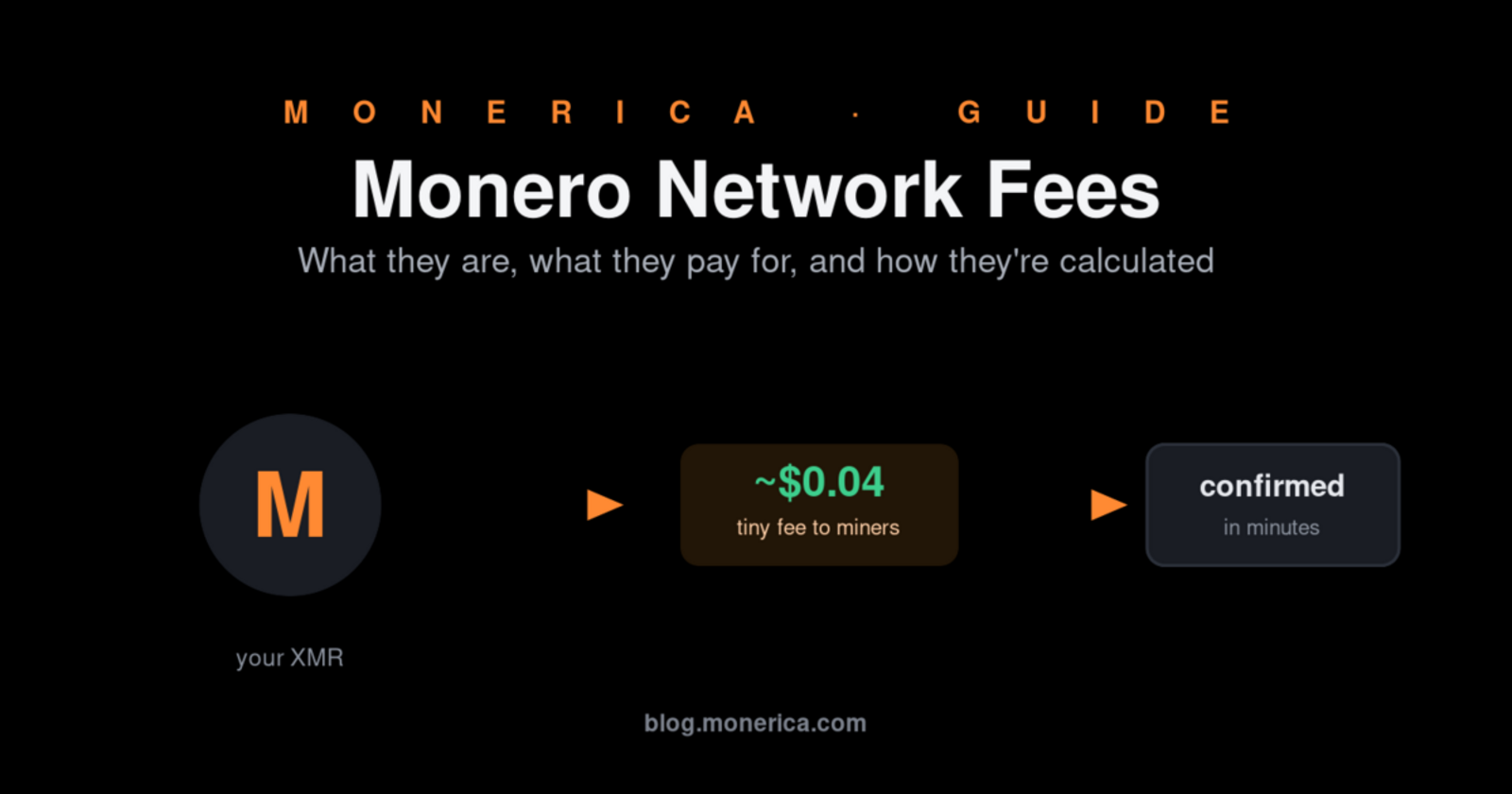
Send Monero and you'll pay a tiny network fee — usually just a few cents. It's easy to ignore because it's so small, but it's doing real work: it pays the miners who secure the chain, keeps the network from being spammed, and lets you choose how fast your transaction confirms. Here's what that fee actually is, what it pays for, and how Monero calculates it.
What a network fee is
A network fee is a small amount you attach to a transaction and hand to whoever mines the block that includes it. It is not paid to a company, an exchange, or the Monero project — it goes to the decentralized network of miners doing the work of confirming and securing transactions. On Monero the sender pays it, and it's separate from the amount you're actually sending.
What the fee is for
- Paying for security. Miners spend real electricity and hardware to process transactions and defend the chain. Fees (alongside the block reward) are how they're compensated.
- Stopping spam. If transactions were free, anyone could flood the network with junk. A small cost makes large-scale spam expensive without pricing out normal users.
- Prioritizing when it's busy. If more transactions are waiting than a block can hold, miners naturally include the higher-fee ones first. Paying a bit more buys you a faster confirmation.
How Monero's fees work
Monero was deliberately designed to keep fees low and predictable, and it does that with a dynamic block size. Unlike Bitcoin's fixed block limit — which causes fee spikes when blocks fill up — Monero blocks can grow to absorb extra demand (with a penalty that discourages abuse). Because supply of block space expands with demand, fees don't explode during busy periods; they've stayed in the range of a few cents for years.
Two more things shape Monero's fees:
- Tail emission. After the main emission ended in 2022, Monero pays miners a small, permanent block reward (0.6 XMR per block). That guaranteed baseline means the network never has to rely on high fees to keep miners around — another reason fees can stay tiny.
- Priority levels. Your wallet lets you pick how urgently you want the transaction confirmed. A higher priority multiplies the fee and gets you into a block sooner; the default level is cheapest and is fine for almost everything.
How the fee is calculated
Monero's fee isn't a flat number or a percentage of the amount you send. It's based on the size of the transaction:
fee ≈ transaction size × base fee-per-byte × priority multiplier
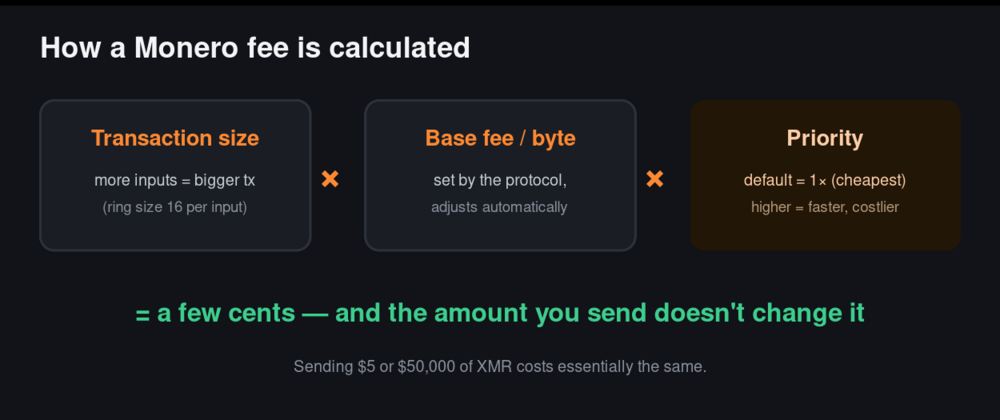
- Transaction size (weight). Every transaction is a certain number of bytes. The more inputs it spends, the larger it is — and because Monero hides the real input among decoys (a ring size of 16), each input carries those decoys with it. Sending from many small received amounts makes a bigger, more expensive transaction than sending from one large one.
- Base fee-per-byte. The protocol sets a minimum fee per byte that adjusts automatically from the block reward and the recent median block size. This is the mechanism that keeps fees stable in real terms without any central price-setter.
- Priority multiplier. The wallet's priority setting scales the base fee up. The default is the 1× baseline; higher settings cost several times more and confirm faster. For an ordinary payment, the default is almost always the right choice.
Because the amount you're sending doesn't affect the fee, sending $5 or $50,000 of XMR costs essentially the same — what matters is how many inputs the transaction has to combine and which priority you pick.
Keeping your fees low
- Use the default priority unless you genuinely need a faster confirmation.
- Avoid a wallet full of tiny amounts. Lots of small received payments mean lots of inputs, which makes future spends bigger and pricier. Consolidating them (sending them to yourself) when the network is quiet keeps later transactions lean.
- Don't sweep to exactly zero if you'll transact again soon — a small working balance saves you from awkward input-combining later.
Learn more
For the technical details straight from the source:
- Moneropedia: Transaction — how a Monero transaction (and the fee attached to it) is built.
- Moneropedia: Ring Size — the decoys that make each input bigger, and why that drives your fee.
- Moneropedia: Scalability — Monero's dynamic block size and how it keeps fees low.
- Moneropedia: Tail Emission — the permanent block reward that keeps miners paid.
- Want to see live prices while you're at it? MoneroPriceNow shows the XMR price across exchanges.
The short version: Monero's network fee is a few cents paid to miners for securing your transaction, calculated from how big the transaction is rather than how much you send — and thanks to dynamic block sizes and tail emission, it's engineered to stay that way.