
If you want private Bitcoin, you have basically two paths: run your coins through a mixer, or swap into Monero, whose privacy is built into the protocol. They are not equivalent — mixers leave you on a transparent chain and now carry serious legal baggage, while Monero hides sender, receiver, and amount by default. This guide compares the two and explains why swapping into Monero is usually the better move.
How a Bitcoin Mixer Works
A mixer (or "tumbler") tries to break the on-chain link between your old and new coins. Custodial mixers pool everyone's coins and pay you back different ones; non-custodial designs like CoinJoin combine many payments into one transaction so an outsider cannot tell which input paid which output. Either way, you are still transacting on Bitcoin's fully public ledger.
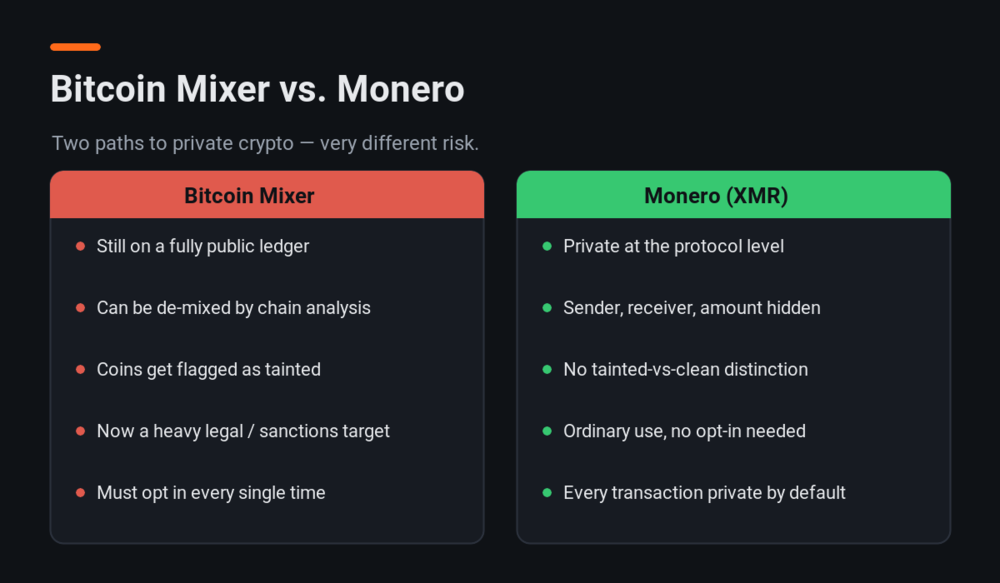
Why Mixers Are Fragile
- The chain is still transparent. Chain-analysis firms use heuristics to de-mix many transactions, and privacy decays over time.
- "Tainted" coins. KYC exchanges flag coins that touched a mixer and may freeze deposits or close accounts.
- Custodial risk. A mixer that holds your coins can simply exit-scam.
- You must opt in every time and rely on a large, honest anonymity set that may not be there.
The Legal Problem With Mixers
This is the big one. Mixers have become a law-enforcement target in a way Monero users should understand:
- In 2022 the US Treasury sanctioned Tornado Cash, an Ethereum mixer — the sanctions were later removed in 2025 after a court challenge, but not before years of fallout.
- US authorities arrested and charged the founders of the Samourai Wallet mixing service in 2024.
The pattern is clear: operating or heavily relying on a mixer can attract scrutiny that ordinary Monero use does not. (This is general information, not legal advice.)
How Monero Is Different
Monero does not bolt privacy on afterward — it is private at the base layer for every transaction. Ring signatures, stealth addresses, and confidential transactions hide the sender, receiver, and amount, so there is no "anonymity set" to opt into and no tainted-vs-clean distinction. For the mechanics, see our explainer on whether Monero is private and how it compares with Bitcoin.
Why Swapping Into Monero Is Usually Best
- No de-mixing. There is no public trail to reconstruct in the first place.
- No tainted-coin stigma and no per-transaction opt-in.
- Optional round-trip. Swap BTC → XMR for privacy, then swap back to any coin later if you need to — the Monero leg breaks the link cleanly.
You can do this with a no-KYC instant swap or a trustless atomic swap between BTC and XMR. Compare services in Monerica's instant-swap directory.
Frequently Asked Questions
Are Bitcoin mixers illegal? Operating or heavily relying on a mixer has drawn sanctions and prosecutions in some jurisdictions. This isn't legal advice, but it's a real risk that ordinary Monero use doesn't carry.
Is Monero just a built-in mixer? No — it's stronger. A mixer is an optional step on a transparent chain; Monero hides sender, receiver, and amount at the protocol level for every transaction, with no anonymity set to opt into.
Can "mixed" Bitcoin still be traced? Often, yes — chain-analysis firms de-mix many transactions, and exchanges may flag coins that touched a mixer. Monero leaves no such trail to reconstruct.