Short version: a deposit guarantee is a public bond — a sum of money an exchange has set aside and pointed to openly — that it stands to lose if it cheats its customers. It is one of the clearest signals that a no-account swap service has real skin in the game, and it is slowly replacing “just trust us” with “here is the proof.” On monerica.com you'll find deposit guarantees listed right on each exchange's profile, so you can weigh them before you send a single coin.
The problem deposit guarantees were invented to solve
Privacy-respecting, no-signup instant swap exchanges are genuinely useful: you paste a receiving address, send one coin, and get another back — no account, no ID, no custody held longer than the swap itself. That frictionlessness is the whole point, and it is exactly why so many people reach for them to get Monero.
But the same thing that makes them convenient also removes the usual safety nets. There is no account to log back into, often no company name or jurisdiction, and no chargeback. If an operator decides to simply keep the coins you sent, there is frequently no one to appeal to. This isn't hypothetical. As centralized exchanges delisted Monero and demanded ever more invasive identity checks, a wave of small no-KYC swap services appeared to meet the demand — and alongside the honest majority came copycats and outright exit scams: sites that ran cleanly for a while to build a reputation, then vanished with a batch of customer funds. For years the only defense a user had was word-of-mouth and “this one worked for me,” which is a thin thing to trust with your money.
Deposit guarantees grew out of that frustration. If reputation alone can be faked or cashed out, the thinking went, then let an exchange put money behind its promise — money it loses if it misbehaves.
What a deposit guarantee actually is
A deposit guarantee is a sum an exchange publicly commits — typically by depositing funds with, or posting verifiable proof to, a trusted third party such as a long-running forum (for example a BitcoinTalk escrow thread), an exchange-rating site, or an aggregator that tracks these bonds. The amount is stated out in the open, and the terms are simple: if the exchange is shown to have scammed a user, that bond is on the line. It is the crypto equivalent of a shop leaving a cash deposit with the mall it rents from — proof that walking away has a real, quantified cost.
How it works in practice
The mechanics vary by venue, but the shape is consistent:
- The exchange posts a bond. It places funds with a reputable third party, or publishes on-chain proof of reserves earmarked as a guarantee.
- The proof is public. Anyone can click through to the forum post, listing, or transparency page and see the amount and the date.
- The bond is at risk. If a user is cheated and can demonstrate it, the guarantee is used to make them whole — or, at minimum, the operator publicly forfeits the bond and the reputation that came with it.
The key word is verifiable. A deposit guarantee is only worth anything if you can actually open the link and confirm it exists — which is exactly why the proof link matters as much as the number.
Where you see deposit guarantees on Monerica
On monerica.com, deposit guarantees are shown directly on an exchange's listing page. When an exchange has posted one, its profile displays a Deposit Guarantee section with the amount and a “view proof” link that takes you straight to the evidence. A single listing can show several guarantees at once (up to four), because a serious operator will often post bonds across more than one venue — and when it has multiple, Monerica totals them per currency so you can see the full picture at a glance.
Each guarantee carries three things: the amount, the currency (USD, BTC, or XMR), and the proof link. Those proof links are marked as external, unendorsed references — Monerica is pointing you at the evidence, not vouching for it — so you can judge the source yourself.
How to read the number
Bigger is generally better, but read it with a little context:
- Size signals commitment. A five-figure bond represents real money an operator is willing to lose. A larger guarantee means a larger deterrent.
- Currency matters. A guarantee quoted in BTC or XMR floats with the market; one in USD is a fixed target. Monerica shows the currency so you're never guessing.
- Several bonds beat one. An exchange that has posted guarantees at multiple independent venues has staked its reputation in more than one place, which is harder to fake and costlier to abandon.
- Age and source count. A long-standing bond on a well-known forum carries more weight than a fresh post on an obscure page.
What confidence it brings — and what it doesn’t
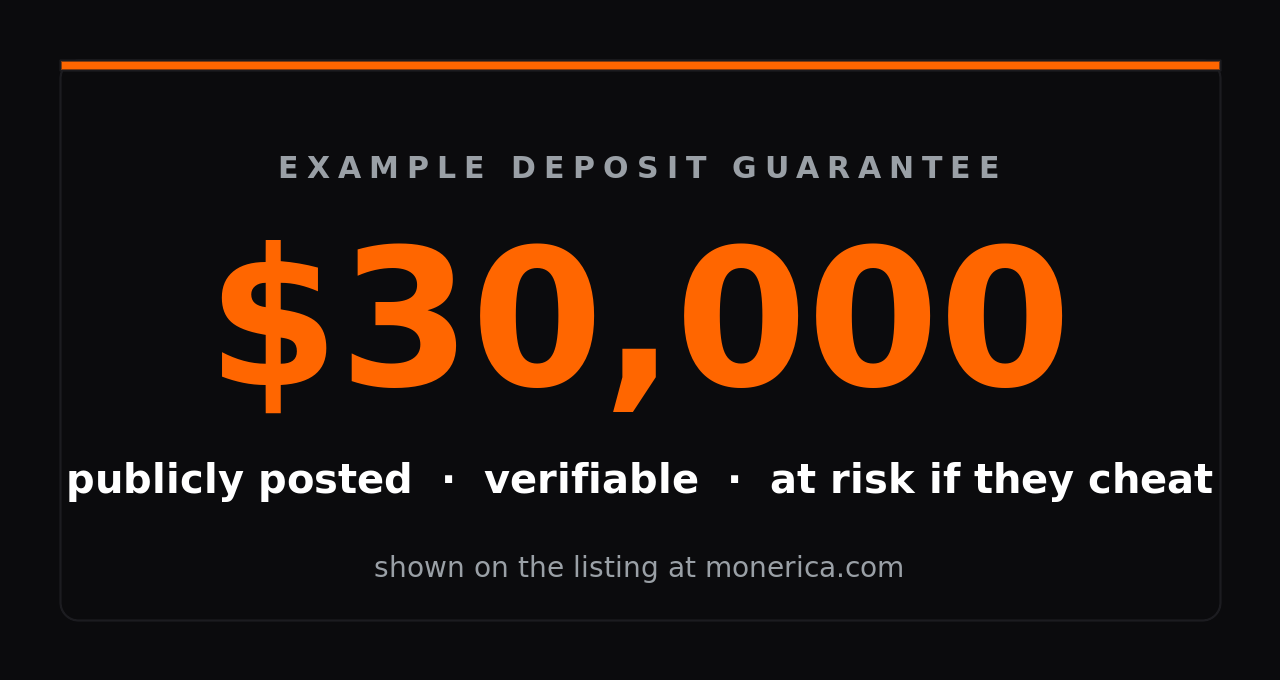
A deposit guarantee is skin in the game, and that changes the incentives dramatically. An operator with a $30,000 bond publicly on the line has a powerful reason not to torch its reputation over any single trade — the math simply doesn't work in favor of cheating.
But be clear about what it is not. A deposit guarantee is not a personal escrow for your specific swap, and it is not insurance that pays out automatically. A large bond doesn't mean your individual $200 trade is individually underwritten; it means the business as a whole has money at stake in staying honest. Treat a guarantee as one strong input among several — alongside track record, community reputation, how the service handles support, and your own test with a small amount first. It raises the floor on trust; it doesn't replace common sense.
The bottom line
No-KYC swapping gives you privacy and control, but it asks you to trust strangers. Deposit guarantees turn that leap of faith into something you can measure: a public, verifiable amount an exchange will lose if it betrays you. They exist because the ecosystem got tired of “trust me” — and they bring confidence precisely because they cost the operator something real.
When you're choosing where to swap, look for the deposit-guarantee section, open the proof, and favor exchanges that have put money behind their word. You can browse exchanges and compare their guarantees on monerica.com, and if you want a curated starting point, see our guide to the best Monero exchanges.