Monero (XMR) is mined with your CPU using the RandomX algorithm, and the pool you point your miner at decides how often you get paid, how big a cut the operator takes, and—most importantly—how decentralized the network stays. The short answer: for almost everyone the best Monero mining pool is P2Pool. It is decentralized, charges no fees, needs no signup, and pays rewards straight to your own wallet. Below we compare P2Pool against the best centralized pools and against solo mining so you can pick the right setup.
TL;DR: Best Monero Pools (2026)
- Best overall (decentralized, 0% fee): P2Pool — no account, paid to your own wallet, keeps Monero decentralized.
- Best for auto coin-switching: MoneroOcean — mines the most profitable RandomX coin and pays you in XMR.
- Best classic centralized pool: SupportXMR — long-running, reliable, low fee.
- Other solid pools: 2Miners, HeroMiners, Nanopool.
- Best for privacy purists / large miners: Solo mining on your own node.
What Is a Monero Mining Pool?
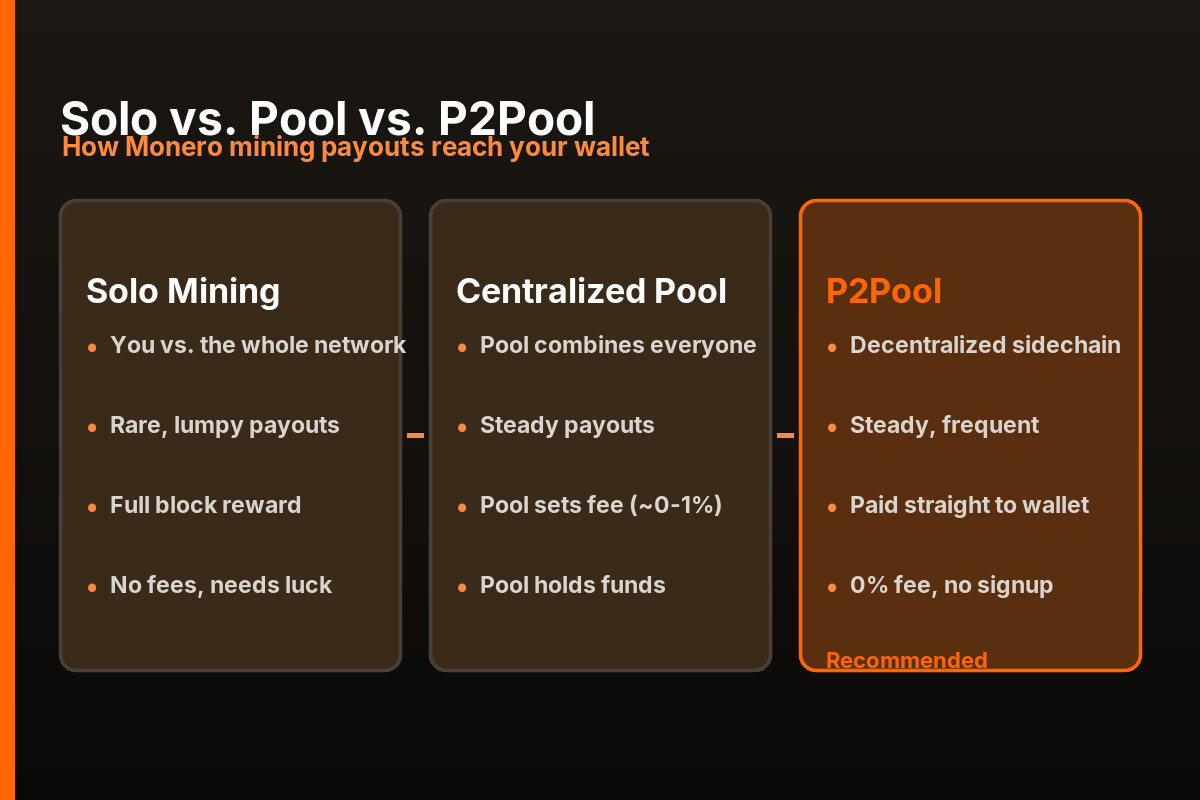
A single home CPU might find a Monero block only once every several years, so miners join a pool to combine their hashrate. The pool finds blocks far more often and splits the reward among contributors in proportion to the work they submitted (usually a PPLNS scheme). The result is small, steady payouts instead of a rare jackpot. The big question is who holds the money and who controls the block—and that is exactly where P2Pool differs from a traditional pool.
P2Pool — The Best Monero Pool for Most People
P2Pool is a decentralized pool. Instead of a company running a server that collects the block reward and pays you later, P2Pool is a peer-to-peer sidechain: when the pool finds a Monero block, the coinbase transaction pays every miner directly, in the same block. There is no operator wallet in the middle, no withdrawal step, and no minimum-payout balance to reach.
Why P2Pool wins
- 0% pool fee — you keep the full reward minus tiny node/transaction costs.
- Non-custodial — XMR is paid to your address every block; the pool never holds your funds.
- No account, no KYC, no email — you just start mining.
- Decentralization — large centralized pools are a threat to Monero; every P2Pool miner strengthens the network instead.
- Choice of chains — the main chain suits big rigs, while the mini and nano chains give smaller CPUs smoother, more frequent payouts.
The trade-offs
- You should run your own Monero node (monerod) so P2Pool can validate blocks. It syncs once, then stays light.
- Payouts arrive as many tiny outputs; that is normal and fine for a private wallet.
- Setup is a little more involved than pasting a URL—but Gupax automates node + P2Pool + XMRig in one click, so most people are mining in minutes. See our best Monero mining software guide.
Best Centralized Monero Pools
If you truly cannot run a node—say you are mining briefly on a laptop—a centralized pool is fine. Pick one with a modest fee and a healthy but not dominant share of the network, and choose a server region close to you.
SupportXMR
The long-standing community favorite: reliable uptime, a low fee (around 0.6%), a clean dashboard, and a reasonable minimum payout. A safe default if you want a classic pool.
MoneroOcean
MoneroOcean auto-switches your CPU to whichever RandomX coin is most profitable at the moment and pays you in XMR. It can squeeze out extra earnings, at the cost of trusting the operator's switching and custody.
2Miners, HeroMiners & Nanopool
All three are well-run pools with global servers, live stats, and PPLNS payouts. They are good backups or regional choices; compare fees and minimum payouts before committing.
Solo Mining
Solo mining means you run your own node and keep the entire block reward when you find one—with zero fees and maximum privacy. The catch is variance: unless you command a very large amount of hashrate, blocks can be months or years apart. For big miners it is unbeatable; for a single desktop, P2Pool gives you almost the same benefits (0% fee, self-custody) without the painful wait.
Monero Pool Comparison
| Option | Fee | Custody | Payouts | Signup |
|---|---|---|---|---|
| P2Pool | 0% | Your wallet (non-custodial) | Every block, direct | None |
| SupportXMR | ~0.6% | Pool holds until payout | Steady (min payout) | None |
| MoneroOcean | ~0%–0.6% | Pool holds until payout | Steady, auto-switch | None |
| 2Miners / HeroMiners / Nanopool | ~1% | Pool holds until payout | Steady (min payout) | None |
| Solo | 0% | Your wallet | Full reward, very rare | None (own node) |
How to Choose the Best Pool
- Decentralization first. If a single pool ever controls too much of the network it can censor or reorganize it. Prefer P2Pool; if you use a centralized pool, avoid the largest one.
- Fees & custody. 0% and non-custodial (P2Pool) beats a pool that takes a cut and holds your coins.
- Payout minimums. Low minimums matter for small CPUs; P2Pool's mini/nano chains help here.
- Privacy. No pool should require KYC. Combine mining with your own node and a fresh wallet.
- Server location. Lower latency to the pool means fewer stale shares.
Quick Start: Mine on P2Pool
- Set up a Monero wallet and copy your primary address (P2Pool requires the primary, not a subaddress).
- Download Gupax, which bundles monerod (node) + P2Pool + XMRig.
- Paste your address, pick the mini chain if your hashrate is modest, and let the node sync.
- Start mining. XMR lands in your wallet every time P2Pool finds a block.
- Check profitability first with our Monero mining calculator.
FAQ
What is the best Monero mining pool?
For most people it is P2Pool: decentralized, 0% fee, non-custodial, and no signup. If you cannot run a node, SupportXMR is the best classic centralized pool.
Is P2Pool better than SupportXMR?
For decentralization, fees, and self-custody, yes—P2Pool pays you directly with no cut. SupportXMR is simpler because it needs no node, which is its main advantage.
What is the best Monero pool for beginners?
P2Pool via Gupax is beginner-friendly despite being decentralized. If you want the absolute simplest start, SupportXMR with XMRig also works in minutes.
Do Monero mining pools require KYC?
No. Reputable XMR pools need no ID, email, or account—you mine to your own address. That is one of Monero's advantages over KYC-heavy exchanges.
Related Articles
- How To Mine Monero
- Best Monero Mining Software
- Best Monero Mining CPU
- Is Monero Mining Profitable in 2026?
- Monero Mining Calculator